
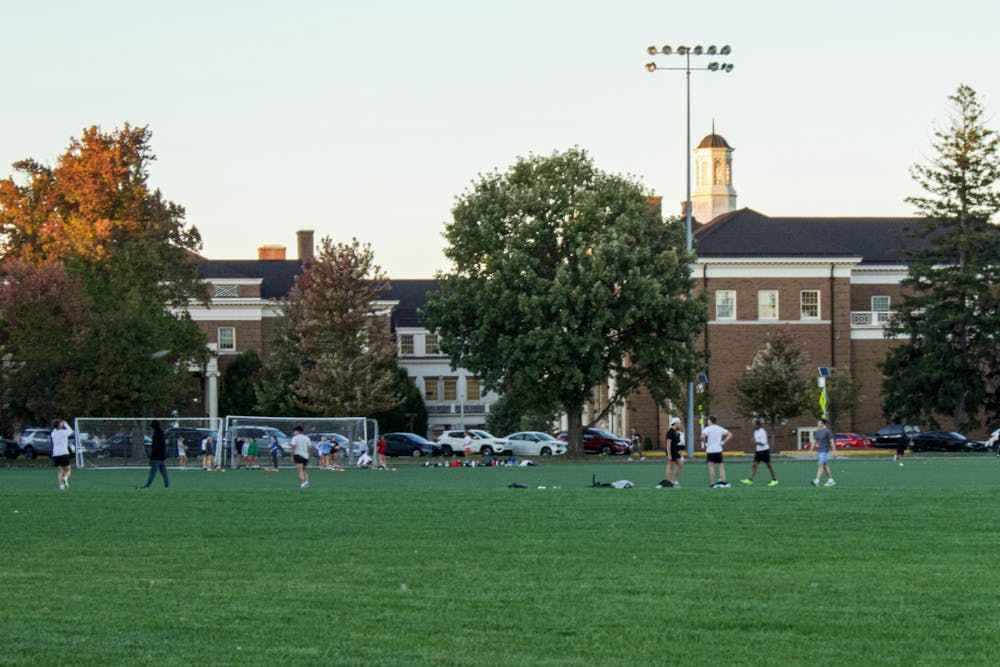
The initial findings of a student-led community survey reveal that a large majority of respondents oppose the construction of an arena district on Cook Field, a current recreational green space. The results, based on over 3,347 responses, challenge the Board of Trustees’ historic decision from Feb. 2025.
Miami University’s Board of Trustees unanimously decided to place a new sports arena on Cook Field in February 2025. This decision came after an initial site survey committee found that the Cook Field location was overwhelmingly not preferred – less than 300 people preferred the construction in that area out of the 1,500 total responses.
After community members felt their opinions had not been taken into account by the Board of Trustees when selecting the location, a team of Miami students, faculty and alumni designed a new Qualtrics survey. The Cook Field Arena Project Survey was shared around Oxford and online with the goal of collecting opinions from the community and gauging perspectives of stakeholders.
“We had responses from ages 18 all the way up to 94 years old, and the theme is pretty much consistent,” Bri Fitzgerald, undergraduate team research leader and senior organizational leadership major, said. “I want the board to be aware that what the board thinks the community wants and what the community wants are not lining up based on our data.”
The initial findings of the survey can be found on the Cook Field Arena Project Survey website. According to the results, 89% of respondents oppose the arena project and 7% support it. This objection is also reflected in the results of questions about the future of Cook, where 79% of respondents prefer to preserve it as a green space.
Additionally, 69% of respondents reported they are less likely to donate to the university in the future if the project proceeds. The research team concluded that the project is viewed as misaligned with Miami’s values and may decrease future donations.
According to the takeaways section of the website, very few respondents see Miami athletics as important to the institution’s “brand” and values. Results showed that 95% of stakeholders reported that campus beauty and aesthetics were important qualities, whereas 25% believed athletics and quality of facilities were significant. This made athletics one of the lowest priorities among stakeholders.
The research team also looked at the potential impact of changes to existing facilities. 82% of respondents indicated that Cook is an important aspect of their experience in Oxford, but if the outdoor space were relocated to where Millett Hall is now, it would be used “a lot less.” In comparison, 31% of respondents feel that Millett has been an important aspect of their experience in Oxford, but if Millett were moved to where Cook is now, there would be no impact on use, or, adversely, it would diminish attendance.
“The data really speaks for itself,” said Anna West, undergraduate research team leader and junior individualized studies and comparative religion major. “It’d be amazing for the board to look at that and take into account the opinions and ideas that the community has, since they’re going to be directly impacted by decisions made.”
The survey research team shared their documents with the Board of Trustees and offered to formally present at the next meeting with the goal of informing the administration's planning and decision-making process based on community input.
In an email to The Miami Student, David Creamer, vice president for finance and business services and university treasurer, said that the trustees will decide whether to move forward with constructing the design as presented at the next meeting on Feb. 26 and 27.
Duganec@miamioh.edu
Enjoy what you're reading?
Signup for our newsletter
Read More

Miami University professor alters course after backlash about AI chatbot
By Liam Clarke | 2 hours agoA Miami University professor was forced to reconstruct his class after a failed attempt to integrate an Artificial Intelligence (AI) chatbot. The attempt to enhance learning overwhelmed students.

University Senate debates Center for Artificial Intelligence at Miami
By Kylie Bunn | 4 hours agoThe University Senate discussed the Center for Artificial Intelligence (AI) at Miami, changes to the graduate council and student government updates in its meeting on Sept. 14.

Miami dominates Holy Cross for first win of the 2026 campaign
By Cooper Meneghetti | 2 days agoThe Miami University football team (1-1) defeated the College of the Holy Cross Crusaders (0-3) in a convincing 45-7 fashion.