
The proposed Cook Field arena district project has left Miami University students, faculty and alumni wondering why that green patch on the eastern part of campus is significant to the Miami experience.
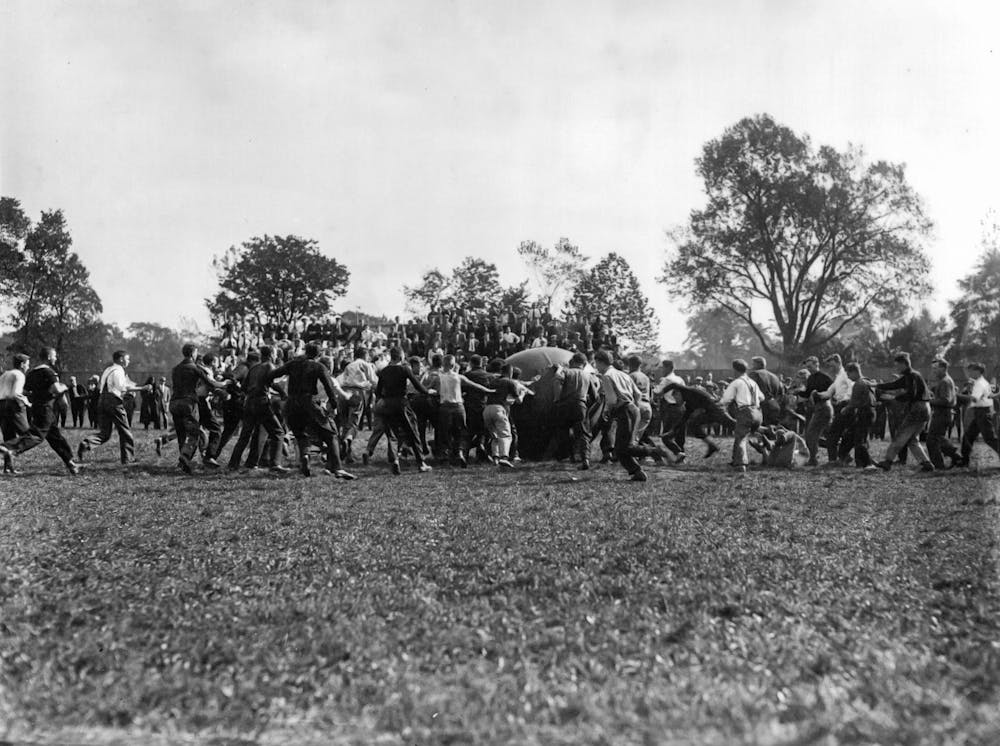
Throughout the 1900s, Cook Field was used for recreational sports, bike races, music festivals and many other student gatherings, according to The Miami Student archives. However, Cook Field and the surrounding area are swarming with dark history revolving around a mental asylum, the disappearance of a student and alleged ghost sightings.
“I think Miami’s campus — open spaces and vistas — is really a special place,” said Stephen Gordon, Miami alumnus and former administrator at the McGuffey House and Museum. “[The campus is] very fragile, and it has accumulated over many, many years because the people that developed Miami have been very cognizant of the special character.”
In the 1880s, following the $45,000 sale of Oxford Female College’s main building, the space became a private sanitarium named the Oxford Retreat Company, which was run by George F. Cook and his son, Robert Harvey Cook. The Oxford Retreat operated as a hospital specifically focused on treating mental and nervous disorders, as well as alcoholism and narcotic drug abuse.
An underground tunnel led from the Pines, part of the sanitarium, to Cook Place, Harvey Cook’s Spanish Mission-style residence. According to the Miami University Alumni Association, the tunnel allowed Cook to get from his home to the Pines undetected by his patients.
“[The tunnels] were for privacy, of course, and health reasons,” said Jacky Johnson, university archivist and interim head of special collections and archives.
Enjoy what you're reading?
Signup for our newsletter
Miami bought the Oxford Retreat building in 1925, marking the end of its medical use, according to a 1918 letter by the Committee Advisory to the President. The sale included the main building, two cottages, the Cook residence and 14.67 acres of land, where East Quad and Cook Field reside today. The acres of land, now Cook Field, were purchased for $7,500.
After remodeling, the Retreat building became a men’s residence in 1927, named Fisher Hall, also housing men in the Naval Radio Training School during World War II. Students living in Fisher Hall had strange encounters, including ghostly noises, according to The Miami Student archives.
“There is a certain feeling deep within the life at Fisher Hall which cannot be discerned from the surface, as those who have lived there can truly testify,” News Editor Kenneth C. Flint wrote in The Miami Student in May 1932. “Fisher Hall is not merely a place to live, but a way of life. The grounds surrounding the hall, in a spiritual sense, have a drawing power which cannot be denied.”
Before demolition in 1978, Fisher Hall earned its peculiar and haunted reputation in 1953 when Ronald Tammen, a resident assistant in Fisher Hall, vanished from his dorm room, leaving a psychology textbook open, a lamp burning, music buzzing and his belongings behind. Before disappearing without a trace, Tammen found a dead fish in his sheets, according to The Charley Project.
The Student played a role throughout the investigation of Tammen’s disappearance by providing transparency and dispelling false rumors.
“Simple fact can often become distorted until it is nothing but a fantastic story,” Sally Barnes, issue editor, wrote in a May 1953 article. “Such was the case last week with a story concerning the disappearance of Ronald Tammen, who has been missing from campus for over two weeks. As college students we should be adult enough to consider the harm that starting or passing on an unverified rumor might do to a fellow student."
Jennifer Wenger, a 1980 Miami alumna, took up the investigation in 2010. Wenger’s theories, featured on her website, led all the way back to James W. McCord Jr., a Watergate burglar, with whom Tammen shared similar FBI stamps. Wenger worked with The Student to share her thoughts on a podcast episode.
In a January 1976 issue of The Student, writers reported on a Board of Trustees debate regarding the future of Fisher Hall and Cook Field. Similar to today, the Cook Field land was presented as an option for building development. However, it was dismissed, and another site was chosen.
“When I look at Cook Field, it’s part of that open space which is so important, but in a way, it’s kind of taken for granted until you lose it,” Gordon said. “I think there’s a tendency when you have an open space for any institution, you see it as a building site. After a while, you start creeping construction, and then you suddenly wake up one day [and ask]: ‘What happened to our campus?’”
The acres of land that are now Cook Field have been used by students for decades. Bonfires and pep rallies took place on the field during homecoming weekend starting in the 1920s, and Gordon said the burn pile would often reach 20 to 30 feet tall. Cook Field was also the location for a music festival starting in 1995.
Now, Cook Field is used by students and community members for recreational activities. In fall 2022, Miami held Megafair on the field, and in April 2024, a viewing party for the solar eclipse took place.
“When I was touring schools, one of the most important things to me, after academics, was a place to go and play soccer. Not just for leagues, but those pick-up games are important because that’s where you make connections,” Hunter Johnson, a sophomore intramural soccer player and exploratory studies major, said. “If Cook Field wasn’t a thing, and it was just the indoor field, the dynamic would not be the same.”
On-campus stakeholders expressed concern with the arena district project on Cook Field through a survey opened in October 2025. The survey, organized by students, faculty and alumni, found that the estimated $281 million project is opposed by 89% of respondents. The Board of Trustees will decide whether to move forward with constructing the design as presented and the increased price at the Feb. 27 meeting.
Cook’s mental asylum, Tammen’s disappearance and the alleged ghost sightings remain Miami mysteries. What Miamians do know is that a major part of East Quad — Cook Field — will be lost if the arena district comes to fruition.
Read More

Sydney Sweeney’s newest ad is a mockery of women in sports
By Elisa Rosenthal | 7 hours ago"I’ve seen videos from every corner of the women’s sports community showing how valuable sports are and what they mean to women. Diminishing our love for sports by making a nude commercial is not only hurtful but harmful."

Saturday soundtrack: The perfect game day playlist
By Elise Hanna | 7 hours agoMusic is an integral part of players’ pregame ritual. Watch any warm-up, from the pros to your local little league, and I guarantee you’ll hear something pumping from the speakers.

Miami University professor alters course after backlash about AI chatbot
By Liam Clarke | YesterdayA Miami University professor was forced to reconstruct his class after a failed attempt to integrate an Artificial Intelligence (AI) chatbot. The attempt to enhance learning overwhelmed students.