
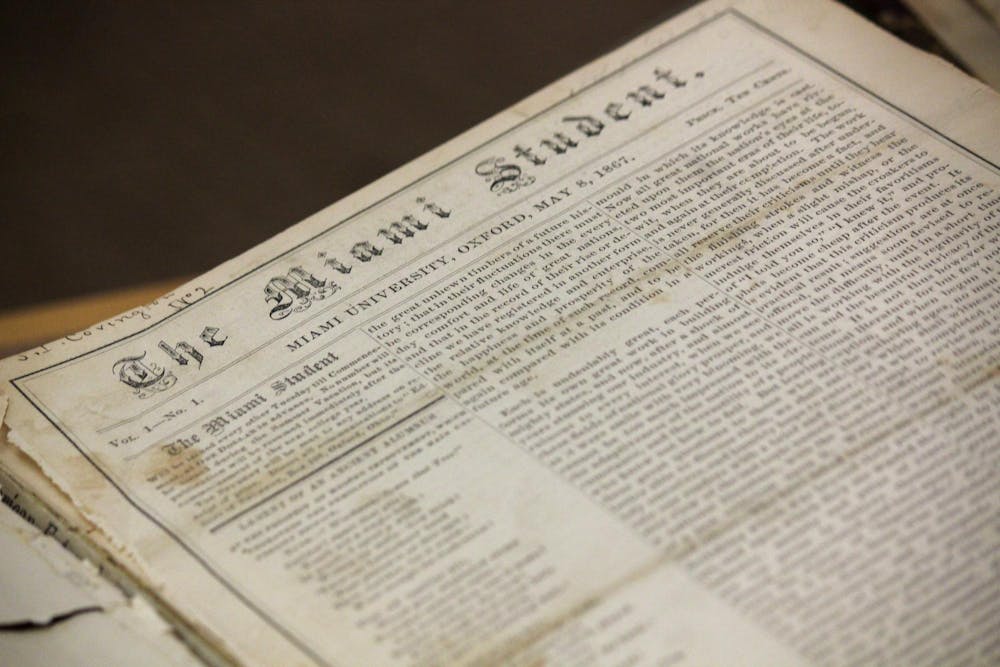
It’s 1827, and students are in between classes or sitting in the student center on campus reading the paper. They’re not holding The Miami Student, though. Instead, they’re leafing through The Literary Focus.
The Erodelphian and Union Societies were Miami University’s first student organizations, composed of all male student writers. These exclusive groups engaged in debate about literature, politics and society. In 1825, they came together and formed a monthly periodical initially known as The Literary Focus, and began publishing two years later.
David Udelf, Miami graduate and alumnus of The Miami Student, said at that time, people looked down upon journalism and thought it was taking away from important literary works. Alfred Horatio Upham, the namesake for Upham Hall, shared this opinion in his book, “Old Miami: The Yale of the Early West.”
“Sometimes men tell us today that journalism has stolen the thunder from the literary forum,” Upham said. “In the 1820's these two seem to have lain down together, the lion and lamb of holy writ."
Udelf said these literary societies were seen as progressive and often clashed with the university and each other. When they joined efforts to create The Literary Focus, the three original editors — Robert C. Schenck, James H. Bacon and John W. Falconer — oversaw the four sections posted monthly. He said the sections included news and editorial content, poetry and essays, literary and scientific essays, and miscellaneous reports and advertisements.
Yet, there was an overflow of content that these two ambitious literary societies covered, ironically spelling its demise, since printing during the time was costly.
Enjoy what you're reading?
Signup for our newsletter
Sue MacDonald, a ‘76 Miami graduate, The Student alumna and active volunteer at the Cincinnati Type and Print Museum, said The Literary Focus only published one print edition before running out of funds and ceasing operations due to printing difficulties in Oxford.
“Printing was so time-consuming,” MacDonald said. “One letter at a time.”
For The Literary Focus, time was money, but membership dues were cheap, limiting the paper’s abilities and future.
“Twenty-five cents from a couple of college kids isn’t going to get you very far,” MacDonald said. “There just weren't that many students to get involved.”
The students who got involved were dedicated academics; passionate and inquisitive, with a desire to share information from gardening and vegetables used in cooking to the Aurora Borealis. At its core, the publication wasn’t a newspaper; it was a literary extension of the societies and their interests in writing as a craft.
“Don’t think of it as a newspaper — it’s long columns of really tiny type,” MacDonald said, as she glanced over an original copy of The Literary Focus to provide an example. “There’s an essay called ‘The Love of Fame,’ and that goes on for four pages.”
She said the dense and flowery words that filled the paper’s pages were purposely pretentious. Despite Miami’s English program having few students, they were motivated by ambition and status. There were levels of membership to the literary societies, cleverly classified as “ordinary” and “honorary.”
“To be an ordinary member, you had to apply and be vouched for by three members and be in good standing, morally and in scholarship,” MacDonald said. “The honorary members were to be gentlemen of established reputation noted for their literary attainments.”
In fact, these ordinary and honorary members played an instrumental role in the establishment of the Miami library system. Both literary societies convinced their members to donate books to the organizations, and they expanded access to all residents of Oxford, provided they paid a one-time fee.
“The desire to create a library soon overcame their original exclusiveness to their societies,” MacDonald said.
Students’ interest in writing and publishing has carried on to the present day. Miami boasts a wide range of publications, including The Student, Inklings Arts and Letters, Happy Captive Magazine, UP Magazine, The Miami Student Magazine, Pixel Magazine, The Femellectual and Oxford Magazine.
Jody Bates, chair of the creative writing program and co-editor of the Miami University Press, said student publications are important because they’re often the beginning of great literary careers, citing Sylvia Plath and T.S. Elliot as two prolific writers who both first began their careers in university publications. He also said Miami is unique in the number of publications it has, and that before coming to Miami, he had never been at a university with more than one.
“What that shows is an investment in literature and the creative arts here,” Bates said. “What that shows is the passion of our students to run these magazines, the passion of our students to want to read each other's work and to promote each other's work.”
Read More

Meet the Columnist: Karma Abboud
By Karma Abboud | 5 days ago"While I still love creative writing, creating opinion articles for The Miami Student is not just a hobby or coping mechanism: It allows me to share my thoughts confidently with the Miami community."
Agree to disagree: Debate club fosters inter-club dialogue
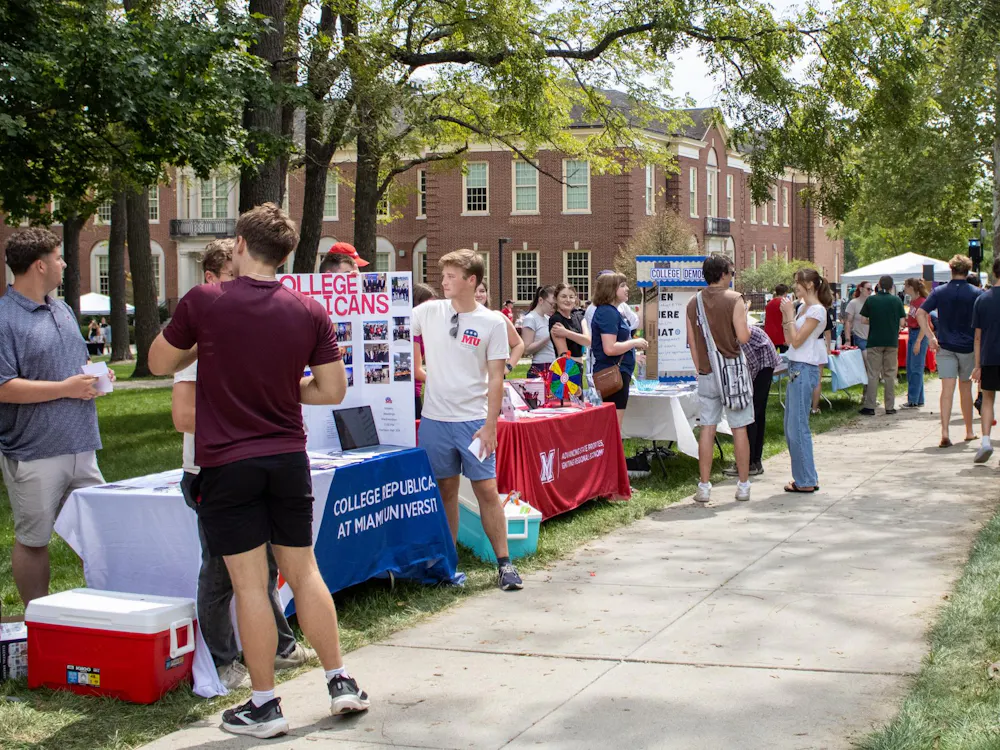
By Elisa Rosenthal | 6 days agoThe Miami University (MU) Debate Club is preparing for its second annual College Democrats and College Republicans debate. This bipartisan event drew 800 people last November, a total far exceeding the 500-seat space.

Recommendations from a reminiscing junior on having roommates
By Jada Rogers | 6 days ago"I made myself miserable as a first-year student because I refused to make other long-term friends, swayed by my own misconception that my roommate was the only person I needed. Humans crave companionship, so please go find your people."