
Each year, migratory birds make their way across the Americas, calling both North and South America home at different times of the year. However, habitat loss threatens their survival in both areas.
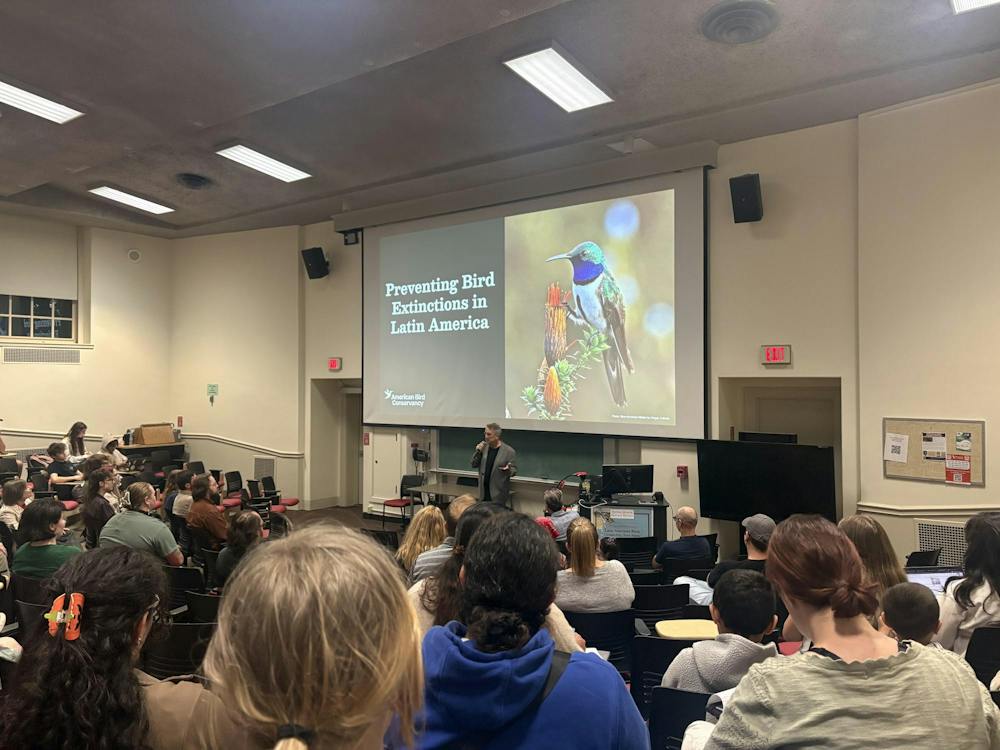
This year’s Hefner lecture, an annual lecture series that has brought leaders in ecology and natural science to Miami University for 52 years, featured American Bird Conservancy President Mike Carr to share the story of these migratory birds in South America.
The American Bird Conservancy (ABC) aims to create a sustainable amount of habitat for at-risk birds. He spoke to a full audience in Laws Hall, filled with students, staff and Oxford residents — many of whom were birdwatchers themselves.
Carr used maps of human development and bird habitat to demonstrate how the largest problem areas for endangered birds are those where human development is the most dense. He said that it is easier for protected areas to be established in more remote spots since there is less political pushback.
Carr then explained that ABC tracks species and classifies them by risk levels such as threatened and endangered. The organization has a two-tiered goal of ensuring the most endangered bird species have at least one protected area, with the hope they will eventually have sufficient habitat to sustain the species long term.
Carr said that although the extinction of many bird species would not result in immediate catastrophic impact to human life, he believes it is worth it to do something for life on Earth beyond humans alone.
“It’s not going to cause the human race to disappear,” said Carr. “... Nothing dreadful is really going to happen to all of us. Solving this crisis is really a truly philanthropic thing for us to do. I feel like humans should do some things that aren’t just about saving us. We should be able to do some things that go beyond what is in our immediate self interest to actually improve things on the planet as a whole. If we don’t do that, at what point does it stop?”
Steve Sullivan, director of the Hefner Museum, said he hopes that people would leave the lecture with an appreciation for the value that bird species could provide humanity. He said these birds connect us with people thousands of miles and that it is important we are good stewards of these birds when they are in our hemisphere so that people on the other side of the world can enjoy them as well.
“We … have a mutually beneficial relationship in maintaining these habitats to maintain this bird that [makes] our lives happy for a little bit,” Sullivan said.
Carr discussed how appreciation for birds and conservation are working hand in hand in South America through for-profit bird conservancies where people participate in bird tourism. Those who run the conservations have found creative ways, such as holding bird-attracting flowers, to allow visitors to get close to birds and take memorable photos.
“They’re making money out of bird conservation and to do that, they have to protect bird habitat,” he said. “[Non-governmental organizations] got it started but that’s not what’s driving it. It’s bird driven economies, and that’s pretty awesome.”
Carr closed out the lecture by showing the crowd the many close-up photos that were taken at these bird conservation areas of colorful, charismatic birds. Several birdwatchers in the crowd expressed enthusiasm and raised their hands to indicate which birds they had seen and which ones they hoped to see one day.
Enjoy what you're reading?
Signup for our newsletter
Matt Valiga, a sixth-year doctoral student, focuses on bug research but has a personal interest in birds. He saw several of the birds shown in Carr’s lecture during his own time in Ecuador. He has been attending the Hefner Lecture for eight years now, and was a part of the Hefner Lecture Committee for this year’s programming.
“It’s a really special thing because you see how much love and care goes into bringing this kind of opportunity not only to Miami but to the community as well,” he said. “I think that’s my favorite thing because part of my research [focuses] on how to communicate science … so the fact that we have a built-in thing to communicate [science] — it rocks.”
The night closed out with a reception at the Hefner Museum where attendees enjoyed food and conversation together. They also had the opportunity to be among the first members of the public to see Ohio’s first migratory armadillo, which was found dead in Oxford. The specimen has been taxidermied and is now and on display at the Hefner Museum.
Read More

Miami’s sustainability week cultivates community and conversation
By Venezia McHenry | 2 days agoSustainability week returns to campus Oct. 18-24, bringing the community together around eco-friendly crafts, trail clean ups and environment-centered activities.

Annual Ethel Belk Lecture welcomes Dr. Cassandra Quave, “The Plant Hunter”
By Tori Fee | October 9, 2026Medical ethnobotanist and professor at Emory University, Cassandra Quave, spoke to a full room during the annual Ethel Belk Lecture on Wednesday, Sept. 30. Quave gave the audience a thorough walkthrough of her book, “The Plant Hunter: A Scientist’s Quest for Nature’s Next Medicines.”

Local areas provide acres of land to explore
By Tori Fee | October 9, 2026Southwest Ohio has numerous outdoor areas that students can explore in their free time, a well-known example being Hueston Woods. There are also many opportunities to venture off the beaten path and explore other unique areas, all under 30 minutes from campus.