
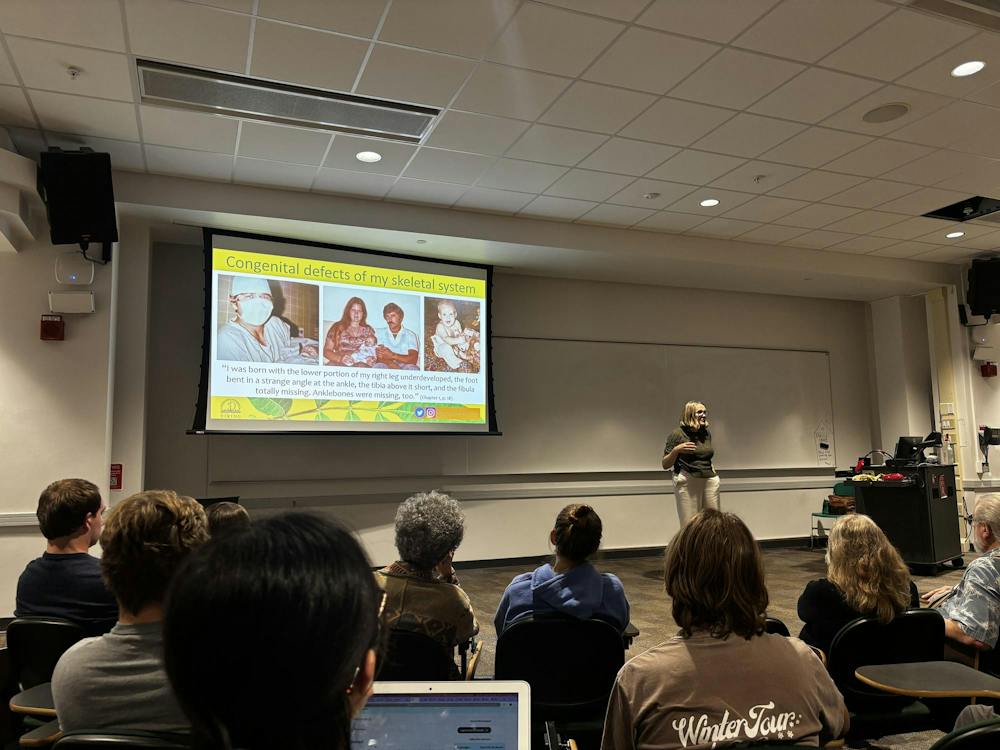
Medical ethnobotanist and professor at Emory University, Cassandra Quave, spoke to a full room during the annual Ethel Belk Lecture on Wednesday, Sept. 30. Quave gave the audience a thorough walkthrough of her book, “The Plant Hunter: A Scientist’s Quest for Nature’s Next Medicines.”
Quave broke her book down into sections, moving from overcoming childhood struggles to her discovered love for science, then eventually her path through research, insights and media attention.
Quave was born with a number of orthopedic defects that resulted in the amputation of her leg. She said during her youth, she dealt with a serious, life-threatening infection that had eaten up her leg tissue and made its way to the bone.
“I was having surgeries once or twice a year from the age of three until I was 20 years old,” Quave said, “so, I am like the million dollar woman.”
She said that as a very competitive child, her hometown didn’t have many opportunities for disabled children. The science fair, however, gave her an outlet, not only for her competitive spirit, but also her curiosity.
Local clinical microbiologists at the hospital took her under their wing and taught her how to work with bacteria from a young age. She said her small town upbringing played a large role in her future endeavors.
Quave attended Emory University, partly because of its proximity to the Centers for Disease Control and Prevention (CDC) and because she thought she’d become a physician. This was where she found her love for the humanities.
“[Anthropology] was so easy and fun,” she said. “It also opened my eyes to concepts from medical anthropology that helped me reframe my own understanding of self.”
She said she was able to bring the fields of anthropology and biology together through ethnobotany. She called it the science of survival.
Through trips to the Peruvian Amazon and Ginestra, Italy, Quave said she realized she didn’t want to be a physician. Instead, she studied how different cultures used medicinal plants as a primary source through ethnobotany.
She also discussed the “post-antibiotic era,” referring to the fact that new classes of antibiotics haven’t been discovered since 1984. Her book studies the question: Can plants be a solution to this drought?
Quave said one difference she found within natural medicinal plants is that they don’t kill the bacteria, like many current-day antibiotics do. These medicinal plants act by dampening the bacteria’s toxicity.
Enjoy what you're reading?
Signup for our newsletter
She said the key to an ethnobotanical-guided study is ethically connecting with communities around the globe to combine past research with their current understandings and emphasize building research opportunities.
“I am so fortunate to be in a country with such a large investment in science,” she said, “but in most of the world where we have rich biodiversity, you have brilliant scientists that don’t have that access.”
Quave said the opportunity to write her book stemmed from an interview with the New York Times Magazine. She said, at the time, she didn’t realize how big a deal that was. Afterwards, she was on radio, TV and met with National Geographic. She also met with a literary agent and started writing.
“I thought, ‘This is my chance to write about my story as a disabled woman in science and to share how awesome ethnobotany is,’” Quave said.
The lecture brought in audiences from many backgrounds and all ages, one of which was Sydney Bruggeman, a junior zoology major and sustainability co-major.
Bruggeman said she came to the lecture because she thought human health and medicinal-plant use would be interesting. She said she thought Quave’s international trips gave great insight into areas using traditional medicine.
“I really enjoyed her personal story and how that led her to science, anthropology and botany in college,” Bruggeman said.
Katty McIntyre, a bluegrass musician from Cincinnati, also attended the lecture. She said a friend of hers had told her about the event and she found it interesting.
“I look at it as something completely new and different from what I spend most of my time thinking about,” McIntyre said.
She said she found Quave’s comments about Indian curry most interesting. Quave used Indian curry dishes as an example of how people use their knowledge of different plant combinations.
Quave said that intentionally blending plant ingredients can create medicinal goods, using curry ingredients like black pepper and coconut oil as an example. McIntyre said she’d heard of other cultures using different plant blends to create protein, but she’d never thought of curry that way.
One of Quave’s take-home messages to students was to follow their interests. She said she realized after returning from the Peruvian Amazon and receiving her medical school acceptance letter that she didn’t want to become a physician; she wanted to continue her passion for ethnobotany.
“It’s never too late to change your mind when figuring out what you want to do,” she said.
Read More

Local areas provide acres of land to explore
By Tori Fee | 17 hours agoSouthwest Ohio has numerous outdoor areas that students can explore in their free time, a well-known example being Hueston Woods. There are also many opportunities to venture off the beaten path and explore other unique areas, all under 30 minutes from campus.

From Texas to Ohio: Next steps for the migratory armadillo found in Oxford
By Venezia McHenry | 3 days agoThis September, the first migratory armadillo in Ohio was found deceased. Now, the Hefner Museum and Jezkova lab are preparing to conduct research and debut the taxidermied specimen.

Oxford helps keep the Great Miami River clean
By Cameron Murray | September 24, 2026On Sep. 19, volunteers across southwestern Ohio and southeastern Indiana participated in the annual Clean Sweep of the Great Miami River Watershed event.