
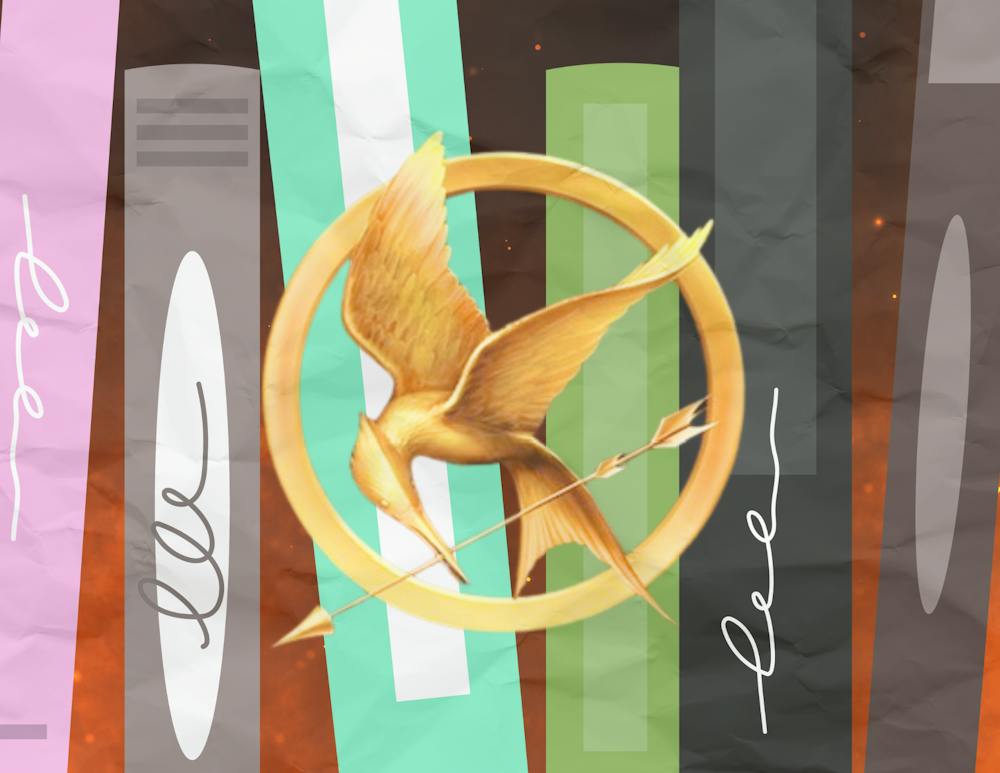
If you were born before the year 2000 or after the COVID-19 pandemic, the “orphaned girl who singlehandedly brings down a corrupt government” era of young adult novels probably passed you by without even bothering to introduce itself to you. If that’s the case, I’m honored to introduce to you (probably) one of the best series to come out of that era: “The Hunger Games.”
I first read the books in the fifth grade, and I remember feeling so “cool” and “old” because I was allowed to read books that were “mature for my age.” Like almost any fifth-grade girl on the planet, I always imagined myself as Katniss and that I possessed the skills to do the same things that Katniss could…even when I should’ve been focusing on my actual academics.
Charlotte Murphy, a junior anthropology major, said that she loved the prequel “The Ballad of Songbirds and Snakes” so much that she went to see it in theaters roughly five separate times so that she could continue to experience the film with other friends.
But Murphy isn’t the only one with a strong connection to the franchise.
“Some of my favorite memories with my mom have come from that series,” said junior economics major Aiden Albanese. He said he first fell in love with the series as a kid during a sleepover.
This series is complex and thought out, but if you’ve never seen it, the most basic way I would describe it is this: children are forcibly chosen to be on a televised death show, where one winner will be gifted the riches they’ve only been able to dream of.
Now truthfully, I was introduced to this series way earlier than I should have — like 12 years too early — but trust me when I say I could talk about all of the symbolism and hidden meanings scattered throughout for hours. However, I’m not the only one who feels that way.
“The message is authentic but also surreal. I’ve even seen people take the song [‘The Hanging Tree’] and put a modern politics spin on it. And considering the dystopian fiction that it is, I was surprised at the connection with our society,” first-year nutrition major Sophie Hudak said.
And that’s true. I don’t remember the exact title of the text, but in an English class I took, I remember reading something about how there is no story that’s completely original. Every story that exists is created through a multitude of experiences and feelings (such as hopes, dreams, fears, current events and past ones) combined into one. Using made-up worlds and characters can better help us understand the reality we’re living in.
Similarly, Olivia Frampton, a sophomore media and communication major, said she loves the series but worries that “The Hunger Games” is becoming niche.
“I feel like not a lot of my friends know about ‘The Hunger Games,’ and that makes me sad because I feel like it is a really entertaining and important series — especially in the times that we are living now,” Frampton said.
Literature has an undeniable effect on how we view and understand the world. How will you connect the pieces you’ve read to the things you’ve yet to experience?
Enjoy what you're reading?
Signup for our newsletter
August Humphrey is a first-year undecided student at Miami, minoring in German. When she’s not studying, you’ll most likely find her at home in bed with her cat.
Read More

The role of politics in the humanities: Welcomed or unwelcomed?
By Catherine Sherman | 2741 minutes ago"The study of English, philosophy, history and culture teaches us how to take a step back and carefully analyze the intentions behind every piece of media we encounter."

Reports of an active threat create widespread confusion
By Shannon Mahoney and Owen Martin | 14 hours agoAt approximately 2:00 p.m. on Oct. 15, Miami University students received multiple warnings about “active threats” on campus.

JANUS Forum sparks open conversations about politics
By Molly Fahy and Parker Green | 18 hours agoOn paper, the only things former Ambassador to the Netherlands Shefali Razdan Duggal and former Speaker of the House Paul Ryan shared on Oct. 13 were an alma mater and a stage.