
In June, the New York Knicks appeared unbeatable. They were in the NBA Finals for the first time since 1999, up 2-0 over the Spurs, and had won 13 straight playoff games. It seemed nothing could ruin their moment.
Then, President Donald Trump showed up for the third game, leading to closed-off streets, hours-long airport-style security and the relocation of fan watch parties outside the arena.
Sports are inherently irrational. Describe American football to someone who has never heard of it, and it’s not far from Roman gladiator matches. We engage in sports not despite, but because they defy rationality. They bring us into a simpler world with its own rules, winners and underdogs.
Game studies scholars Eric Zimmerman and Katie Salen popularised the idea of the magic circle, the mystical space that surrounds a game and allows the impossible to take place. Within a game, the rules of our modern world can fall away, and fictional ones emerge.
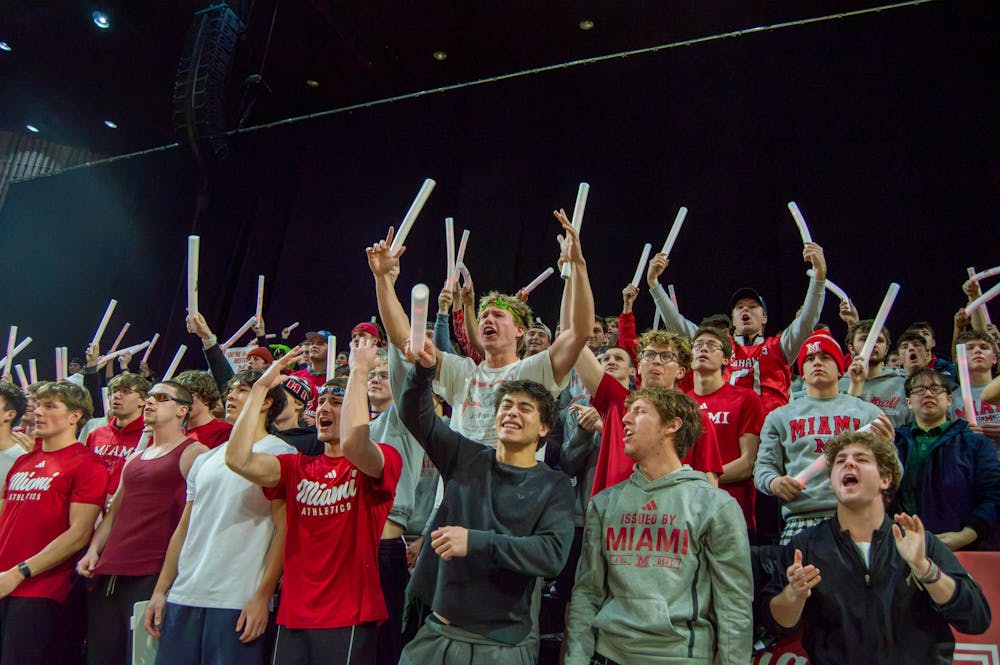
That magic circle doesn’t end at the bounds of the field. It reverberates through the stadiums designed to amplify the crowds’ roars. It permeates through cameras and into the homes of people around the world. It fills bars and cities with cheering fans.
Sports are one of the last monocultural events we have — a time when a whole country, or the world, watches one thing together. The magic circle creates a space where we can take a break from the pressures of our rational world.
But rationality is a tricky thing; its existence requires it to push on the edges, claiming everything can be calculated. It bears down on the barriers of the circle, trying to break in. The rationale of capitalism tells us anything that can be monetized should and will be.
Little holes are punctured in the magic circle — ad breaks remind you you’re a consumer or tell you to gamble and place bets on the odds to quantify the likelihood of a victory. All as if to say, “Forget the magic; there is a 60% chance he will win.”
Watch a baseball game today, and behind the batter, you will see signs for the blatantly named “Bet365” with the slogan, “Winning is Everything.” If you’re betting 365 days a year, you have a problem.
These holes slowly widen; players are told to transfer teams based on who pays the best, they get embroiled in doping scandals and team owners relocate franchises to different towns or refuse to spend money on coaches. Soon, the circle tears — someone places a bet on the game and rigs it, and the magic exits the circle, leaving behind a poor illusion of the real thing.
Trump clearly didn’t care about the Knicks game as he appeared to be sleeping through it. His presence seemed only to remind fans they can’t escape the real world. The magic circle was punctured — the Knicks lost game three.
In July, the U.S. team was the underdog story of the FIFA World Cup, making it to round 16 with a home-team advantage that made their success feel all but inevitable.
Enjoy what you're reading?
Signup for our newsletter
Then, after U.S. striker Folarin Balogun got a red card and was forced to sit out the next game, Trump called FIFA President Gianni Infantino and asked the decision be reversed. FIFA announced Balogun would be allowed to play. Again, Trump punctured the circle, and the magic surrounding the team dissipated — they lost the game 4-1 and were knocked out of the tournament.
No one has ever been comforted by the words, “It’s just a game.” Sports are a place where time seems to halt, worry and hate drop away, and we all engage in something truly magical. Games can heal countries, forge bonds between people and reimagine the world to be just a little better.
Trump continues to push into sports because he sees this power. He's not the first president to do so — former President Jimmy Carter presented the World Series trophy in 1979, and George W. Bush bought a share of the Texas Rangers in 1989. Trump won’t be the last to intervene, but he misses the fact that the power of sports comes from its uncontrollability. Sports only work because they exist independently of the rational world.
Just like sports gambling corporations and advertisers, his attempts to harness it — to force rationality onto the irrational — always fail. The magic leaks through his grasp and leaves the game.
If we want sports to maintain their power, we have to resist these incursions from capital.
After the World Cup, Infantino attempted to sell a portion of a new company that would run its major events, like the World Cup, to a Trump-associated investment company. This plan was canceled after being widely rejected by fans and regional soccer confederations, and Infantino’s future within FIFA is uncertain.
New Yorkers met Trump’s appearance at the Knicks game with a chorus of boos, and after he returned to the White House, the Knicks went on to win the series 4-1. New York exploded in celebration. Despite Trump’s meddling, the magic held strong; the impossible was made possible.
Abe Hagood is a sophomore double majoring in creative writing and emerging technology in business and design. He is the assistant Opinion editor for The Student, a steering member of the Miami University Young Democratic Socialists of America and a leadership member of the Game Design Club.
Read More

In defense of being educated
By Vedika Kaushal | 11 hours ago"In a society where education is often treated as an ordinary part of growing up, we get to choose what we study, question what we learn and complain about the classes we take. For many others, even that choice remains out of reach."

Your squishes are going to be the landfill’s newest accessory
By August Humphrey | 11 hours agoI’ve seen them, you’ve seen them, and your cousin who you see twice a year has seen them: squishes. Whether it be a lucky scoop video, a blind box unboxing, a wax-cracking video or a tour of the 1,000 squishes an influencer’s kid has accumulated, squishes are seemingly more attractive than the thought of a professor cancelling an 8 a.m. class.

ASG votes to encourage university to provide allergy shots
By Shannon Mahoney | YesterdayMiami University’s Associated Student Government (ASG) passed a resolution involving allergy shots, discussed lighting issues at the intramural courts and elected members to serve on the search committee for the next student trustee at its meeting on Oct. 6.