
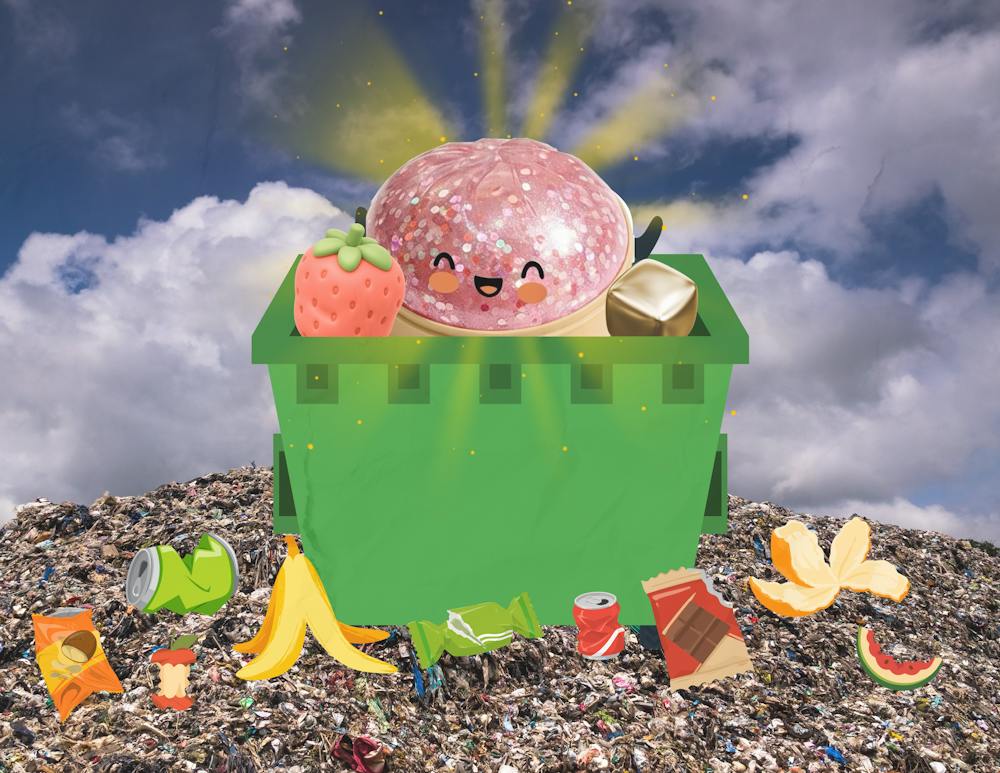
I’ve seen them, you’ve seen them, and your cousin who you see twice a year has seen them: squishes. Whether it be a lucky scoop video, a blind box unboxing, a wax-cracking video or a tour of the 1,000 squishes an influencer’s kid has accumulated, squishes are seemingly more attractive than the thought of a professor cancelling an 8 a.m. class.
On social media, there are tons of creators who gather hundreds of thousands — if not millions — of views, just by showing off their latest haul or the “new” squishy they made by cutting up a NeeDoh and filling it with slime. It’s a well-known fact that no one mindlessly scrolls and critically thinks about the content they’re consuming. But whenever this sort of content comes up on my feed, there are two things I just can’t help but wonder: who needs a whole shelf of the same chemical-filled toy, and where do these people get the money to buy them?
In an article published by CNBC, 60% of the population who contributed to the $297 million in squishy sales this year were parents purchasing them for their children (I mean, because what 9-year-old has access to their own bank account?). But that doesn’t really explain how so many young people end up listing every kind of squishy they can think of on their birthday wishlist — but social media might be able to.
I, like most people in my generation, love using social media, and while it’s a fabulous place to decompress, I’m not naive enough to believe that companies and influencers aren’t constantly trying to sell me something. Whether it be a brand new product or something that I “won’t be able to live without,” social media is like an episode of “Shark Tank” that never ends. So is it really that surprising when Capital One — a company that makes money off of people who spend their money inappropriately — reports that roughly 39% of TikTok users actively use the platform to shop, and that 55% of American TikTok users have made impulse purchases on social media apps.
These statistics may not seem like a huge deal out of context, but according to the United States Census Bureau, the number of people in the United States — as of Sept. 30 — is roughly 343 million. Of that 343 million, young people make up 13.81% (or 47,368,300 people) of that population. Give or take, a few million young people are spending their money on cheap things that they don’t really need — they’re spending their hard-earned money on a dopamine rush that will end quicker than it lasted.
You may only have to pay two dollars for some cute squishes you saw on TikTok Shop, but I urge you not to believe that’s a “steal.” Regardless of whether it’s the earth, or if it’s a random person you’ll never meet, someone will always pay the price for the two seconds of instant gratification you’ll get.
August Humphrey is a first-year undecided student at Miami, minoring in German. When she’s not studying, you’ll most likely find her at home in bed with her cat.
Read More

In defense of being educated
By Vedika Kaushal | 1 hours ago"In a society where education is often treated as an ordinary part of growing up, we get to choose what we study, question what we learn and complain about the classes we take. For many others, even that choice remains out of reach."

ASG votes to encourage university to provide allergy shots
By Shannon Mahoney | 19 hours agoMiami University’s Associated Student Government (ASG) passed a resolution involving allergy shots, discussed lighting issues at the intramural courts and elected members to serve on the search committee for the next student trustee at its meeting on Oct. 6.

A Kaleidoscope of Memory: Miami’s Archives at Work
By Kate McDonough | 19 hours agoWithin King Library, Special Collections, manuscripts, archives and preservation act as a cultural hub providing students, patrons and residents the coveted privilege of directly engaging with the past for academic pursuits and curiosities alike.