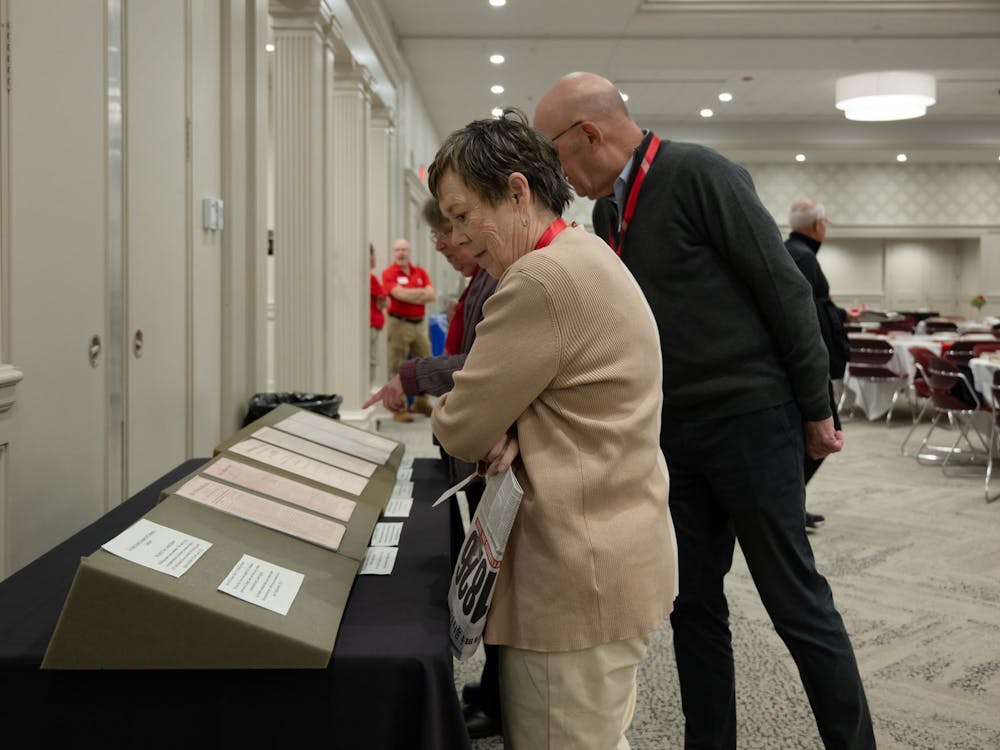
In small towns and news deserts like Oxford, there are times student publications are the only form of journalism a community has access to. Local student journalism serves as the backbone for sharing information to both students, faculty and the surrounding city.
Emily Lichty, editor-in-chief of The Daily Northwestern, Northwestern University’s newspaper, said stories shared by student journalists are just as important as the stories people are seeing on the news every morning.
“A big part of what drives me as a student journalist is if we weren't telling these stories, they wouldn't always be getting told,” Lichty said.
Here in Oxford, that problem is exacerbated. Rosemary Pennington, chair of the Department of Media, Journalism and Film at Miami University, said the lack of thorough news coverage of Butler County is a problem. Miami is Butler County’s largest employer, so people in town rely on students’ reporting as much as the student body does.
“Student media is one of the only places people in Oxford can turn for news about what is happening in the town,” Pennington said.
Even for areas fortunate enough to have local news sources, it’s difficult for them to get the inside look at a college campus. Students have the advantage because they’re close to the scene and know what their peers want to read about — they have a unique perspective that big news outlets can’t achieve.
Enjoy what you're reading?
Signup for our newsletter
In addition to its role of providing news in the community, student journalism also gives students platforms to experience professional journalism before entering the workforce.
Sydney Pinchouck, a first-year journalism and media and communication double major, started her journalism career at Hamilton Southeastern High School in Fishers, Indiana, where she wrote for her school newspaper, the Orb. Now, she’s an active member of Redhawk Television — Miami’s only student-run broadcast news station.
“I've had to work on some stories that were really emotional and kind of hurt,” Pinchouck said, “but those have made me a better journalist.”
For students looking to make journalism their career, these platforms help them learn skills they can’t always gain sitting in a classroom.
Journalists are required to talk to strangers, tell the truth and serve the public good, but this can be overwhelming to transition into without previous exposure. Meanwhile, organizations like The Miami Student and Redhawk Radio provide students with professional clips to submit to jobs and internships.
Jackson McCoy, the editor-in-chief of The Post, said he feels this way for himself and his coworkers in the newsroom at Ohio University.
“So many people who I work with and who work around me are shaping and creating a student media ecosystem that kind of mirrors what they want to see when they graduate,” McCoy said.
It also lets people know what work the administration is doing; it reflects transparency, holding institutions accountable for how their choices impact the community.
Pennington said that at this current time, when trust in the media is low, student journalists are important because they’re learning how to do the work, and they become the journalists who will move the profession forward when they go out into the field.
“There's always going to be a place for student media,” Pennington said.
Read More

University Senate discusses arena survey, reviews new online services
By Kylie Bunn | 6 hours agoThe Miami University Senate reviewed the community arena survey and discussed the implementation of Student Workday and Online Library Video Educational Resources (OLiVER) during its meeting on Feb. 23.
Miami report lists 5 years of hazing violations in fraternities, sports teams
By Zoee Robinson and Zoe Erickson | The Miami Student | 19 hours agoMiami University released its updated biannual report on hazing violations for the fall semester of 2025. The report cites all violations five years prior to Dec. 1, 2025.