
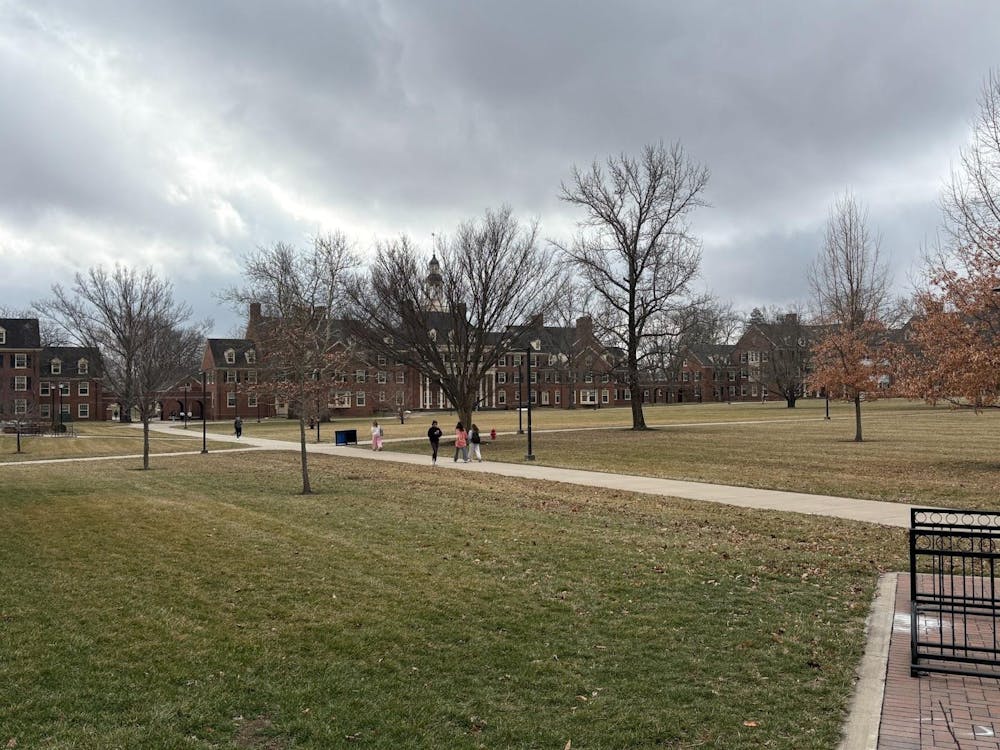
Miami University released its updated biannual report on hazing violations for the fall semester of 2025. The report cites all violations five years prior to Dec. 1, 2025.
The data launch is required under Miami’s code of conduct and Ohio code section 2903.31, also known as Collin’s Law, which makes hazing and failure to report hazing criminal offenses.
Organizations charged with violations include the Miami Dance Team, Men’s Golf Team and Club Baseball. Greek organizations listed include Alpha Delta Phi, Chi Psi, Delta Sigma Phi and Kappa Alpha Psi Fraternity, Inc. The report lists what violations occurred and the penalties enforced.
According to Miami’s code of conduct, hazing can include a range of activities such as forced alcohol consumption, deliberately creating messes for members to clean up, sleep deprivation and physical or psychological abuse.
“When I was a pledge, we had to do stuff like crawl on bottle caps or put together a puzzle in the dark,” said a member of the Delta Kappa Epsilon fraternity, who will remain anonymous for fear of retaliation.
The reporting process begins when a student files a report with the Office of Community Standards or submits one anonymously through EthicsPoint.
Enjoy what you're reading?
Signup for our newsletter
Alex Fields, director of the Office of Community Standards, said EthicsPoint reports are monitored by Miami’s legal counsel, who then notifies her office and the Miami University Police Department (MUPD).
Fields said it is essential that MUPD is informed because all hazing allegations are allegations of a crime.
To receive reports, the Office of Community Standards also partners with national headquarters of campus organizations, the Cliff Alexander Office of Fraternity and Sorority Life, Campus Recreation, Intercollegiate Athletics and the Center for Student Engagement, Activities and Leadership.
From there, officials determine whether a victim has been identified and if they’re willing to participate in the process. Then, a formal investigation begins.
If no one comes forward, a smaller and informal investigation still takes place, but the lack of victims limits officials’ ability to act.
“It can be a bit of a longer process,” Fields said.
Once the formal investigation begins, a non-decision-making body will gather facts and determine what happened.
“We use a standard of evidence called preponderance,” Fields said, “which means that the evidence needs to weigh out … that what has been alleged to have happened, took place.”
If preponderance is met, the Office of Community Standards reviews previous misconduct, if any, to determine appropriate sanctions.
Fraternities and sororities also have their own boards to settle internal matters. These judiciary boards, or “j-boards,” can charge members of their chapter with hazing in violation of their organization’s bylaws.
BaShaun Smith, associate vice president of student life and dean of students, said violating Ohio Law and Miami’s Code of Conduct is a completely separate process from violating your own organization’s bylaws.
“If you are found responsible or going through a process like a student conduct process, [organizations] can hold you accountable through their own constitution and bylaws, too,” Smith said.
Hazing violations can also include elements of sexual assault.
When this occurs, Georgia Hensley, Miami's Title IX, Title VI and hazing prevention coordinator, intervenes.
According to the American Psychological Association, 50% of sexual assault cases occurring on college campuses happen from August to November. This period is referred to as the “Red Zone.” It is typically the beginning period of a new school year because there is a link between increase in social gatherings and rates of sexual assault. This spike can also occur after Greek life recruitment.
“I think it’s about the newness of being on campus, the excitement of events happening and the more student exposure to instances where they are all together,” Hensley said, regarding the “Red Zone.”
To combat hazing and sexual assault, Hensley and her staff will lead Miami’s National Hazing Prevention Week, Sept. 21–25. The event will be a joint celebration of many university offices.
“[This is] the first year that we as an administration celebrate hazing prevention with a coordinated calendar of events,” Hensley said. “We’ll have an event or speaker every single day that week.”
Sororities take steps to educate and protect their members, as well. New members go through a new member education experience and an online course to help prevent hazing and sexual assault.
Throughout the Panhellenic recruitment process in the spring, all sorority members and potential new members participate in a mandatory dry period where drinking and visiting bars Uptown, as well as going to fraternity houses, are prohibited.
During this time, girls are not allowed to visit fraternity houses, so there’s no possibility of witnessing hazing.
“They don’t want you at the frats because they don’t want you in the household when hazing is happening,” said a Phi Mu member, who asked to remain anonymous because she was not authorized to speak on behalf of the chapter.
If you or someone you know witnesses hazing or sexual assault on campus, fill out the anonymous EthicsPoint form or contact the Title IX office or MUPD. You can also contact the national hazing hotline at 1-888-668-4293.
Read More

Meet the Columnist: Karma Abboud
By Karma Abboud | 3 days ago"While I still love creative writing, creating opinion articles for The Miami Student is not just a hobby or coping mechanism: It allows me to share my thoughts confidently with the Miami community."
Agree to disagree: Debate club fosters inter-club dialogue
By Elisa Rosenthal | 4 days agoThe Miami University (MU) Debate Club is preparing for its second annual College Democrats and College Republicans debate. This bipartisan event drew 800 people last November, a total far exceeding the 500-seat space.
Recommendations from a reminiscing junior on having roommates
By Jada Rogers | 4 days ago"I made myself miserable as a first-year student because I refused to make other long-term friends, swayed by my own misconception that my roommate was the only person I needed. Humans crave companionship, so please go find your people."