
Kazue Harada can’t vote. She can’t apply for certain grants. She can be deported.
Yet Harada is an associate professor of Japanese in the Department of German, Russian, Asian and Middle Eastern Languages and Cultures (GRAMELAC).
She’s not a citizen of the United States and doesn’t want to be. Japan doesn’t allow for dual citizenship, and she still wants to continue seeing her family back home. She’s also uncomfortable with the United States’ current political climate surrounding immigrants.
Harada said even though she is consciously choosing not to become a U.S. citizen, she still thinks about what would happen if the United States Immigration and Customs Enforcement
(ICE) came to campus, or if one of her students got in trouble.
“Traveling, re-entering the country and also domestic travel, like going through TSA, is nerve-wracking for me,” Harada said. “Some people wondered, ‘Who should I contact?’ ‘What should I do if people are detained on the spot?’ So [Faculty Alliance of Miami] is trying to provide information at the next meeting … about what to do when it happens to them, so there is some sort of support contact information that [students] can actually contact.”
She’s also frustrated with the unclear position the university has taken regarding ICE. However, even though Harada said many of her colleagues feel the same way, many are fearful of putting their green card sponsorship on the line by speaking up.
Enjoy what you're reading?
Signup for our newsletter
Harada was one of the sponsored GRAMELAC faculty members, meaning Miami University paid for her to get her green card in 2021. She came to Miami in 2015 and, for five years, had the H-1B specialty occupation visa, allowing her to work in the country.
To get sponsored, a professor needs the support of their department chair and their colleagues, which can make them vulnerable to racial bias.
But racial bias is hard to prove. It can come in the form of small, passive-aggressive remarks and microaggressions that someone who is white might not catch. Harada herself has heard of such things from many colleagues.
“I know my colleague also felt that students or anybody could say racial slurs or discriminate, [and] say biased things against us,” Harada said, “even though they were not comfortable saying them before [the first Trump administration].”
She said if Miami were to stand up and support international students and faculty, it would be good for the university as a whole. But as of mid-April, she still doesn’t know where the university stands.
One of the only communications faculty have received from the university’s administration was in the form of the Office of the Provost’s “Weekly Three” email from February.
It stated that in any event, if law enforcement, including ICE, contacts Miami faculty or staff for information about an international student or scholar, the request should be referred to the Office of General Counsel. Also, any law enforcement or ICE agents who come to campus seeking information about an international student or scholar generally do so by contacting the Miami University Police Department.
This information can also be found on Miami’s visa and immigration updates page.
Seth Baugess, senior director of communications, wrote in an email to The Miami Student that the university is not aware of contact by law enforcement, including ICE agents.
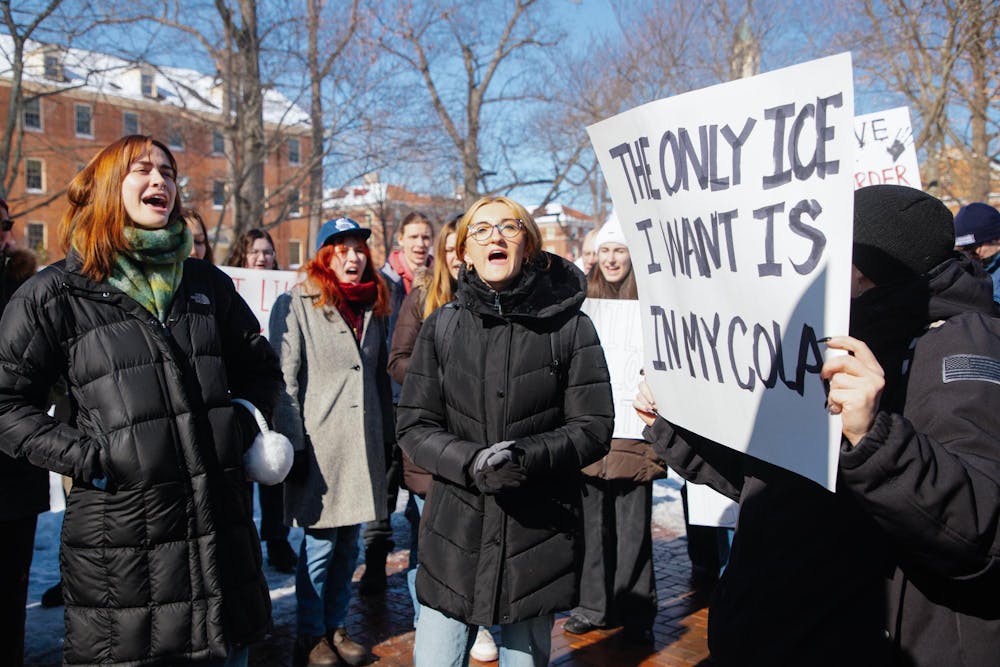
April 10, Faculty Alliance of Miami, Young Democratic Socialists of America, the Ohio Student Association and Miami University College Democrats protested funding shortfalls, departmental issues and ICE in front of the Armstrong Student Center.
At the protest, members of the College Democrats of Ohio and Miami’s chapter of the College Democrats agreed with Harada’s sentiment, saying the administration needs to recognize the threat ICE poses to Miami’s neighbors and to recognize how international faculty are being mistreated on campus, according to reporting by The Miami Student.
“Even though there are actions going on, I don’t know how many people actually feel comfortable going there because of arrest, even though [they’re] peaceful protests,” Harada said.
There have also been ICE protests at Florida College to remove federal immigration agents from its campus, as well as at Columbia University and others across the nation.
Since the start of President Donald Trump’s second term, the Department of State has revoked 8,000 student visas, according to Inside Higher Ed. In total, the administration has revoked 100,000 non-immigrant visas, which is more than double the amount from 2024, according to Fox News.
The Trump administration has detained protesting college students, encouraged changing policies to make it more difficult for international students to study in the U.S. and capped the number of international students universities can enroll at 15%.
In an email interview with The Miami Student, Dean of Students Bashaun Smith also said he’s unaware of any deportations on Miami’s campus and that since ICE is a federal agency, and Miami is a public institution of higher education, Miami will comply with all laws and regulations.
“If they come on campus, we will work with our Miami University Police Department,” Smith wrote.
Molly Heidemann, director of International Student Scholar Services, said her office primarily handles helping international students maintain their legal status in the U.S.
Heidemann said the discussion around ICE has been limited because there hasn't been an imminent threat of them coming to campus, yet. She hasn’t heard much from other local or peer institutions, either.
“I don’t know if as many [international students] have expressed concern about ICE coming to campus,” Heidemann said. “I don’t know if that’s maybe because we’re not in a big city, you know, I don’t think we’re quite as much of a target as some of the bigger schools … But in general, I think there is a feeling of stress and concern and anxiety for our population.”
Part of that concern is the Trump administration’s travel bans in place for 75 countries, according to the Council on Foreign Relations, an American think tank. Some of the full bans include Afghanistan, Equatorial Guinea, Iran, the Republic of Congo, Somalia and Syria.
Those same students affected by the travel ban are also currently subjected to delays in their U.S. work authorization applications.
“[International students are] vital to our campus community and add so much to it,” Heidemann said. “There’s a good percentage that don’t [study abroad,] so to be able to interact with people who are different from you, who come from a different place, a different culture, a different language, a different background, and be able to learn from them is very helpful for personal development, but also for planning for a future career.”
Read More

‘Practical Magic 2’: Shenanigans
By Eliza Garrett | YesterdayThe Owens sisters are back after nearly three decades, and this time, they have even more magic, family drama and romance than ever before. “Practical Magic 2” brings Gillian and Sally Owens back to the big screen and allows the audience to experience their magic once again.

Lizzy McAlpine makes folk her own in ‘Angel’
By Ren Chaffee | 3 days ago“Angel,” Lizzy McAlpine’s new album, released Sept. 18. Although there are some mixed reviews, “Angel” hits the mark for me.

Recap: McComb shines in 24-21 thriller against UConn
By Graham Young | 3 days agoOn Sept. 26, 2026, the Miami University RedHawks met their next competitive match of the regular season.