
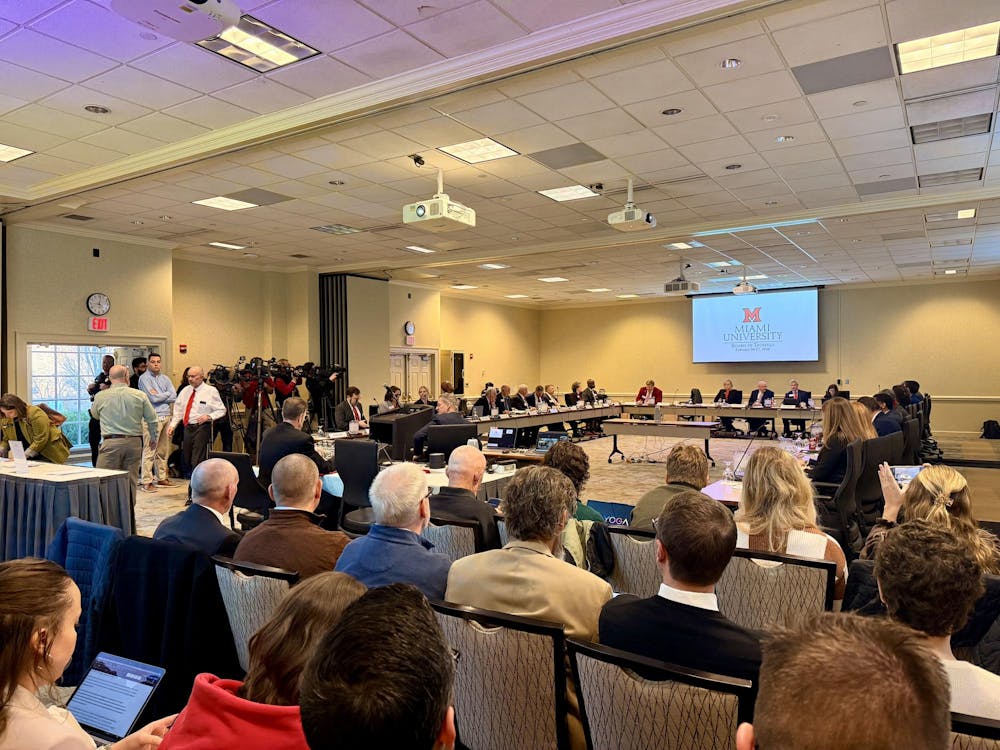
Miami University’s Board of Trustees met to discuss campus development and approved plans for a new basketball arena on Cook Field, while also addressing administrative changes and regional campus expansion at its meeting last Friday.
The board unanimously approved the proposed arena project despite ongoing student and faculty opposition, according to the survey. Community members spoke during public comment about concerns over cost, university priorities and the loss of green space. Student petitions previously circulated opposing the arena, but the board moved forward with the project.
Board leadership framed the arena as part of a long-term enrollment strategy.
“We are making this historic investment as one part of a broad-based strategy to invest in our future,” said chair of the Board of Trustees, Mary Schell. “Given a steep and ongoing decline in the number of students who choose traditional higher education after high school, we must implement new strategies to recruit the number of students we need to remain a healthy institution. The arena proposal is one part of that work.”
Schell said updated facilities are necessary for recruitment and athletic competitiveness. Amber Tretter, a forward for Miami’s women’s basketball team, agreed that current space limitations affect student athletes' schedules.
“Right now, one of our biggest issues is scheduling court time,” Tretter said. “We have three teams sharing primarily one court. Between classes, lifting, practice and academic commitments, gym availability becomes a daily puzzle. Moving forward with the new arena shows Miami is committed to excellence in the classroom, competition and the overall student experience.”
Students and faculty questioned the university’s spending priorities during public comment, particularly as academic programs face cuts.
“My major is gone,” Ashley Reynolds, president of the Ohio Student Association (OSA), said. “We allegedly don’t have funding to support humanities, but we want to go millions of dollars into debt. If we don’t have funds for our education, we don’t have funds for an arena.”
Some speakers connected the arena project to recent reductions in arts and humanities programs across the university. Commenters said arts programs at regional campuses have been largely eliminated and reduced on the Oxford campus, including the dissolution of Miami’s art degree program.
Jennifer Purdum, a professor who taught at Miami for 18 years and lost her position after the program’s closure, said the changes have been felt and seen by faculty.
“Until now, I have never known the grief or feeling of utter disposability I’ve experienced from our institution over the last three months,” Purdum said. “The callous and dismissive treatment of faculty and staff has been startling and deeply wounding. The possible elimination of entire disciplines has been conveyed with the same detached efficiency as the removal of a building or a parking lot.”
She said the reductions would limit opportunities for future students.
“Access for future artists, musicians and theater students is shrinking,” Purdum said. “This isn’t just a local issue. This is a national assault on the arts and humanities. Ours has arrived in the form of a sports arena.”
Enjoy what you're reading?
Signup for our newsletter
Members of OSA protested the project and stood outside the Marcum Hotel during the meeting. They held signs with slogans like “$280 mil for an arena but $0 for our education” and “We are skipping our lessons to teach you one,” arguing the university should prioritize academic programs rather than take on additional debt. Other protesters outside of OSA also raised concerns about traffic congestion near the intersections bordering Cook Field.
Some commenters also challenged the board’s justification that facilities drive student engagement.
“We’ve had plenty of world-class speakers come to Miami, and they weren’t held back by Millett Hall,” a community member said during public comment.
Others argued that student attendance is more closely tied to team performance than building upgrades.
“Student attendance is driven by team success, not facilities,” the community member said.
The meeting also included criticism regarding the removal of the Physician Associate Studies Program director. Abigail Steele, a graduate student in the Physician Associate Studies program, said the decision has already affected the program’s stability and applicant pool.
“Dr. Howell’s reputation brought opportunities for students that we now don’t have,” Steele said. “The next cohort has already lost qualified applicants, and faculty have had to accept less experienced candidates.”
Steele said the program’s medical director resigned due to the decision to remove Howell, and the vacancy is already affecting accreditation.
“Our program is not following PA standards,” Steele said. “ [It’s] damaging our accreditation.”
The next Board of Trustees meetings will take place on May 14 and 15 at the Marcum Hotel and Conference Center.
Read More

The Miami Student celebrates 200-year anniversary… …or 199?
By Anna Reier and Olivia Patel | 3 hours agoIt is correct, but no one verifies it, until one day someone says, ‘Wait a minute, you're not the oldest. We're the oldest.’

From printing press to pixels, journalism constantly evolves
By Parker Green | YesterdayLike everything in this digital age, journalism has rapidly evolved. While some assume this shift was out of the blue, journalism and media more broadly have long been subjected to rapid evolution.

Progression of Earth Day celebrations at Miami
By Tori Fee | YesterdaySince its beginnings in 1970, Earth Day has been celebrated and honored by Miami University students. From early pushes to recognize the event locally to a vibrant annual celebration, students have been at the center of promoting the holiday.