
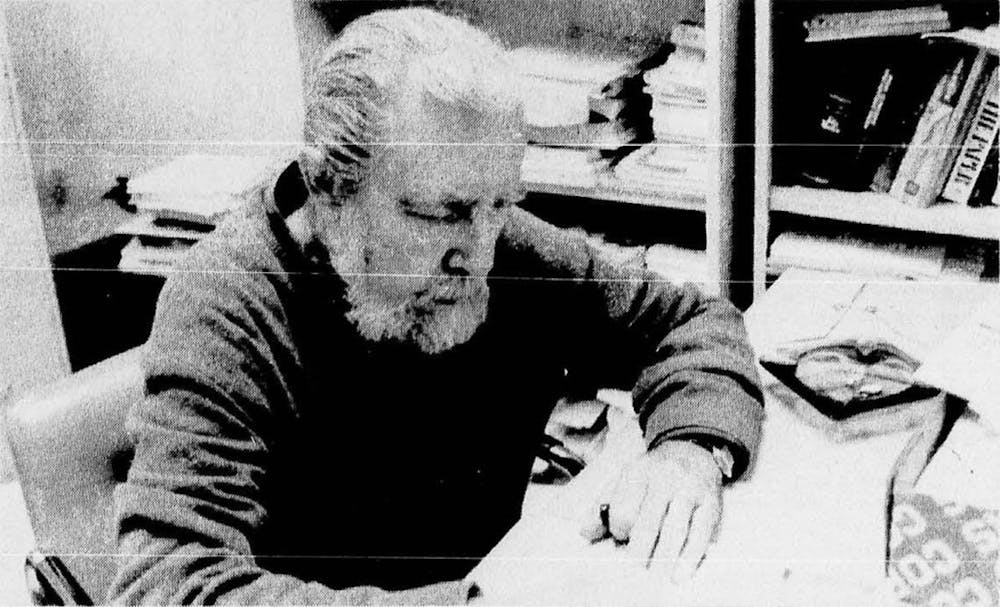
By picking up this edition of The Miami Student, students engage in the 200-year-old tradition of print news-gathering here in Oxford. That’s 200 years of local and national news, recommendations, opinions, editorials and, in the later years, photos.
Like everything in this digital age, journalism has rapidly evolved. While some assume this shift was out of the blue, journalism and media more broadly have long been subjected to rapid evolution.
The early years (Pre-American Revolution–1830)
According to Stanford University’s history of journalism, 90% of white Americans could read by the 18th century, creating a high demand for literature and readable news.
Despite this demand, a combination of high paper prices and labor-intensive printing practices kept production in the hands of wealthy people who had near-complete control over content. It also made papers themselves expensive.
“The key thing is that [colonial newspapers] were partisan,” said Richard Campbell, a retired Miami University journalism professor and founding member of the Oxford Free Press. “People like Thomas Jefferson and Ben Franklin owned newspapers, and they used them to push their own positions and power.”
Enjoy what you're reading?
Signup for our newsletter
This partisan style of news dominated throughout the 19th century.
The golden years (1830–1870)
Not only was the Gilded Age a great time for people who took advantage of limited child-labor laws, but it was also the start of the newspaper boom.
Campbell credits this boom to the new accessibility of newspapers.
“With the invention of the rotary press, you could print a lot of papers at one time,” Campbell said. “It reduced the cost of papers from six cents to a penny. Before the penny press, it was mostly wealthier people, educated people — almost all men — who had subscriptions to newspapers.”
James Tobin, a professor in the Department of Media, Journalism and Film, pointed to this time period as one of the most significant moments in the history of journalism.
“That mass market [from the penny press] made newspapers influential and rich — an important thing in itself, but also because it allowed the development of the profession of journalism, a class of people trained to use the craft well (not that they always did) and who could make a decent living at it,” Tobin wrote in an email to The Miami Student. “The result, fusing the creators and the audience, was a culture of news and a remarkably well-informed public, compared to earlier eras.”
The Student was established at the very beginning of this era.
Radio (1870–1950)
Moving in tandem — and eventually beyond — this accessibility boom was the advent and expansion of radio news.
Stanford’s history of journalism credits the broadcasts of World War I and Franklin D. Roosevelt’s famed “fireside chats” as hallmarks of the era.
For the first time, the average United States citizen could hear the president speak and deliver news, expanding the power of the bully pulpit– the idea that someone in public office can push their agenda via the prominence of their office.
Television and trust (1950–2005)
In the 1950s, television became the way most people received their information, according to Stanford's history. For many U.S. citizens, TV also became a way to see their own government in a new light.
“The Vietnam War was the first television war because now you could see news [this way],” Campbell said. “That actually helped end the war, because people could see that it was not going well and began thinking, ‘What business do we have, trying to fight communism in Vietnam?’”
The media also delivered some of the most infamous reports in U.S. history during this time, including the Pentagon Papers, Watergate, the Clinton-Lewinsky affair and the Sept. 11, 2001, terrorist attacks.
It’s one of these explosive reports that Rosemary Pennington, chair of the Department of Media, Journalism and Film, cites as one of the most significant moments in journalism.
“One of the most significant [events in journalism] was the publication of the first Spotlight article on priest abuse in the Catholic Church in The Boston Globe,” Pennington wrote in an email to The Miami Student. “It not only forced a community to confront an ugly truth about what had been happening, but it also was the start of news coverage all over the world that showed that this was a systemic problem in the church, not something isolated to a specific location.”
This concise and meticulously reported journalism lent trust to the media, which sharply declined in 2005 after a slow post-’70s descent, according to the Pew Research Center.
Modernity (2005–present)
“The ultimate biggest change [to journalism] was the arrival of the internet,” Campbell said. “The internet means that newspapers can do news immediately.”
This lightning-quick journalism has only been supercharged by social media, which can be a useful tool for many journalists, but can also contribute to misinformation and disinformation.
“Everybody used to read at least one newspaper daily,” Tobin wrote. “By comparison, most younger people today — and even their parents — are surviving on a very thin diet of well-reported journalism, which they can barely distinguish from the flood of junk food that flows toward them on social media and TV. That's not to say newspapers used to all be great — far from it. But just about everyone read them.”
Now, news organizations have to compete for attention spans, not to mention a growing mistrust sown by top officials.
“A lot of [media mistrust] is what I call the ‘Trump phenomenon,’ because he’s used attacking the press as a strategy to get elected,” Campbell said.
But Campbell is more concerned with the closure of local media than attacks at the federal level.
“Where do people go for information?” Campbell said. “They go to social media, they go to talk radio and they go to the cable talking heads in the evening. That’s not journalism, and it makes people who live in small communities care more about what’s going on nationally than what’s going on locally.”
Many small communities like Oxford now rely on non-profit news sources, like the Oxford Free Press and The Student, a student-run publication, to report on local issues.
Other concerns about the future of journalism include AI.
“News media are constantly having to contend with technological advances; however, AI presents a particular challenge because it can almost do the work of journalists, at least as far as writing goes,” Pennington wrote. “That can make it seem like maybe reporters aren't as needed. Reporters do so much more than write — they fact-check, they evaluate sources, they compare data, they contextualize information. AI does none of that well.”
Throughout the 200-year run of The Student, the journalism industry has reinvented itself time and time again.
What remains consistent is that where there are people who want to be informed, there is a place for journalism.
“I guess the core element is simply this: people have always wanted to know what's going on outside the immediate sphere of their family and their neighborhood,” Tobin wrote. “That basic curiosity is what has always fueled journalism, and it will likely never die. If there's anything that makes me think journalism, however much it's struggling, has a future, that's it — people's hunger to know what's going on.”
Read More

Meet the Columnist: Karma Abboud
By Karma Abboud | 2 days ago"While I still love creative writing, creating opinion articles for The Miami Student is not just a hobby or coping mechanism: It allows me to share my thoughts confidently with the Miami community."
Agree to disagree: Debate club fosters inter-club dialogue
By Elisa Rosenthal | 2 days agoThe Miami University (MU) Debate Club is preparing for its second annual College Democrats and College Republicans debate. This bipartisan event drew 800 people last November, a total far exceeding the 500-seat space.
Recommendations from a reminiscing junior on having roommates
By Jada Rogers | 2 days ago"I made myself miserable as a first-year student because I refused to make other long-term friends, swayed by my own misconception that my roommate was the only person I needed. Humans crave companionship, so please go find your people."