
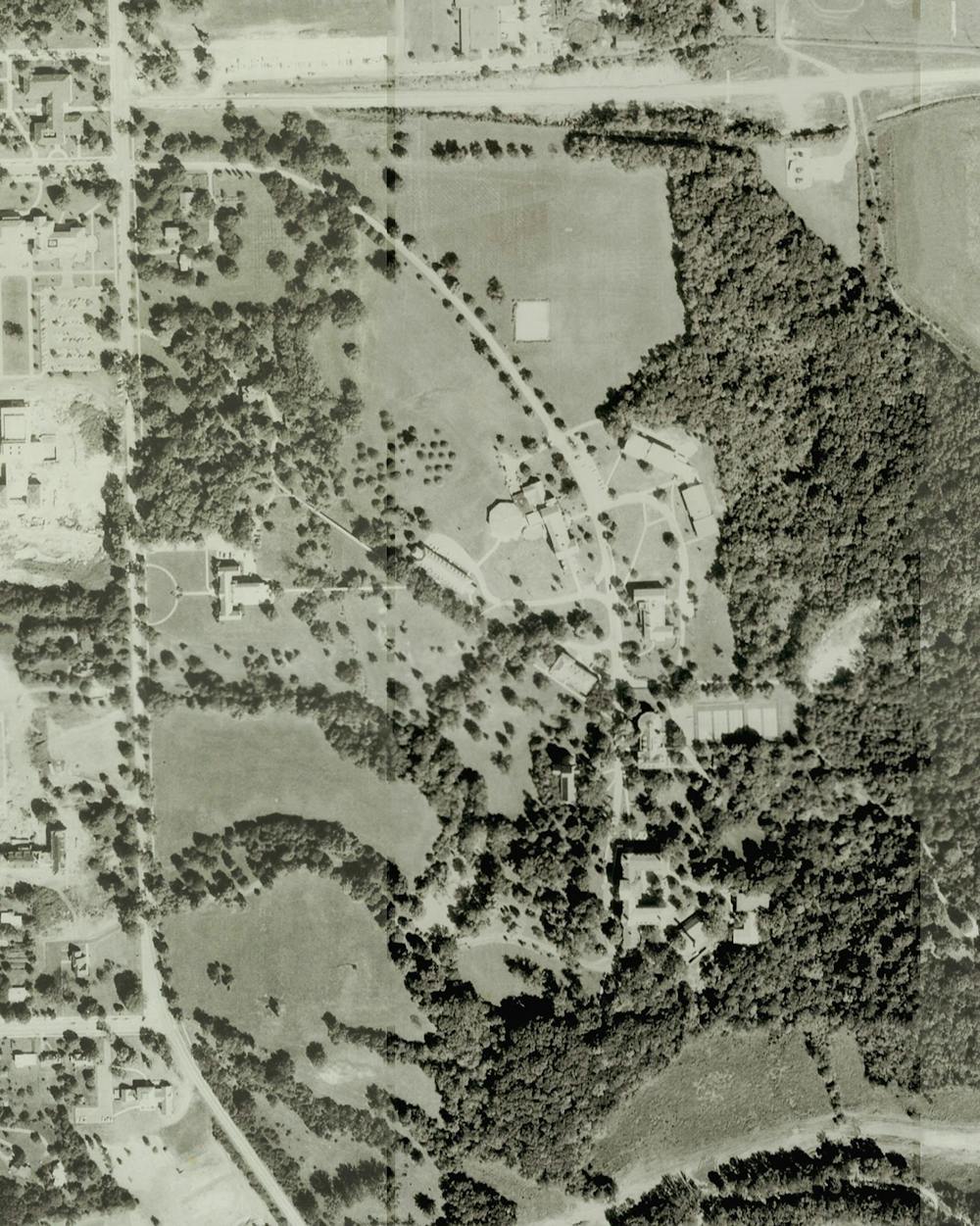
On Miami University’s Western campus sits a small duck pond that is over a century old. The bench at the bank of this pond provides a stunning view of Miami’s Western Woods. However, Miami’s woods didn’t always look as they do now.
In fact, there was a time when these areas didn’t look much like woods at all.
Western campus was once home to a working dairy farm, according to Miami Engineering Designer Rick Costello. This was when the area belonged to the Western College for Women, before Miami acquired it in 1974.
Similarly, Miami’s nearby Peffer Park also served a much different purpose nearly a century ago.
“There was a time when Peffer Park was cow pasture,” said Olivia Herron, Miami's director of sustainability. “This was maybe 100 years ago, but Miami was here, and Peffer Park was still farmland.”
According to Herron, these lands were donated to Miami and the university decided to use them for natural areas.
“Lots of people in Oxford, when they pass away, give their land to the university,” Herron said.
Costello said these surrounding areas are what contribute to Miami’s natural beauty.
“We're lucky to have the neighboring natural areas,” Costello said. “One of them is called Western Woods, and the other one is called Becks Preserve.”
However, some areas of Miami’s green space have shrunk over the years. Naturally, as the university has grown and developed, buildings and roads have taken up routes throughout campus.
“[Western campus, near Kumler Chapel] had a lot more green space than it has now,” Costello said. “[Miami] unfortunately developed some of it, but we tried to do it as tastefully as possible.”
Large trees can be seen dispersed around Miami’s academic and residential buildings, and maintaining forests remains a priority for the university.
Enjoy what you're reading?
Signup for our newsletter
Maintaining these woods has been no walk in the park, or rather walk in the forest, according to David Gorchov, professor of biology and chair of Miami's natural areas committee. From invasive species to deer overpopulation, Miami’s woods have seen their fair share of ecological challenges.
The Emerald Ash Borer (EAB) is a species of beetle invasive to North America that kills ash trees by burrowing into trees to feed. According to Gorchov, EAB were particularly damaging to Western Woods over 10 years ago, as the tree canopy is made up of 10-20% white ash.
"A lot of trees died around 2013 or so — this was kind of the peak when the ashes were dying,” Gorchov said. “The [EAB] came through and killed all of the ash trees, except the seedlings.”
Gorchov also said that high densities of white tailed deer have caused problems for Miami’s woods. Tree seedling loss has resulted primarily from the deer population, although invasive honeysuckle has contributed to this as well.
“Loss of tree seedlings has impacts throughout the community and harms important parts of native biodiversity such as wildflowers,” said Gorchov. “We're trying to restore it and keep it [a] useful place for Miami students and an attractive place for people to walk.”
Whether it’s a rest on a pondside bench, a long walk through the woods or even a game of frisbee golf, Miami’s green spaces are popular places for students and Oxford residents alike.
Contributed reporting by GreenHawks Editor Sarah Kennel
Read More
‘One letter at a time’: The Literary Focus shapes The Student
By Venezia McHenry and Gabriel Slark | 2 hours agoIt’s 1827, and students are in between classes or sitting in the student center on campus reading the paper. They’re not holding The Miami Student, though. Instead, they’re leafing through The Literary Focus.

The Miami Student is more than a club — it shaped the person I am today
By Abi S. Ankeney | 3 hours agoIn the warm fall of 2020, I stumbled my way to Miami University, green behind the ears, eager to get away from home and terrified of where I was going.

The Miami Student is more than a club — it shaped the person I am today
By Abigail Ankeney | 3 hours agoI learned these things because when I needed community, friendship and work to do, I found The Miami Student.