
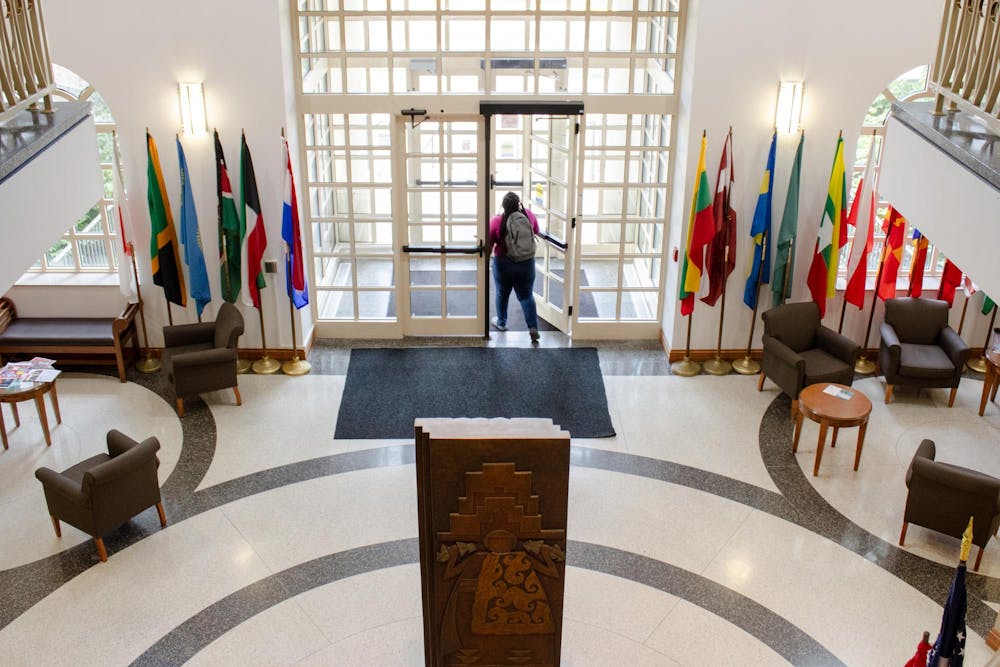
As students make their way to Miami University’s campus by car, train and plane from across the state and country each semester, a small number must return through the international immigration process.
“We have to go through the immigration officer, and they have to look at all our documents, make sure we're legal and able to enter the country,” said Gejla Toromani, a senior biology and pre-medical studies major from Albania.
Recently, as the Trump administration and the United States Immigration and Customs Enforcement (ICE) have expanded visa restrictions and increased the presence of ICE around the country, this stressful process has become even harder. According to NPR, ICE now has more funding than all other federal law enforcement agencies combined.
“A lot of us are scared that they're just going to stop us right there and deport us even though we've never done anything wrong,” Toromani said. “I know a lot of international students who did not go back home during breaks because they were scared that when they re-enter the country, [they might be stopped].”
These new regulations come as part of a larger series dating back to the first Trump administration. According to The Presidents’ Alliance on Higher Education and Immigration, new international student enrollment dropped 11.4% nationally from 2016 to 2019, due in large part to policies from the first Trump administration.
Miami was uniquely affected by these changes, especially in its large Chinese international student population. In 2018, the number of Chinese students peaked at 2,682 and then quickly started to decline. Today, only 214 Chinese students attend the university.
Enjoy what you're reading?
Signup for our newsletter
Before 2018, Miami’s international population was rapidly expanding.
“It grew and grew and grew for 10 years straight,” said Molly Heidemann, the director of international student and scholar services, “and the vast majority of that growth was among undergraduate Chinese students.”
At the time, there was a booming middle-class economy in China, and many students were traveling to the U.S. for higher education, according to the Center for Strategic and International Studies. But as President Trump began his first term in office and started enacting new policies, a decline began. This was only exacerbated by the COVID-19 pandemic, leading to widespread travel restrictions, especially from China, where the outbreak originated.
By the time the pandemic ended in 2023, China prioritized its own higher education systems, and the population of students that had once flocked to the U.S. did not return. According to the New York Times, Chinese schools are already near or above top research institutions in the U.S. on many international rankings. This drastic decrease in students has affected the university's budget.
“[The reduction in international students has] been one of the major factors in the decline of tuition revenue that the university generates,” said David Creamer, vice president for finance and business services and university treasurer.
Now, the second Trump administration has begun further regulation of international student visas. As reported by Forbes, the administration has threatened to eliminate programs such as Optional Practical Training, which allows students to work in the U.S. for one to three years after graduation, and a duration of status, which allows students to stay for their full time as a student, even if their program exceeds the traditional four years.
Broader immigration restrictions, such as travel bans, also affect international students.
“We have a little over a dozen students on campus from Iran,” Heidemann said, “and Nigeria is in our top five countries of international students.”
These bans make it much harder for existing students from specific countries, like Iran and Nigeria, to travel to the U.S., and impossible for new students from those countries to attend.
In recent months, according to TIME Magazine, ICE has detained and deported many international students with legal status, and while those officers haven’t arrived on Miami’s campus yet, students are still preparing for the possibility.
“We have to carry our passports with us at all times,” Toromani said. “It's definitely really stressful, and there's a lot of fear. There's definitely been emails where they told us not to protest, not to make any social media posts that relate to governmental issues or what's going on right now.”
Toromani had to renew her visa this year. She said it was much harder than before because the Department of Homeland Security went through all of her social media and had her declare which ones she was active on. This included making every account public.
This only adds to the existing struggles of being an international student, on top of taking classes in a foreign language to the isolation that comes from being separated from your family.
“Often people don't realize these are 18-year-olds coming to the other side of the world where they don't have a support system,” Heidemann said.
The future of Miami’s international program is cloudy, and it's hard to predict how enrollment will continue to develop.
“I'm not super hopeful that we're going to see increases,” Heidemann said. “Our biggest decreases have been in our Chinese population, and I'm hoping that we can sort of continue to build up some relationships in other countries where we can develop a little bit more of a recruiting pipeline.”
Despite the decrease in the amount of international students on campus, Heidemann emphasized the crucial role they play on campus.
“Our students are in many cases among the best and brightest; they're just fantastic students, and I think we are a better place for having their skills and knowledge here.”
Read More

Kent State eliminates Miami from the MAC tournament in a 3-1 pitchers duel
By Cooper Meneghetti | YesterdayThe Miami University RedHawks baseball team suffered a 3-1 defeat at the hands of the Kent State University Golden Flashes. The loss eliminated the RedHawks from Mid-American Conference (MAC) tournament title contention.
Huskies deal RedHawks first defeat of MAC tournament in a 15-inning marathon
By Cooper Meneghetti | 2 days agoRedHawks drop game one of MAC tournament to NIU
Board of Trustees approves Miami Plan changes, AI in majors and departmental mergers
By Shannon Mahoney | 3 days agoMiami University’s Board of Trustees voted to approve the Miami Integrated Learning Experience (MILE), the addition of AI across all majors, departmental mergers and increasing tuition and fees for the incoming cohort.