
A study released by the Center for Equal Opportunity, a national conservative think tank, alleging Miami University's admissions policy discriminates against white students is seriously flawed by its limited scope.
The study looks at race, standardized test scores and grades but ignores the nearly two dozen other criteria Miami uses to select students.
Miami publicly states that "potential contribution to diversity" is a criterion for admission, but not strictly in the sense of race.
Socioeconomic status and life experience can also bring diversity to campus.
By being overly exclusive in its inspection of selection criteria, the study clearly commits the fallacy of questionable causation and by doing so dangerously oversimplifies the issue of race at Miami.
Although the study clearly asks too few questions to arrive at defensible findings, the weight given to non-academic factors in the admissions process is concerning.
While this board understands the need to factor in things like extracurricular involvement or work commitments, this is an institution of learning and the bottom line for all applicants must be academic strength.
We recognize that the admissions process is subjective for a reason. Each applicant has a unique set of factors which predict whether they will be academically successful at Miami.
While the conclusions of this study are clearly flawed, it does leave unanswered questions.
The study alleges an imbalance in admissions opportunities, but the more visible imbalance of concern to this board is the lack of diversity in the current makeup of the student body.
Miami's percentage of black and Hispanic students is far below the general population and also other public universities.
Enjoy what you're reading?
Signup for our newsletter
As such, the university is clearly doing something wrong or at least not doing something right.
Miami's various stereotypes as a conservative, upper-middle class white campus clearly hurt our ability to attract a highly-qualified multicultural applicant pool.
Smaller issues such as the lack of a place in Oxford for black women to get a haircut may also play a role.
By the time admissions decisions are being made, it is much too late to be trying to get a diverse student body.
There are plenty of qualified multicultural students in Ohio and throughout the United States. Miami needs to do more to get them to want to come here.
Improving campus diversity cannot and should not be the responsibility of the Office of Admissions alone.
It should be the on the minds and reflected in the actions of all administrators, students and faculty.
Tax credits will empower Ohio students
Middle-class families are missing out on millions of dollars in tax relief for one of the most important investments they make, a college education for their children.
Ohio college students and their families can receive up to an extra $2,500 this year by claiming the American Opportunity Tax Credit.
Only 35 percent of qualified families applied for the tax credit last filing year. Ohioans missed out on an estimated $700 million by not filing, but it's not too late to claim this tax credit.
As college costs continue to rise, this extra money can provide additional support to Ohio families struggling to pay for college and empower Ohio students with the resources needed to out-compete and out-educate the world.
For more information, visit my website at www.brown.senate.gov.
A few weeks ago, Joshua Carpenter wrote two editorials on the perceived dangers Wikileaks poses to our civil liberties and to the security of the government. I responded to these letters, arguing that Wikileaks is a medium for us to learn about and to learn from our government. I argued that the leaks allowed us a clearer but still obscure picture of the people running the country and fighting our wars.
If what we have seen is any indication of the larger picture, then I demand more leaks. Indeed, I demand a truly open government.
Tuesday, in his latest editorial, he contends that an open government would lead to less privacy for its citizens. Though Carpenter ditches the talk of Wikileaks, his opinion is akin to conspiratorial ramblings of cable news anchors (some of whom have called for the execution of Julian Assange and Bradley Manning), and, like those anchors, he fails to recognize the numerous flaws in his own logic.
Let me be clear, I am one of the people in Carpenter's fairytale who have swallowed a sugarcoated pill of absolute transparency. According to him, I am someone who ignores implicit assumptions and I have a deeper goal than "simply changing corruption to honesty."
He is absolutely correct. I do have a deeper goal, but he is absolutely wrong in what those goals are.
First, I want to address a couple of the most glaring inconsistencies in Carpenter's arguments. He seems obsessed with the idea that the transparency is going to run amok. There will be agency after agency, code word for bureaucracy, formed to oversee transparency, and that will get out of hand.
What evidence does he have for such a claim? This position evokes imagery or conservative commentators when there is talk of a national health care system or some other progressive ideal.
One has to look no further than the Patriot Act, which, at the time of writing, looks like it will be extended again, to see that the government is already spying on citizens with the full support of the Congress. But this shouldn't be the case, for this is a world where, according to Carpenter's previously published opinions, governmental secrecy actually protects our rights.
His mixture of Orwellian and Randian dystopias seems to distract his view of what is going on in the world we live in.
Carpenter's analogy to the civil rights act (equal employment) fails because he tries too hard to find a flaw in a law that has provided very valuable protections for minorities in the workplace, and in the end he actually makes one up.
The act is meant to increase fairness, equality and oversight in hiring and firing. Carpenter should note that parts of this law are actually under question right now in the Supreme Court, and it could be stripped of some very important provisions regarding the rights of a worker to an unbiased review in the firing process.
He seems to believe that in a world where governmental transparency is real, a person can only be fired because of issues with that transparency. Or, rather, a worker can't be fired if they aren't performing well because he seems to believe that every single case of a person (in government, I suppose, it was hard to tell if he was referring to the larger public) being fired can and will be construed as racist, sexist or some another chauvinist bend.
Now, here is an alternative goal that I share with many, a government that is both totally open and totally run by the people that are most affected by it.
I think Carpenter and I can agree that governmental surveillance of citizens is totally self-serving, but the government that does this (our government) is run by a ruling class whose interests are entirely separated from the interests of the rest.
Corruption in government exists, it seems, to ensure that separation remains. An open government would expose that corruption at every level, in every branch and would provide for the formation of something totally different.
This is what those of us who have, according to Carpenter, swallowed the pill of absolute transparency want. We don't just want an open government, we want an open-source government, a participatory democracy.
We want a government that we control, not one that controls us. We want a government that serves everyone and doesn't give preference to a rich few. We want a government that is free of collusion with the capital hoarding enemies of the lower 99 percent of the socio-economic strata, a collusion that Carpenter seems to acknowledge. We want a government that will protect the rights of workers no matter their color, age, religion, gender, sexual orientation, ability or country of origin. We want a government where opacity is nonexistent, where transparency is the natural state.
Read More

Who’s who at MU: Head of special collections
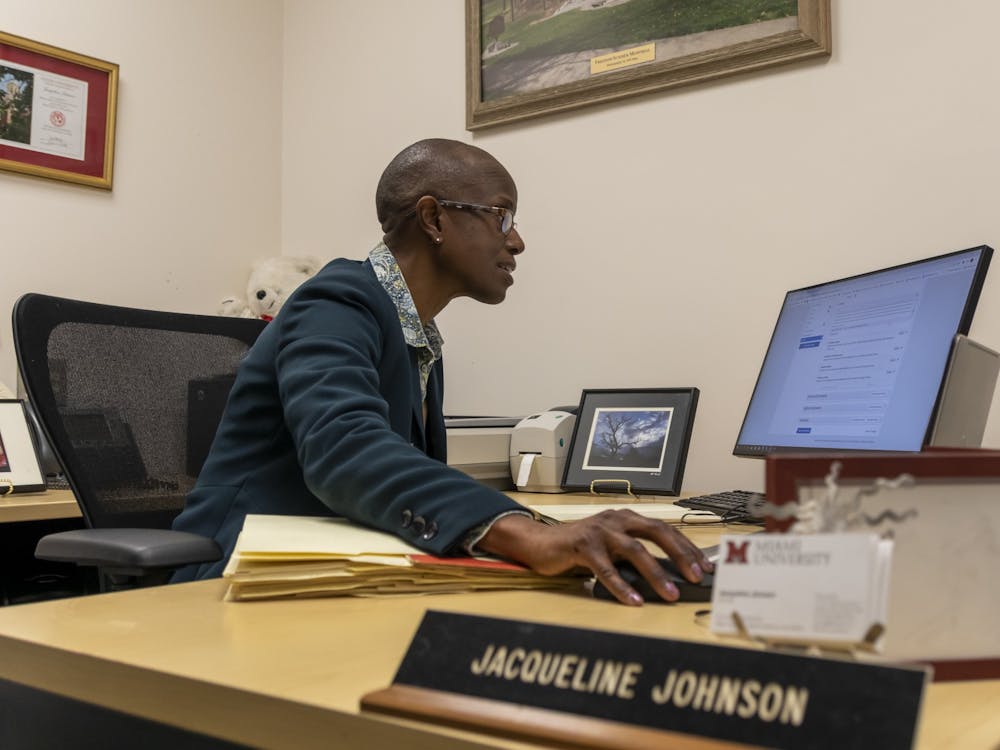
By Shannon Mahoney | March 6, 2026If you’ve ever wanted to learn more about Miami University’s past, research the history of Western College or find the first copy of The Miami Student, chances are you’ve ended up at the university archives, a collection of Miami’s 217-year-long history. Behind this complex collection, one woman is at the center of it all: Jacky Johnson, head of special collections and archives.
How one professor and her classes are preserving Oxford’s Black history
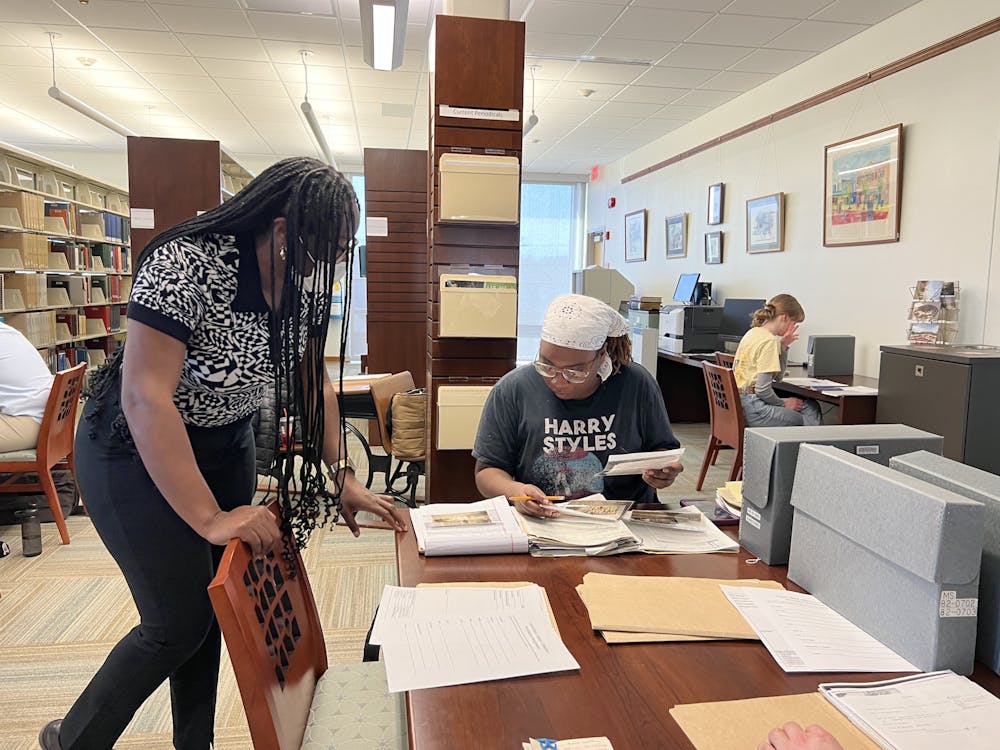
By Sean Scott | March 20, 2024Jazma Sutton, an assistant professor of history, teaches The Black Midwest (HST 350Q) and Black Women in America (HST 450D) classes. In both courses, she has students working with the Smith Library of Regional History and Miami’s archives to document and preserve Black history in Oxford.
Miami faculty members recount Freedom Summer in new documentary
By Luke Macy | February 25, 2022After seven years of work, “Training for Freedom,” a documentary highlighting Oxford’s involvement in the Freedom Summer of 1964, premiered on PBS Western Reserve on Valentine’s Day.