
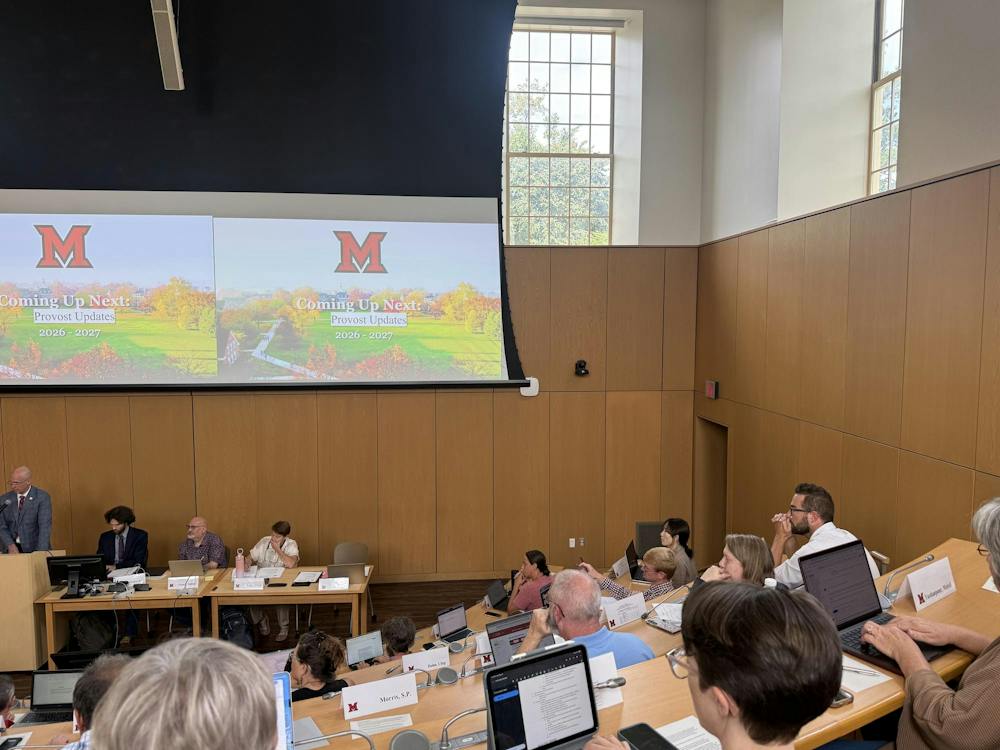
The University Senate discussed the Center for Artificial Intelligence (AI) at Miami, changes to the graduate council and student government updates in its meeting on Sept. 14.
Provost Trent Gould shared several institutional updates regarding technology and academic processes.
The University will end the 18-year-old competitive technology fee process to prioritize direct student technology support.
The fee was intended to provide technology opportunities that support students in their education.
“Participation in the tech fee process has significantly decreased, while costs to provide core services and technology have increased,” Gould said. “The competitive tech fee will end in order to ensure that we can continue to provide technology, including classroom upgrades, software licensing and IT support for student use.”
Dennis Cheatham, associate professor of graphic and experience design, proposed a Miami Center for Artificial Intelligence.
Enjoy what you're reading?
Signup for our newsletter
This proposal aims to support interdisciplinary teaching and research. The center plans to offer faculty support through curriculum development assistance, grant review meetings, professional development programming and industry partnerships.
Cheatham said this program could boost Miami as it continues to compete with other colleges and universities.
“When we lose students that don’t come here, oftentimes they go to Indiana University … Since 2020, [they’ve received] 60 million dollars in grants because of a concerted effort and a focused effort on AI,” Cheatham said.
Cheatham also clarified that this body would be advising, not making policies.
Senator Madelyn Detloff raised concerns about the conflicts of interest in funding the center.
“We might learn other things about AI that aren’t as lovely, like the impact on power grids and water tables,” Detloff said. “How are we going to maintain the ability to research this from an environmental or social science aspect if we are dependent on AI providers to fund the center?”
Cheatham said it will be important to focus on the ethical components and who the partnerships will be with in order to avoid those issues.
Senators also questioned the center’s future relevance, claiming the rapidly changing technology may change the need for this specific addition to the university.
Jason Abbitt, interim dean of the graduate school, provided an update on the graduate council.
The council is currently off its three-year term rotation due to previous vacancies. Abbitt proposed a two-year term for upcoming elections in order to realign the cycle.
Senators discussed whether representation should be adjusted to ensure widespread department leaders are included in the committee.
Carol Fabby, associate teaching professor of physics, introduced a project to modernize and clarify the University Senate bylaws and policies. The goal is to resolve inconsistencies across digital documents. Fabby proposed a target date of March 1, 2027.
Charlie Merrill, Associated Student Government president, addressed the senate with his first updates of the school year.
Merrill discussed the positive turnout from the recent Mega Fair and ongoing efforts to recruit more senators.
He also asked the senate for support in an upcoming event organized to encourage students to get off their phone.
“An idea that we had was to create a space where students can come, put their phones away, and just establish that eye-to-eye connection,” Merrill said. “Something that’s super valuable is long term relationships, because texting, Snapchat all goes away one day or another, so, stay on the lookout because we’d love to get as much support as we can for that event.”
The University Senate’s next meeting will be at 3:30 p.m. on Monday, Sept. 28, in the Joslin Senate Chamber.
Read More

The Battle for the Victory Bell games should continue
By Jamie Gowans | 3198 minutes ago"The most recent Battle for the Victory Bell, held in 2024, ended in an unfortunate loss for Miami University. It also happened to be the first college football game I got to experience."

Preview: RedHawks visit the Victory Bell one last time
By Graham Young | 16 hours agoThe rivalry will come to a close at 3:30 p.m., Sept. 19 at TQL stadium in Cincinnati, as the Miami University RedHawks (1-1) will face the University of Cincinnati Bearcats (2-0).

Meet the Columnist: Karma Abboud
By Karma Abboud | 6 days ago"While I still love creative writing, creating opinion articles for The Miami Student is not just a hobby or coping mechanism: It allows me to share my thoughts confidently with the Miami community."