
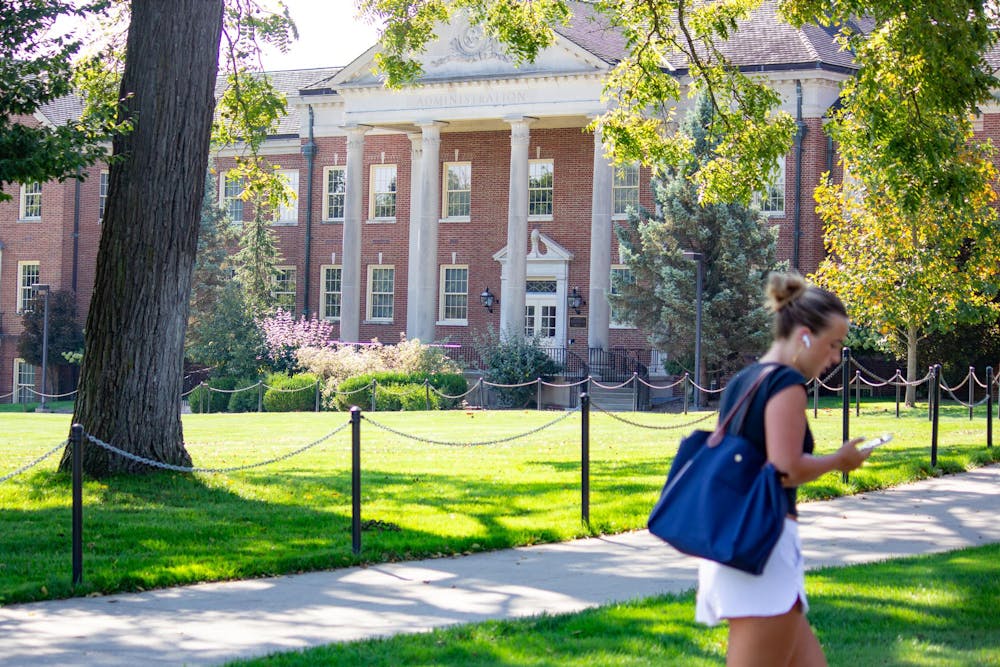
When Alex Fields joined Miami’s staff as Director of the Office of Community Standards in April 2024, she brought a philosophy of conduct that pulls back on fear and leans into collaboration with students through a holistic approach. Fields took the initiative to apply that philosophy by collaborating with Dean of Students BaShaun Smith and the Student Life Council to reform Miami’s Code of Conduct during the fall semester of the 2026-27 academic year.
The changes to the Code of Conduct are part of a large overhaul, as the Office of Community Standards reforms its process from something students once feared to a collaborative process meant to foster growth and understanding.
To Fields and Smith, these changes aren’t about giving students more leeway in their actions, but helping students in “understanding, internalizing, and acting on these values,” according to the revised Code of Conduct.
Those values are based on a statement adopted by Miami’s Board of Trustees in 2002, built around honesty, personal responsibility and respect for the rights of others.
New policies include two new violation categories, bullying (2.1.3) and fire safety (2.1.12), which were previously combined charges. They are now split apart, distinguishing destruction, damage or defacement of property (2.1.5) and theft (2.1.18). Legalistic language like ‘plea’ was also removed from the process in favor of mutual resolution in conflict.
However, some students are unaware the code changed.
“I didn’t even know it changed; it wasn’t really advertised,” Norah Daugherty, a sophomore zoology student, said.
With nine sections, including one exclusively for definitions, Fields and Smith want students to know what these changes mean for them and why they happened.
Before the new code was adopted this academic year, Fields says the document was complicated and contained terms that made students feel the student conduct process was more grave than it was.
“We used a lot of language, like asking students to tell us how they plead,” Fields said. “I wanted to propose a process that offered students a lot of autonomy and agency.”
That process involves finding compassionate solutions that focus on the student, giving them more say and influence on their conduct process. Fields said an example of this comes in how they’ll approach meetings with students after receiving reports. Before, students had no say in when these meetings took place.
“So in the past… if we had received a report and we wanted to talk to a student about what happened, we would assign a meeting time for them and say, ‘This is when you come in,’” Fields said. “Now, for example, we ask students to schedule meetings with us by using a link and taking into consideration their entire schedule.”
Enjoy what you're reading?
Signup for our newsletter
“We’re not doing something to students — we’re working with them now,” Smith said.
He said it was Fields who brought about the Office of Community Standards’ rebranding. Her experience and values made her stand out.
“When you’re hiring people, you want to look at someone that’s… student-focused [and] student-centered. Alex has been consistent with that in her career,” Smith said.
Fields brings experience from former positions at the University of Cincinnati and Western Carolina University, where she served as the director of student conduct and decreased student recidivism by 22%, according to an article on Miami’s website.
She also holds a background in social work that’s taught her to view the student and their behavior as separate. For Fields, holding students accountable is not a matter of punishment, but redirection with dignity.
“It’s a gift to be able to sit with a person when they’re at a crossroads in their life,” Fields said. “Most misconduct comes … because students are struggling somewhere else.”
Chase Stockton, associate director of the Office of Community Standards, completed the first mutual oral resolution with a student on Aug. 26. Though there’s not yet enough data to prove the changes are effective, but Fields and Smith said the new student conduct process is significantly faster and less nerve-wracking.
“The cases [previously] took forever, in my opinion,” Smith said. “You’re nervous; in fact, you’re not focusing on the number one reason for being here.”
To track success, the office will monitor how long cases take to process. Their target is 15 days or less. In the end, though, the office has attempted to change their process from punitive to compassionate.
Fields and Smith encourage anyone with questions to reach out to them.
“Don’t be afraid. This is not the principal’s office by any means,” Smith said.
Read More

Rejecting minimalism: It’s okay to hold on to sentimental things
By Layla Norris | 4 hours ago"Yet a huge difference lies between maximalism and messiness. Maximalism is about intentional clutter: Filling a space with colors, patterns and memories cultivates a personalized place of belonging."

TMS Culture Class Outfits
By Layla Norris | 4 hours agoThe most stressful part of a day can be deciding what to wear. You need something practical while still looking put together and somewhat stylish.
