
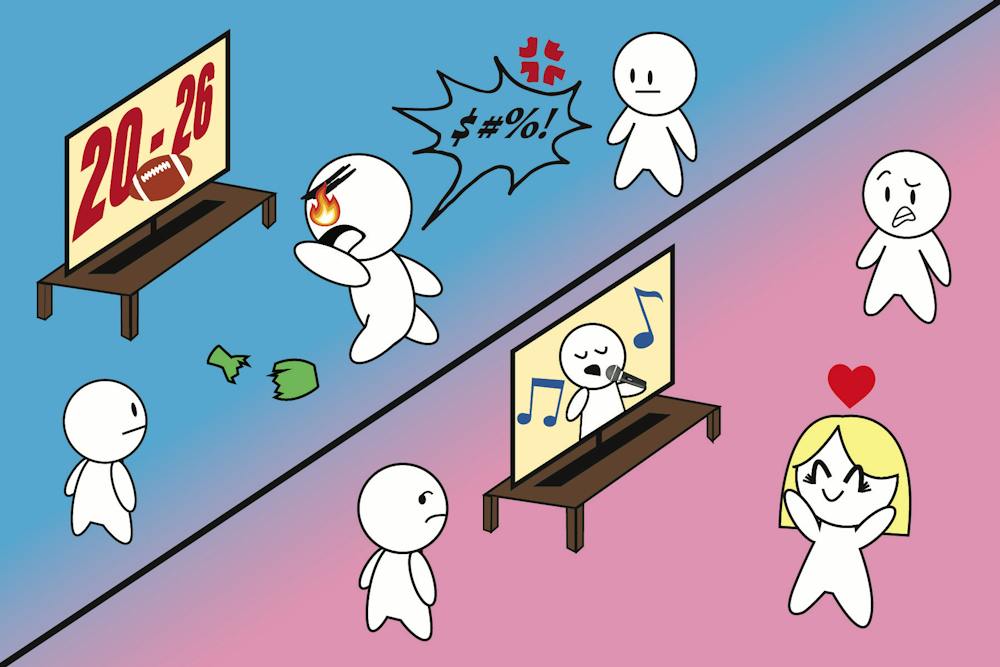
Everybody is a fan of something: movies, books, bands, games and teams. It becomes a hobby, a lifestyle, a piece of self-identity.
With every fan base comes a stereotype about them. Football fans are passionate; they never miss a game, have countless jerseys, watch old highlight reels and even bet money on the outcome. This is accepted as normal behavior.
Bands typically also have notorious fan bases. Specifically, boy bands are known for having predominantly teenage girl fan bases. These women are also passionate; they buy merchandise, watch interviews on YouTube and spend up to thousands of dollars on concert tickets.
However, these similar fandoms have extremely different connotations.
In fact, the word fandom itself shows this difference. A fandom is any subculture of people who share the same interest. Throughout time, this word has become synonymous with “crazy” female fan bases, who are obsessed with a pop band or a singer.
Young women have been ridiculed for decades simply because they’re fans. They are looked down upon for liking Taylor Swift, One Direction or Beyoncé. Yet they are typically not doing anything problematic.
On the other side, male sports fan bases rarely receive this kind of publicity. Yet the news shows significantly more sports celebrations turn violent than any female crowds celebrating their favorite singers.
Last summer, the New York Knicks won the NBA championship. Times Square rampaged with celebration, which quickly turned into violence. School buses were set on fire and beaten with bats, and a 17-year-old boy was shot in the foot, according to CBS News. The New York Police Department said 63 people were arrested, and 10 members of their department were injured.
This is just one example of sports-related violence. Most of this violence is caused by men — research from Silicon Valley Sociological Review shows that competitive sports stimulate violent urges, especially in young men. Sociologists found correlations between violent sports and “sexual aggression,” and “various sports are associated with the common theme of violence.”
This violence does not just include vandalism — it infiltrates the homes and lives of other people as well. After a team loses, domestic violence between intimate partners increases. Research published by the National Library of Medicine shows that after a team experiences an unexpected loss, at-home violence increases by 10% between men and their female partners.
There is no data found about female fan bases increasingly facilitating domestic or any physical violence after their favorite artist lost an award show. Their reactions usually consist of online feuding and harassment posts, but not violence.
There are however instances of female fan bases causing harm to society. On “stan Twitter,” harassment is not unheard of. After Billie Eilish lost at the Grammys in 2025, her brother Finneas told fans to “be at peace.”
Enjoy what you're reading?
Signup for our newsletter
“I don’t wanna see ANYONE with a photo of me or Billie as their [profile picture] gettin’ in fights with other artists’ fans in comment sections!!!” Finneas posted on Instagram.
There is bullying, death threats and “doxxing,” where someone will publicly expose an individual’s private identifiable information without their consent. This behavior should not be excused — but it also should not define every women-dominated fan base. Nor should we ignore the violence and disruption caused by male sports fan bases.
Why can men slip free from societal judgement, but every movement of young women is scrutinized? These girls are not ridiculous or hysterical — at least, not any more than their male counterparts are.
Being a part of a fan base provides a sense of belonging and community. It becomes part of who we are. This passion should be able to roam freely within societal standards. Yet the restraints on those standards should be the same for every person, no matter their gender.
At the same time, society must remove the negative stigma around female fan bases, but raise awareness around the undesired actions from male fan bases. Nobody should feel ashamed to admit what they like for fear of being looked down upon.
Layla Norris is a sophomore double majoring in political science and professional writing, with minors in history and human capital management and leadership. Alongside writing for The Miami Student, she is involved with Kappa Alpha Pi and RedHawk Radio.
Read More

The lost art of creating art
By August Humphrey | 1 hours agoThe guidelines for creating art only get stricter as we get older, and dictating what is or isn’t art can be costly for everyone.

Historic Power Four vs Group of Six rivalries
By Devin McCartin | 23 hours agoThe Miami-Cincinnati rivalry used to be between two Group of Six teams, but has since become a Power Four vs. Group of Six matchup. There are a few other notable rivalries in this same vein that have similar tensions.

Becoming an adult when everything’s so expensive is a nightmare
By Eliza Sullivan | Yesterday"Many people are rightfully upset with the economy. But just being frustrated is not a plan of action."