
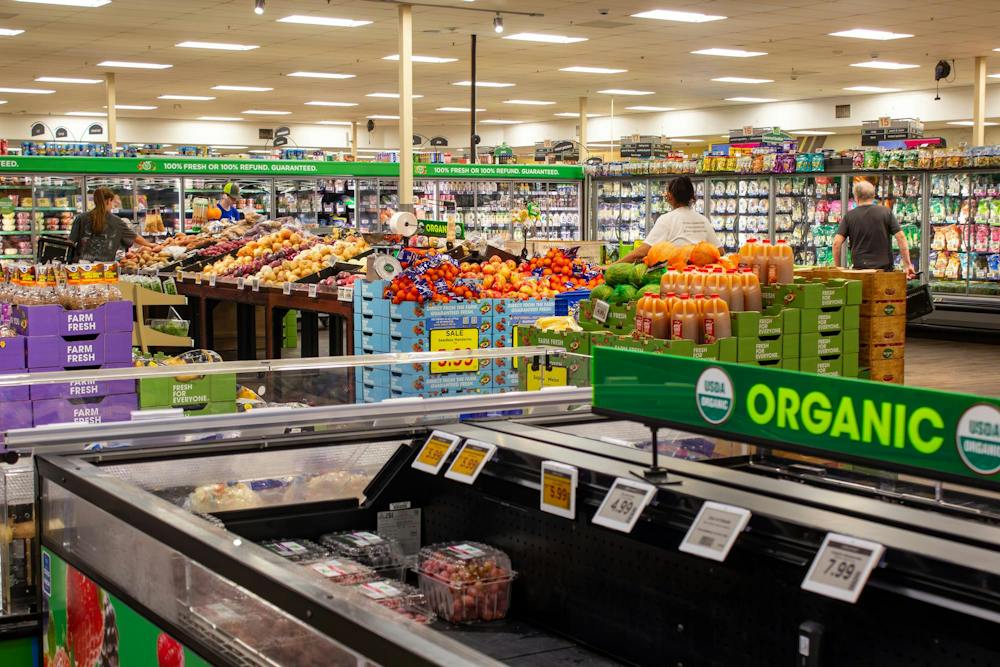
As a kid, going to the grocery store with my mom was an opportunity to beg her to buy fruit snacks and ice cream. This year, when we went on our annual back-to-school grocery stockpiling quest, it felt different.
At least a dozen times during our shopping trip, I heard her repeat something I’ve heard every adult in my life say these past few years: “Wow, everything is so much more expensive than it used to be.”
According to data from USA Today, food is now 34.8% more expensive than it was in January 2020. According to the Associated Press, the rise in grocery prices since the pandemic is the largest increase in 50 years, caused largely by the pandemic itself, tariffs, avian flu, geopolitical conflict and climate change, combined with reluctance from producers to lower prices once they’ve risen.
This increase in food prices means that some people simply can’t afford to eat. According to the U.S. Department of Agriculture, 13.7% of households were food insecure in 2024, an increase of 3.5% from the historically-low food insecurity rate of 10.2% in 2021.
Even those who can afford food are negatively impacted by rising grocery prices. According to an AP-NORC poll, in 2025, 53% of survey respondents said the cost of groceries was a “major source” of stress in their lives.
It’s not just food prices that are rising (although, as a hungry college student, these are definitely the price increases I feel the most acutely). According to data from OCity, the cost of living in Cincinnati increased 8% from 2021 to 2026, with housing prices increasing 10.5% during the same time.
At Miami University, in order to afford the cheapest meal plan and dorm, a total of $7,220 per semester for the 2026-27 cohort, an undergraduate student would have to work the maximum allowed 22 hours per week every week of the semester at a rate of $21.88 per hour. According to Miami’s student pay zones, the highest rate an undergraduate can be paid is $14 per hour.
Even as the cost of living increases, wages do not. Ohio’s minimum wage is $10.45 an hour and increases annually with inflation, which is much higher than the federal minimum wage of $7.25 an hour.
However, Ohio’s minimum wage is still significantly below the $15 that the Fight for $15 movement has been pushing for as a livable minimum wage since 2012. $15 in January 2012 is equivalent to $22.10 in July 2026, according to the U.S. Bureau of Labor Statistics.
This economic squeeze causes widespread pessimism. A 2025 Pew Research Center survey showed that 74% of Americans believe that today’s children will be worse off financially than their parents were.
I see the effects of this economic anxiety in my peers: My fellow humanities majors joke about not being able to find jobs after graduating, people online say just paying rent makes them feel like they’ve been irresponsible with their money and my friends discuss someday owning a house as a far-off fantasy, the same way we used to talk about becoming pop stars or astronauts when we were little.
These issues aren’t just limited to young adults. This year, 55% of Americans said their financial situation was deteriorating, a percentage that has been increasing since 2021, according to a Gallup poll.
Enjoy what you're reading?
Signup for our newsletter
The “American Dream” — a nuclear family, stable job, homeownership and retirement — now seems like a ghost of the past.
Many people are rightfully upset with the economy. But just being frustrated is not a plan of action.
We should be demanding real action from our elected representatives to reduce the cost of living. Policies such as expanding the Supplemental Nutrition Assistance Program, raising minimum wages, encouraging affordable housing developments and lowering tariffs that drive up the cost of essential goods are key steps policymakers can take toward making a real difference in the affordability crisis, according to the Urban Institute.
We can also organize our communities and workplaces to demand better pay. Historically, unions lead to decreased economic inequality, according to the National Bureau of Economic Research. Here at Miami University, we can support unions like the Faculty Alliance of Miami, which often holds demonstrations that are open to all.
In the meantime, to anyone reading who remembers when prices were lower, stop telling younger people about it. We’re tired, and honestly a little jealous.
Eliza Sullivan is a junior studying international studies, Russian and data analytics. She writes for the Opinion section of The Miami Student, is a managing editor for The Miami Student Magazine and is president of Model Arab League.
Read More

‘Film bro’ movies that are actually worth your time
By Layla Norris | 3318 minutes agoWe all know that guy who calls movies “films,” says he is going to the “cinema” and refuses to watch an animated movie. Pretentious men who look down at us common movie watchers have fueled this “film bro” stereotype. Here are typical film bro favorites that are actually worth watching.

FAM frustrated as negotiations with university drag on
By Shannon Mahoney | 23 hours agoThe Faculty Alliance of Miami (FAM) is still bargaining for a new contract after nearly six months of ongoing negotiations.

Finding Miami’s AEDs shouldn’t be a scavenger hunt
By Vedika Kaushal | Yesterday"We don’t keep fire extinguishers around because we expect our buildings to catch fire every Tuesday. We keep them around because if something does happen, waiting for someone else to arrive is not much of a plan."