
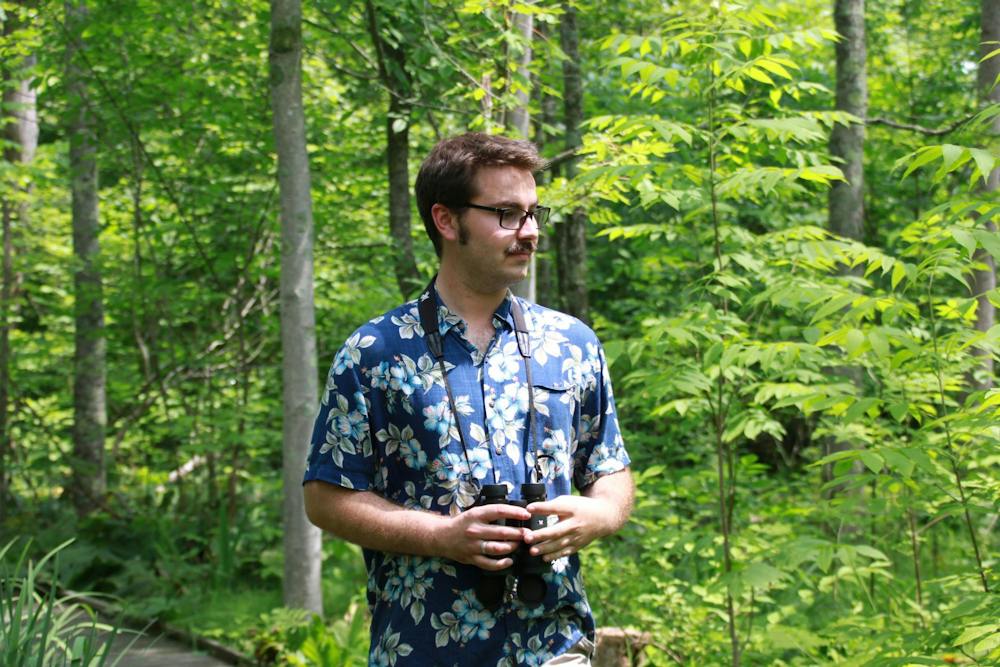
At the beginning of the year, Harrison Shupe set a goal: to observe and identify 200 unique bird species in Ohio before Dec. 31. On Aug. 31, he found his 201st.
Shupe, a first-year masters student in the Department of Biology, only began studying the invasive European starling this fall, but his interest in birds has been a lifelong passion. He was inspired to stretch his birding skills by having a “big year,” a popular challenge among birders, in which the goal is to find as many unique birds as possible within a defined geographic region in the span of a year.
“I’ve been bird-watching for the last couple of years, and really the only major difference is that I was more focused this year,” Shupe said. “If I typically go bird watching in a certain wildlife area or park, I’m seeing the same things there. I’ve diversified where I go.”
To help him find new birding spots, Shupe used eBird, an online citizen science platform from the Cornell Lab of Ornithology where birders can share their sightings at different locations.
“If I see that someone saw a peregrine falcon at this park and I’ve never been there, I’m gonna go check that out,” said Shupe. “Then I have a better chance of seeing that new bird that I don’t have as well as seeing a park that I’ve never been to … Now I’ll get notifications of a rare bird being seen in an area, and I’ll go try to chase that if it’s something I’m compelled by.”
Shupe achieved his goal when he found a Baird’s sandpiper, a small migratory shorebird, in a flooded field in Preble County. On the same outing, he found birds 201 and 202, other species of sandpiper.
“It was funny because … people were [reporting] seeing that species in this spot 20 minutes from here for a week,” said Shupe. “I just gotta go up and see if I can see it. The moment I stopped the car, boom, there it is.”
Harrison Shupe may have seen his 200th bird, but he’s not done with his “big year” yet.
“I have had a couple nemesis birds this year,” he said. “One of them is a yellow bellied flycatcher. They are fairly common in migration, but I have yet to see one ever, actually. That would be a life bird for me. I’m hoping to see one at Hueston Woods this fall.”
Hueston Woods is an excellent place for Miami students to look for birds. Shupe volunteers with the Avian Research and Education Institute (AREI), a local non-profit that runs a bird banding station in Hueston Woods.
“Our mission is to protect and conserve avian species through research, education and advocacy,” said Jill Russell, a retired Miami University professor and the executive director of AREI. “As part of AREI’s mission, bird banding sessions and other bird-related events are open to the public.”
Russell also said the outreach has expanded to engage further audiences through filmmaking.
Enjoy what you're reading?
Signup for our newsletter
“We work with a documentarian who just produced a documentary a year ago on our banding station activities and the community conservation around it,” she said. “He’s previewing his next documentary, which is about our partners in Ecuador and putting up the modus tower [to track birds]. That will preview the last week of September.”
Russell estimates around 16 undergraduate students are currently conducting research projects with AREI. She said she welcomes any curious students to attend events, check the events page or email her at jillrussell@avianinstitute.org.
“Come, reach out and come see what bird banding is all about,” she said.
Students can also find support and community with the Miami University Audubon Society (MUAS). Anyone can join the club to play bird trivia, learn from guest speakers, go on field trips to find birds and help conserve their natural environment.
“With bird club, we get people from all over the map of experience,” said Michelle Baker, MUAS president and senior biology student. “What I love about our community is that it’s never focused on comparison. It’s focused on connection, and I think learning from one another is one of the best ways to build community … and one of the best ways to build new skills.”
Miami Audubon Society meets every other Friday in Shideler Hall.
Finding 200 birds is quite an accomplishment, but Shupe also found a community in birding.
“There have been many instances where I just ran into someone and introduced myself and they’re like, ‘Oh, I recognize you from eBird,’” Shupe said. “Use the resources that are out there, and don’t be afraid to meet new people.”
Read More

Finding Miami’s AEDs shouldn’t be a scavenger hunt
By Vedika Kaushal | Yesterday"We don’t keep fire extinguishers around because we expect our buildings to catch fire every Tuesday. We keep them around because if something does happen, waiting for someone else to arrive is not much of a plan."

Excused absence, but at what cost: How minority religions celebrate
By Parker Green | YesterdayFor students of non-Christian faiths, holidays don't often fall on school breaks.

A rivalry close to home: Grant Lyons reflects on Battle for the Victory Bell
By Jacob Light | 2 days agoFor Miami University senior defensive lineman Grant Lyons, the Battle for the Victory Bell has always been close to home.