
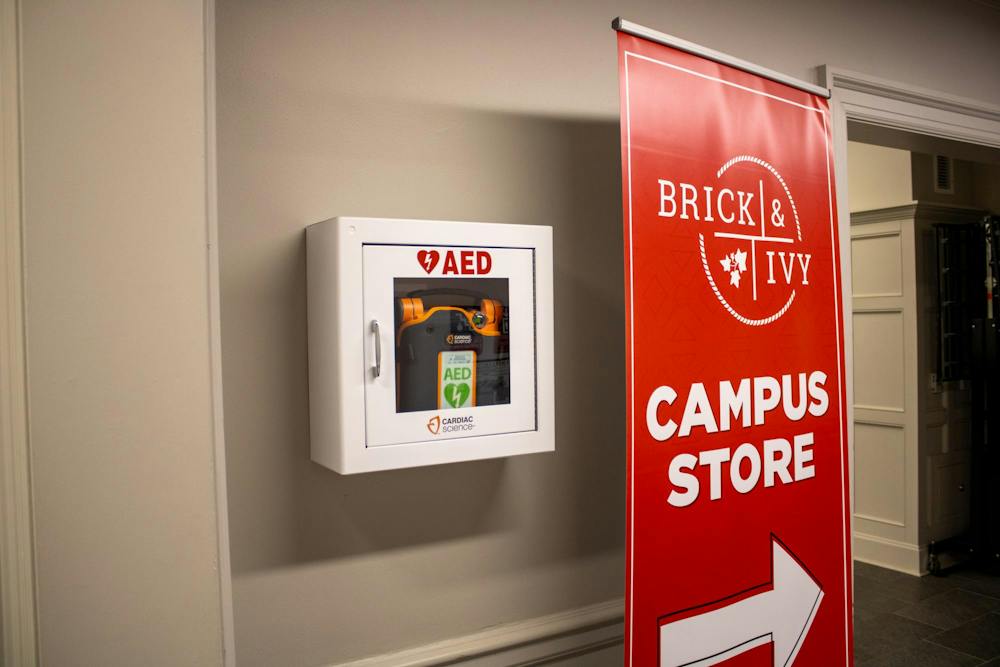
During the second week of classes, I was talking to my friend Olivia about settling into Miami University as first-year students when we got onto the topic of first-aid, CPR and automated external defibrillator (AED) training. We’d both gone through training back home, so we talked about how strange it felt to know what to do in an emergency but not really knowing what resources we’d have around us.
That got us wondering: Where are the AEDs at Miami? I realized I had no idea.
AEDs are those machines mounted on walls around campus. They can deliver an electric shock during certain cardiac emergencies. But knowing how to use one only helps if you can actually get to one when you need it.
And I understand why Miami doesn’t have them everywhere.
As The Miami Student reported in April, Miami uses a risk-based approach to AED placement. Residence halls are considered relatively low risk because the people living in them are generally young. AEDs are instead placed in locations such as police cruisers and emergency response vehicles.
The logic makes sense. College students are young, and sudden cardiac arrest is rare among us. But “unlikely” and “unnecessary” are two very different words.
A nationwide study of NCAA athletes from 2002 to 2022 found 143 cases of sudden cardiac death among 1,102 deaths studied. According to the American Heart Association, sudden cardiac death was the most common medical cause of death among the athletes studied.
Our caffeine habits are worth considering, too. A 2026 American Heart Association scientific statement found that while moderate caffeine consumption is generally safe for most adults, higher doses, particularly those found in energy drinks, can raise blood pressure and contribute to abnormal heart rhythms.
That does not mean Miami students are walking around one energy drink away from cardiac arrest, but our age does not make serious medical emergencies impossible.
This is not an argument that every student consuming caffeine is putting themselves in cardiac danger. It is simply a reminder that “young” does not mean “nothing can happen.”
I think the case for accessible basic first-aid kits is even easier.
Students get hurt. We play sports and pickup games. We bike around campus, cook in dorm kitchens, fall, burn things and occasionally make decisions that seemed much better five minutes earlier.
Enjoy what you're reading?
Signup for our newsletter
NCAA data covering 25 sports recorded 3,183 severe injuries over six academic years, according to a 2017 study. It defined a severe injury as one that kept an athlete out for at least 21 days or ended their season.
Most Miami students aren’t NCAA athletes, obviously, but a first-aid kit is not unreasonable to have around. Bandages, gauze, antiseptic supplies and other basic materials could be useful long before an ambulance is necessary.
I don’t think Miami needs to put an AED in every residence hall just because it would be nice to have one. The university is probably right that cardiac arrest is rare among students. But emergency preparedness is a strange thing to measure by how often something happens.
We don’t keep fire extinguishers around because we expect our buildings to catch fire every Tuesday. We keep them around because if something does happen, waiting for someone else to arrive is not much of a plan.
Maybe the answer is more strategically placed AEDs, better awareness of where existing AEDs are and basic first-aid kits in every residence hall.
We may never need to use them, but if something does go seriously wrong, students should not have to wonder where to look or whether the tools to help are somewhere across campus.
Miami should have a better answer.
Vedika Kaushal is a first-year student studying political science and economics. She is an aspiring journalist and international relations researcher. She spends time reading research on the politics of India and the Middle East. Beyond academics, she enjoys reading poetry, playing chess and finds joy in the kitchen.
Read More

Sports movies that make you feel like part of the team
By Ren Chaffee | 2894 minutes agoIf you’re like me, you don’t always understand the appeal of watching sports. However, if you still want to be involved in the feelings that sports promote, I recommend watching a good sports movie.

Excused absence, but at what cost: How minority religions celebrate
By Parker Green | 22 hours agoFor students of non-Christian faiths, holidays don't often fall on school breaks.

Game day diets: foods and sports associations
By Ren Chaffee | YesterdayEating food and watching sports go hand in hand. While you are sitting back watching athletes work up their appetites, you might as well join in and get a snack.