
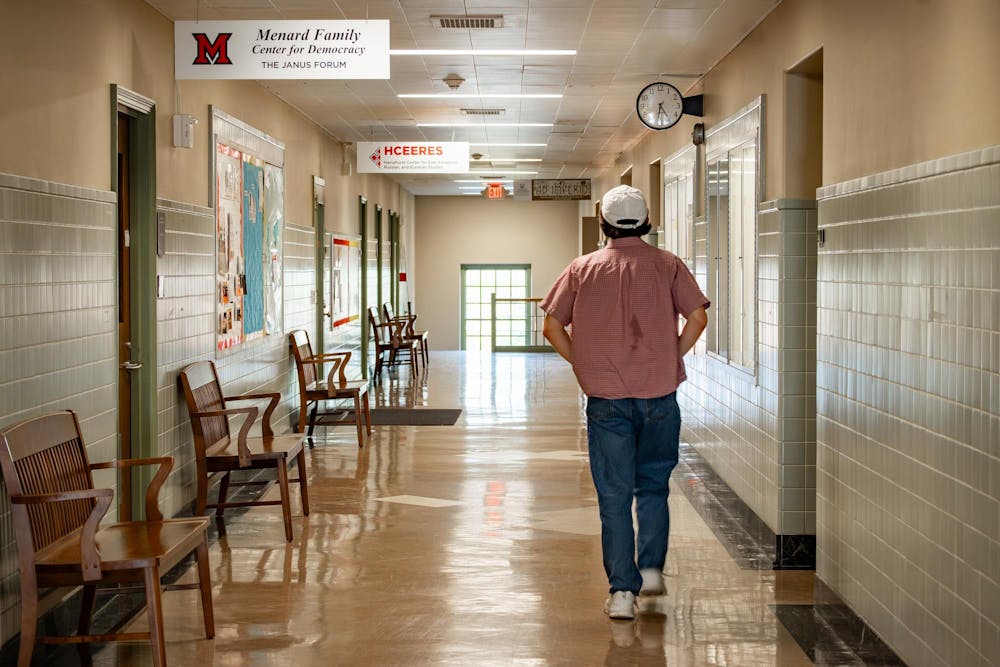
Less than two weeks after it began offering courses, Miami University’s Center for Civics, Culture and Society is facing a potential restructuring from the same body that created it.
The center was created to fulfill a legal mandate from Ohio Senate Bill 117 (S.B. 117), which required all public colleges in Ohio to establish a center for nurturing civic thought. The center hosts events, conducts research and fosters a dialogue related to the historical ideas that have “shaped American constitutional order,” according to their website. The center’s main role is teaching three courses, with curriculum that has been scaffolded by S.B. 117 and Senate Bill 1 (S.B. 1).
Now, however, that curriculum may be subject to change, as proposed legislation in the Ohio General Assembly seeks to give university civics centers more autonomy.
Senate Bill 461, which was proposed by Senator Jerry Cirino, would give the civics center power to make their own curriculum, hire and fire professors and determine their salaries. The bill would also turn the civics centers at the University of Toledo and Ohio State University into their own academic colleges. Miami’s center, which is the largest center by volume, would not become a separate academic college.
On paper, this bill will give the civics center more breathing room from being hampered by the state legislature, especially after last year’s extremely controversial S.B. 1 (which Senator Cirino also introduced) placed several restrictions on how universities can teach “controversial subjects.” In practice, though, government interference on coursework can be relatively minor.
“The thing the state government requires is that students pass a test and that we teach certain foundational documents … Nobody is telling me what to teach,” said Matthew Arbuckle, a professor of one of the new civics courses and a professor of political science.
Right now, the bill manifests itself in two central requirements: maintaining a politically neutral environment and uploading a syllabus. The latter, which the bill describes as a “simple syllabus,” requires professors to upload a version of their syllabus to a unified platform. This requirement applies to all Miami courses, and Arbuckle said he had no issues.
“I teach a ‘policies in climate change’ class, so I wasn’t afraid to upload [my syllabus].”
Where things get more complicated is the requirement to stay politically neutral. According to S.B. 1, professors taking a stance on any “controversial issue” is illegal, and climate change is on that list. This has raised concerns statewide, but Arbuckle says the vagueness of the law has made enforcement difficult.
“We’re not supposed to teach controversial topics, but what does that really mean,” he said.
He also said he is not particularly concerned about government backlash given that he presents classroom material in a neutral way.
“I’m not trying to proselytize,” Arbuckle said. “I’m just not that kind of person.”
Enjoy what you're reading?
Signup for our newsletter
While it is too early in the semester to get a full picture of the student perspective, many students in the civics course said that it just feels like a normal class, at least so far.
“I didn’t know the class was required by state law until the first day,” said Ali Girk, a first-year undecided major in American Government and Civics, one of the new civics courses.
“At least from what I’ve seen, my professor doesn’t feel any pressure to make the class a certain way,” Girk said. “She seems pretty able to teach what she wants.”
While S.B. 1’s policies remain largely dormant at Miami for now, the application of these policies is subject to change. The upcoming gubernatorial and state legislatures elections have potential to lead to changes in higher education, with gubernatorial candidates on both sides laying out several new ideas for administrating Ohio’s colleges.
Miami University’s Center for Civics, Culture and Society declined to comment on this story because of the pending legislation.
Read More

“The heart of Hepburn”: Building Grounds Associate dedicates 24 years to Miami
By Zoee Robinson | 1 hours agoOn the first day of the 2026-27 school year, Kimberly Durham celebrated nearly two and a half decades of service at Miami University – 24 years on Aug. 24, to be exact.

Oxford police cite underage drinking, fake IDs and warrants
By Austin Smith | 4 hours agoBetween Aug. 24 and Aug. 31, police officers responded to 33 incidents, according to the Oxford Police Department report.