
As the Miami University RedHawks kick off another football season, Miami sustainability advocates are making plays of their own.
With waste management in mind, Miami is working to minimize and correctly dispose of waste generated at Yager stadium.
Food waste reduction is an integral part of this. According to Geno Svec, senior director of dining services, this is an area addressed by dining services’ Concessions Division which works to sell all prepared food and reuse anything left over.
“[Following sporting events,] any remaining unserved, prepped food that meets strict food safety, temperature and [Hazard Analysis Critical Control Point] standards is moved to the dining commons,” Svec said in a statement to The Miami Student. “These items are then integrated into daily dining hall menus rather than discarded.”
Another part of minimizing food waste from Yager is anticipating fan turnout.
“Weather plays a major role in guest purchasing behavior,” Svec said. “We closely track local forecasts leading up to game day to adjust our concession inventory, prep levels and menu offerings accordingly.”
While Dining Services handles concessions, Miami’s sustainability department looks at the trash and recycling generated in the stadium.
“[We] try to collect data and have an understanding of the amount of waste generated in athletics and then continue to use that data to advocate for better waste practices during the games,” said Olivia Herron, director of sustainability and adjunct professor of sustainability.
This data collection is done in the form of waste audits. Although waste audits have been performed at other sporting events, such as basketball games at Millett Hall, a home game this November will be the first audit at Yager stadium, with the exact date to be determined soon.
With this waste audit, Miami will be participating in the GameDay Football Zero Waste Touchdown Challenge. This competition requires colleges to submit the amount of recycling, food organics and trash collected at a home game. Winners will be determined by recycling rate, diversion of food waste and food rescued.
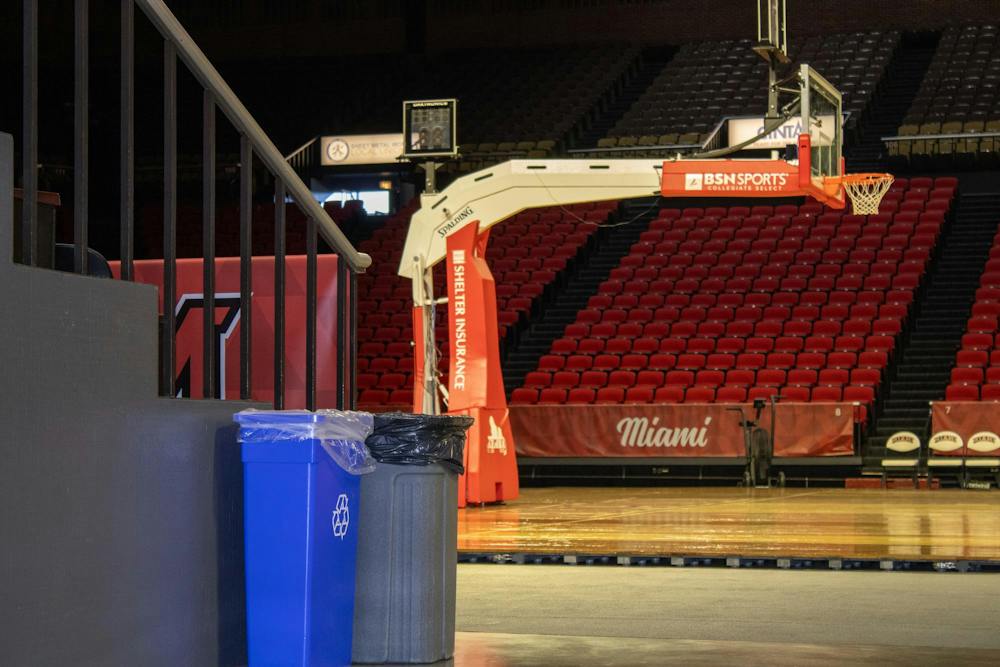
In addition to contributing to the challenge, sporting event waste audits are helping inform the type of waste infrastructure needed for the new sporting arena being built on Cook Field.
“We definitely noticed in Millett that the trash cans were a little bit small,” Herron said. “If the trash cans got completely filled, then we were observing people starting to put their trash in the adjacent recycling bin, which is a huge problem with contamination.”
Enjoy what you're reading?
Signup for our newsletter
As arena plans developed, Herron began working with other staff members to prevent this issue in the new design.
“I have already been having meetings with the campus architect about the new arena,” Herron said. “We [can] make sure the bins are big enough [so] that we avoid that problem.”
However, athletics is just a portion of Miami’s waste reduction efforts.
According to Herron, Miami is working with the national organization Post Landfill Action Network (PLAN) to develop a comprehensive waste reduction plan. PLAN also runs the Atlas Fellowship for students.
“[The Atlas Fellowship] is meant for students to be trained to collect data and then ultimately develop a waste reduction plan for a college campus,” said Herron.
Two of these Atlas Fellows are master of environmental science students Shannon Albert and Will Sayner.
The Atlas Fellowship is broken down into three stages: Atlas Zero Waste Certification, Strategic Visioning and Action Planning that last a total of five semesters.
Albert and Sayner are currently in phase two of the program, which highlights the importance of education, but also infrastructure changes for effective waste management.
“People come from different states where they have different standards,” Sayner said, “so you can’t expect people to know what to do [with waste].”
With this in mind, Sayner and Albert are aiming to construct a plan that will help people on campus navigate these often confusing standards.
“A big focus of the Atlas project [and] the emphasis for what our recommendations will end up being is on infrastructure — making proper waste management the most convenient and obvious option for patrons,” said Albert.
Once completed, the Atlas Fellows hope this comprehensive waste reduction plan will have lasting impacts on Miami’s entire campus, sporting facilities included.
Read More

History of the Battle for the Victory Bell
By Cooper Meneghetti | 22 hours agoDriving south on Ohio State Route 27, drivers are transported from the endless cornfields of Oxford to the urban skyline of Cincinnati. For 138 years, it has served as the causeway for Ohio’s most storied feud.

Bring the Bell home: RedHawks need you in Cincinnati
By Zoe Fleischer | YesterdayFew things in sports are worse than empty stadiums, even venues with a lot of fans rooting for the other team. Students should travel to pack TQL stadium for the Battle of the Victory Bell.

Preview: RedHawks visit the Victory Bell one last time
By Graham Young | 2 days agoThe rivalry will come to a close at 3:30 p.m., Sept. 19 at TQL stadium in Cincinnati, as the Miami University RedHawks (1-1) will face the University of Cincinnati Bearcats (2-0).