
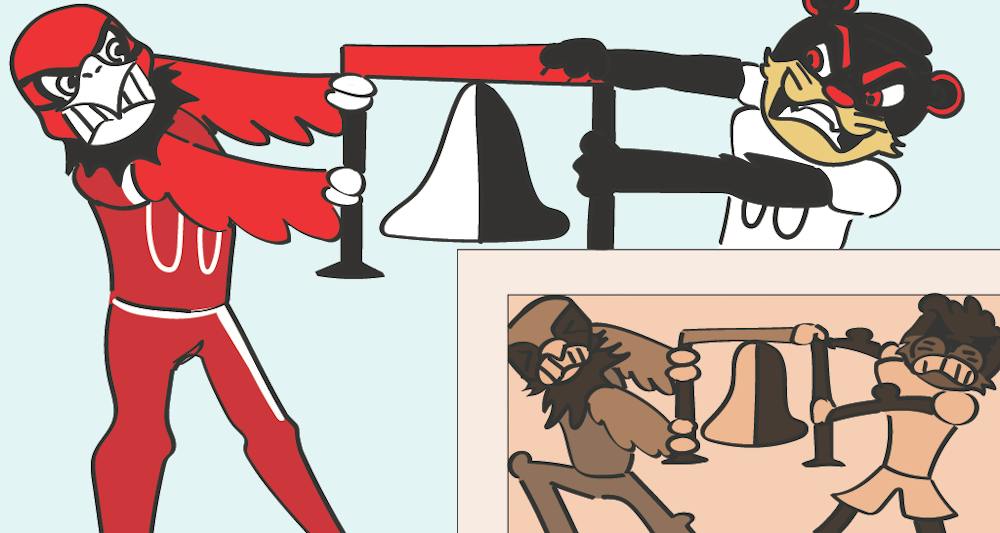
Driving south on Ohio State Route 27, drivers are transported from the endless cornfields of Oxford to the urban skyline of Cincinnati. For 138 years, it has served as the causeway for Ohio’s most storied feud.
The inception of the oldest rivalry in the state of Ohio began long before bells rang through the skies of southwest Ohio: It started with the founding of the state.
Before football
When a fledgling federal government issued a charter for a university in the district of Cincinnati, the district’s founder, John Cleves Symmes, decided to move it to Oxford. From that moment on, the people of Cincinnati harbored a resentment for the university in the north.
In 1822, the residents of Cincinnati unsuccessfully attempted to move Miami to the banks of the Ohio River. Cincinnati had to settle for building its own college.
One of the earliest examples of animosity between the two universities features one of the most prominent Miami University figures, William Holmes McGuffey. McGuffey joined Miami in 1826, quickly becoming one of the most prolific writers of educational textbooks. He was lured away from Oxford in 1836 to join what would become the University of Cincinnati. McGuffey offered little endorsement for his former place of work. \
When asked about if parents should send their children to Miami, McGuffey said, “[It would be] more likely they would be made into Drunkards and Gamblers than good Scholars.”
As both universities continued to develop an identity, donors of Cincinnati believed the university should emphasize agriculture and manufacturing. In Oxford, Miami continued to find its identity in the liberal arts. A natural rivalry began to develop before football found its way to the state of Ohio. Miami became the university for the rich academic, while Cincinnati became the school for the educated laborer.
The true beginning
The rivalry took to the gridiron for the first time on Dec. 8, 1888 at Miami Field in Oxford. On the site of modern day Pearson Hall, the sport of football debuted in the Buckeye state. It would need another year before the first points were scored, as the game resulted in a 0-0 tie.
Miami and Cincinnati joined the University of North Carolina at Chapel Hill vs Wake Forest University and North Carolina vs Duke University as the oldest rivalries in NCAA Division I Football Bowl Subdivision history.
Miami earned the first victory of the rivalry in 1889 in a 34-0 shutout. For the first time in the series history, a bell in Harrison Hall rang out over the Oxford sky to announce the victory. Little did Miami fans know, this bell would become the foundation for the history of one of the longest played rivalries in the nation.
Enjoy what you're reading?
Signup for our newsletter
In the 1890s, fans from Cincinnati decided to “borrow” the bell after a victory and take it back to the banks of the Ohio river. From that moment on, the bell became a symbol for the rivalry awarded to the victor.
The early era
George Little became the first head coach to flip sides in the rivalry in consecutive seasons. Little started his head coaching career at Cincinnati before joining Miami in 1916. The College Football Hall of Famer also coached basketball and baseball during his time in Oxford before his departure to the University of Michigan in 1922.
The 1923 game played a unique role in the history of the rivalry. During the game, James Gamble Nippert was injured by a spike wound. One month later, Nippert succumbed to a blood poisoning infection brought on by droppings from a pre-game chicken race on the field.
James N. Gamble of Procter & Gamble, who was also the grandfather of Nippert, decided he had seen enough. The manufacturing magnate wanted no further athletes to fall afoul of improper medical care. He donated the funds to the university to finish the construction of the stadium, including a locker room and training facilities for the players’ safety. Nippert Stadium would go on to host 61 consecutive editions of the rivalry.
In the 1930s, the bell would mysteriously go missing until it reappeared in the lobby of Miami’s Murstein Alumni Center in 1946. While the original was missing, both teams used a replica trophy for the rivalry. The replica is still in use today.
The legends era
College and Professional Football Hall of Famer Sid Gillman came to Oxford in 1942 and was named head coach in 1944. Miami played a significant role in Gillman’s impressive 80% win rate before he took his talent south to coach Cincinnati in 1949. He would finally leave the rivalry in 1954, taking his high-flying offense to the pro ranks.
The 1950 season became a historic milestone for Miami. A young upstart head coach named Woody Hayes led the RedHawks to victory against Gillman’s Cincinnati in the midst of a snowstorm. Miami took home the Mid-American Conference (MAC) title and defeated Arizona State University in the Salad Bowl. Hayes’s coaching talent caught the eyes of Ohio State University, which lured him away from Oxford.
Miami followed up the Hayes era, piling up the wins against its rivals under several legendary coaches. Ara Parseghian and John Pont led the RedHawks throughout the 1950’s.
They turned to Hayes who recommended his young assistant Bo Schembechler for the open role. In his six seasons at the helm, Miami went 40–17–3. In the 1968 edition of the rivalry, Miami jumped out to a 21-6 lead before the Bearcats high-powered offense came to life.
Jim O’Brien nailed a 47-yard field goal to end Schembechler’s Miami career in defeat. Michigan then called on Schembechler to coach the Wolverines where he would battle his former boss in the legendary 10 Year War.
The return to Oxford
Three years later, the battle would leave Nippert and return to Oxford. The series would begin to alternate host venues each year. Miami dominated the first 15 games of the new look series, suffering just three losses in that stretch. The Red and White achieved an Associated Press top 25 ranking in three of those seasons.
In 1983, Miami moved from Miami Field to Yager Stadium where the RedHawks still play today. During the rivalry, the RedHawks have not fared as well in the new stadium as they did at the original host site.
Legendary Miami quarterback Ben Roethlisberger led the RedHawks into an all-time classic in 2003. The 3-0 Bearcats could not stop Roethlisberger through the air as he threw for 377 yards and two touchdowns in what would finish as a 42-37 shootout at Yager Stadium.
The modern era
Two years later, the RedHawks would dominate Cincinnati 44-16 before the Bearcats began their run of dominance. The team was overseen by former Michigan State University head coach Mark Dantonio and former University of Notre Dame and Louisiana State University head coach Brian Kelly, among others. Cincinnati rattled off 16 consecutive victories against the RedHawks. Cincinnati’s success in the 21st century culminated in a playoff appearance in 2021 under Luke Fickell.
In 2023, the RedHawks stole a 31-24 overtime upset at Nippert Stadium. This edition featured a game-tying field goal, Brett Gabbert touchdown and a game-saving field goal block from Yahsyn McKee, who sealed the victory with an interception.
Cincinnati bested Miami in the most recent iteration of the rivalry, as it took its first lead in series history since 1911. With no more matchups scheduled, the RedHawks have one last chance to tie the series record at 61 games apiece.
The Battle for the Victory Bell has spanned three centuries of Ohio history. It is a fire fueled by the division of rich from the poor, legendary coaches, long runs of dominance and most recently the divide between the upper and lower tiers of Division I football.
As Miami prepares to take on Cincinnati for the final time, the rivalry looks like it will not lose its fire. The words of head coach Chuck Martin sum up the sentiment best.
“It’s the biggest game of the year for the Miami faithful,” Martin said. “We know how important it is to everyone that has anything to do with Miami football. This is our game of the year; this is what [we] live for.”
Read More
Saturday soundtrack: The perfect game day playlist
By Elise Hanna | 3 hours agoMusic is an integral part of players’ pregame ritual. Watch any warm-up, from the pros to your local little league, and I guarantee you’ll hear something pumping from the speakers.

Bring the Bell home: RedHawks need you in Cincinnati
By Zoe Fleischer | YesterdayFew things in sports are worse than empty stadiums, even venues with a lot of fans rooting for the other team. Students should travel to pack TQL stadium for the Battle of the Victory Bell.

Preview: RedHawks visit the Victory Bell one last time
By Graham Young | YesterdayThe rivalry will come to a close at 3:30 p.m., Sept. 19 at TQL stadium in Cincinnati, as the Miami University RedHawks (1-1) will face the University of Cincinnati Bearcats (2-0).