
Per Bloland was the primary professor in the composition major at Miami University. Now, that Major no longer exists. “It was a great program. We had a lot of really great composers,” Bloland said. “The whole department was kind of bummed about it.”
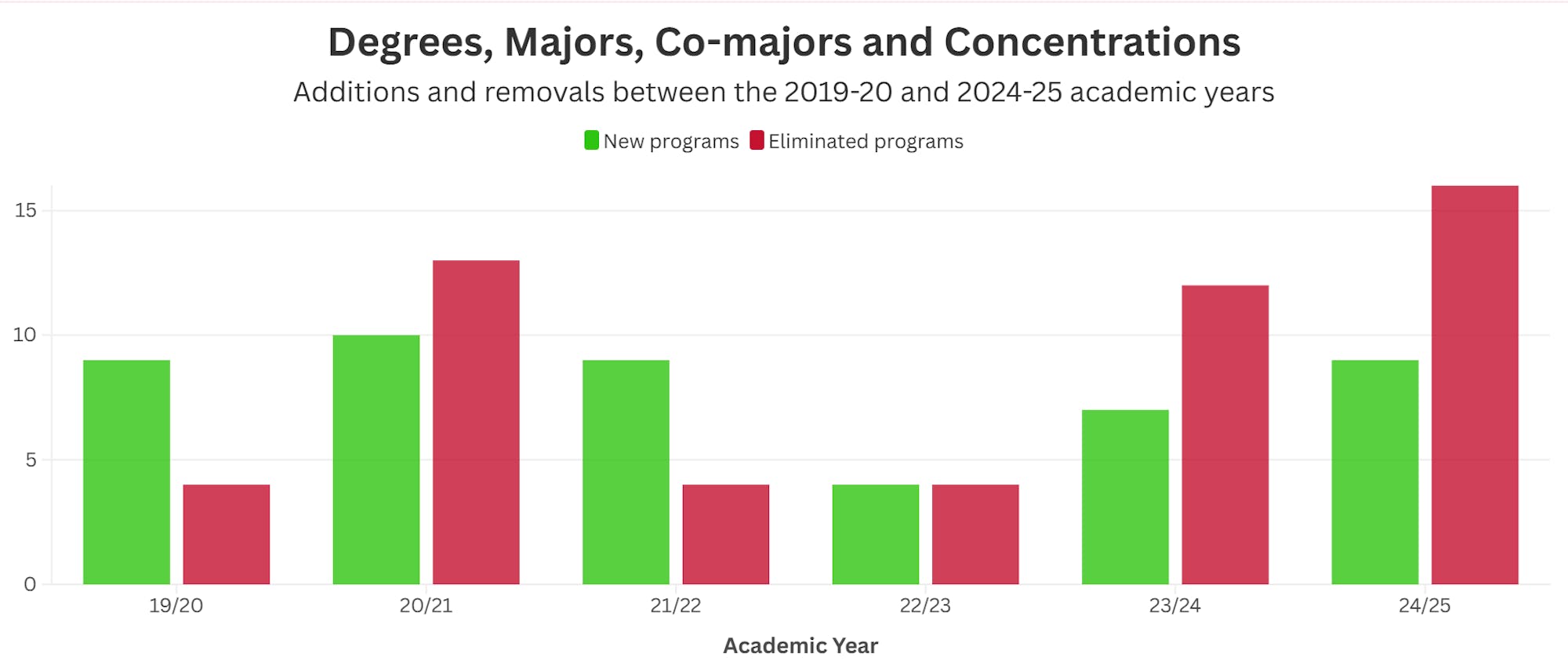
It's part of a growing trend at the university. Since the 2019-20 school year, more than 80 majors and programs have been removed, and several department consolidations are underway. Registrar curriculum reports obtained by The Miami Student from the Provost’s office show that removals of degrees, majors, co-majors and concentrations met or exceeded additions for four out of the six academic years from 2019-20 to 2024-25. This data does not include graduate programs, where 20 programs have been eliminated since the fall of 2020.
The most drastic changes have occurred within the university's largest college, the College of Arts and Sciences (CAS), where in fall of 2025 the Department of French, Italian, and Classical Studies and Department of German, Russian, East Asian and Middle Eastern Languages and Cultures merged into the Department of World Languages and Culture. The Department of Microbiology is consolidating into the Department of Biology, and talks are underway for the departments of Geography, Geology and the Institute for the Environment and Sustainability to merge into a Department of Environmental and Earth Sciences.
“Our goal, in changing our academic portfolio, is to offer a broad range of opportunities, with programs being large enough to offer students plenty of choice within them,” CAS Dean Rennee Baernstein said in an email statement to The Miami Student. “Having many small majors in similar areas tends to fragment resources and paradoxically ends up giving students fewer options for courses. By consolidating low-enrolled options into more robust programs, we avoid spreading resources thin and we provide students with broader course selections within their major.”
Administrators see these changes as adapting to student demands for programs with jobs at the other end.
“[...] We strive to ensure all our majors translate into strong post-graduate outcomes and we promote the life-long value of our liberal arts degrees,” Baernstein wrote in the email. “We know that 98% of CAS graduates are employed or pursuing further education within one year of graduation, which is a terrific result.”
But not all students study with employment in that field as their primary goal.
“You don’t go into composition with the idea that you're going to immediately graduate and get a job,” Bloland said. “There were a number of [composition students] that were double majors, so they were doing this because they loved it. Nobody studies composition in college unless you love it.”
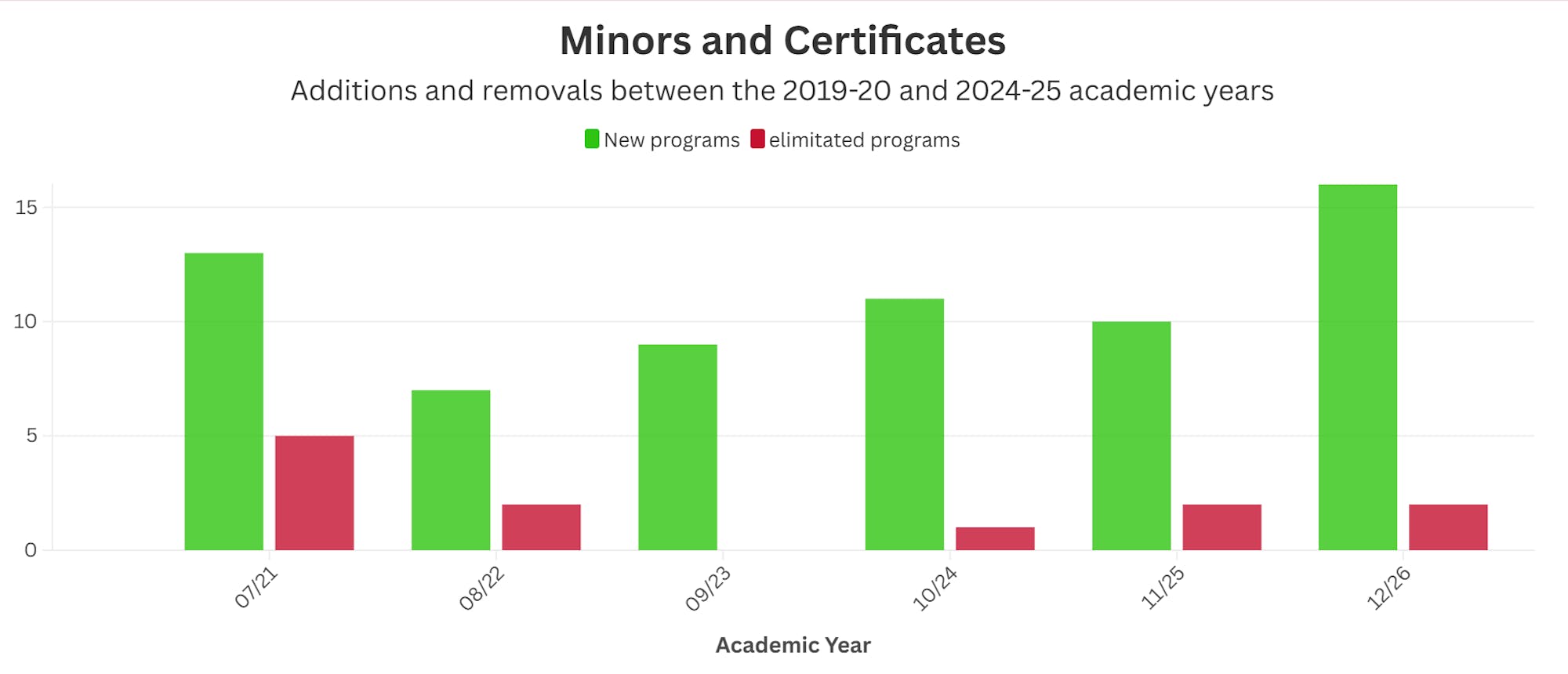
While majors have decreased, minors and certificates have increased, with 66 added and only 12 removed between the 2019-20 and 2024-25 academic years.
Composition will still retain its minor, but there will no longer be any professors teaching it full-time. No full-time professors were let go as part of the Composition Major closure, but one visiting professor did not have their contract renewed.
Enjoy what you're reading?
Signup for our newsletter
“[Adjunct and visiting professors] are never guaranteed any recurring contract,” College of Creative Arts Dean Ryan Fisher said, but he didn’t know of any specific program closures that led to the termination of a contract.
The recent increases in faculty workload also led to full-time faculty teaching courses previously taught by adjunct and visiting professors.
“Faculty position eliminations tied specifically to low enrollment are extremely rare at Miami. As a general matter, hiring follows current student demand and workforce need, so there is ongoing repurposing of positions,” Provost Trent Gould said in an email statement to The Student. “When faculty retire or move on, their positions are evaluated at that time as part of normal workforce planning,” often meaning these faculty are told to teach in a field with higher demand.
Another cause for these changes is new federal and state legislation, like Ohio Senate Bill 1 (S.B.1), which requires that majors graduate at least five students a year on average over a rolling three-year period.
“We could never guarantee that that would be the case. We often had five; we didn't have five every year,” Bloland said. “So it would be a constant battle, and we would probably lose [the composition major] eventually within the next couple of years.”
The composition major couldn’t maintain a large number of students for structural reasons as well as student interest.
“As a composition degree, every composer was responsible for finding performers to perform their pieces,” Bloland said. “We only have so many performers, and they're all very busy. So once we got up to 20 composers, we realized it was very difficult for all of these composers to find enough performers consistently to maintain the system.”
Fisher said the closure doesn’t reflect a lack of quality in the program.
“[Music Composition] is a phenomenal program that was built by a phenomenal professor in Per Bloland. Our students did amazing things. We had world-class musicians and composers coming to our campus because of the work of that professor,” Fisher said. “It's a wonderful program. It just was not going to be large enough in order for us to sustain it in S.B.1.”
These changes aren't just happening at Miami. Laws like S.B.1 are being written around the country and are even more impactful for smaller universities that can’t sustain many programs that meet the quota.
“I'm a little worried,” Fisher said. “What are going to be the knockoff effects from that 15 years, 20 years down the road? Will we have the artists that we need in order to sustain the vibrant cultural cities that have come to depend on them? I'm going to do everything I can as the dean of this college to make sure Miami is still a strong hub for creative people to come and learn to be creatives and learn to take that expertise and to go and impact communities and to go and hopefully live successful lives.”
Read More

Miami’s next top models
By Erin Wadzinski | 9 hours agoA sea of 300 black-clad students lined up outside Armstrong 3056 to answer Miami University Fashion and Design’s (MUF&D) 21st annual model casting call.

Mike Flanagan’s ‘Carrie’ puts a twist on the classic story
By Stella Powers | 12 hours agoIf I had to pick my favorite horror story of all time, it’d probably be Stephen King’s “Carrie.” I love how the real horror in the story isn’t the gore. Instead, it’s how genuinely cruel people can be, pushing a young girl to her breaking point and causing mass destruction.
