
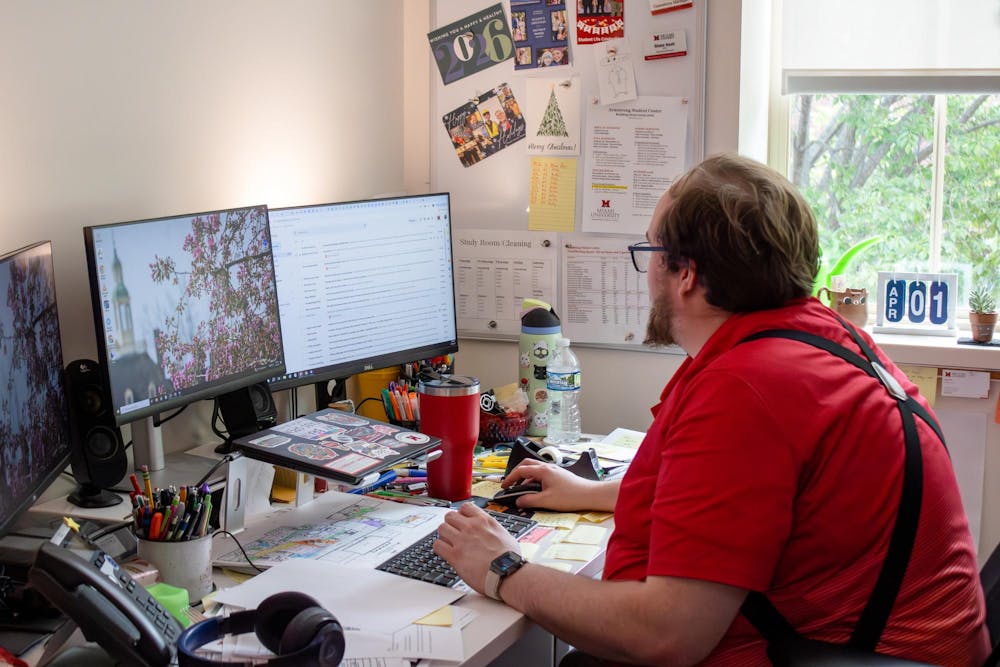
Theater professor Ann Elizabeth Armstrong was cleaning her office in the Center for Performing Arts building when she found her old lesson plans. They were tucked beneath a stack of books, piled 10 high among her other papers and notebooks.
They were for a field trip from four years ago, a visit to the Cincinnati Theater. Armstrong used to enjoy planning trips and giving her students a hands-on learning experience.
She doesn’t have time to do that anymore.
“If I’m teaching an extra class, I can’t take one of my classes on a field trip,” Armstrong said. “That takes away from my other classes, and then everything’s out of balance, but those are the kinds of things that people remember.”
In December 2024, Miami University announced its new professor course load policy. The number of classes professors would be required to teach now runs on a new merit-based approach that considers factors such as the amount of research published or their level of undergraduate teaching.
Interim Provost Chris Makaroff said a professor workload policy is not new at Miami.
Enjoy what you're reading?
Signup for our newsletter
“There’s always been a workload policy,” Makaroff said. “What we have not been good at doing is enforcing the workload policy. So this year, it came to a head, primarily because of [Senate Bill] 1, empowering the Board of Trustees to have oversight over everything.”
Now that the workload policy has been in effect for a year, professors are starting to see its long-term consequences. Makaroff said 61% of professors are teaching the same amount as before the new workload policy, 24% are teaching more and 15% are teaching less.
Why the new workload policy to begin with?
In a report sent to all Ohio public universities, the Ohio Chancellor of Higher Education said most professors in Ohio were not maintaining a proper workload and 70% of a professor’s time should be spent teaching.
In response, the Board of Trustees at Miami tasked Makaroff and other university leaders with developing a revised workload policy that would better align with the Ohio Chancellor’s Office’s recommendations.
The university brought in Bain & Company, a management consulting firm, to see how Miami could improve professors’ output.
Based on the input from Bain and from other universities around Ohio, Miami decided to create a 40-40-20 workload base for tenure-track professors, involving 40% teaching, 40% research and 20% service. These amounts could change depending on how research-active a professor is.
Makaroff also said the new policy was to ensure all professors were actually doing their job and not taking advantage of the previously lesser-enforced workload policy.
“The whole idea was to try to ensure that everyone was carrying their fair load,” Makaroff said. “It wasn’t that the vast majority of the people weren’t working hard, but it was because the chancellor said, ‘These are the guidelines.’ Actually, I think our plan is a lot more flexible.”
Problems with the current course load guidelines
After the new course load policy was announced, individual colleges were instructed to develop their own guidelines for determining workload. This meant after hearing from all the division chairs, the college deans would create a single, massive workload-equivalency rubric. Eventually, these guidelines would be approved by the Office of the Provost.
In colleges with several different divisions, like the Colleges of Arts and Science (CAS), it’s hard to create a single rubric to cover everyone, especially when the workloads between humanities and science professors look very different.
Heidi McKee is a professor in the English and the emerging technology and business design departments and also focuses on artificial intelligence (AI) studies. In such a changing field, McKee is constantly working on her research.
However, social science research often takes longer. Unlike pure science fields, there’s no simple experiment to test a hypothesis. McKee said research in new fields, like AI, coupled with working with a group of undergraduate researchers, makes the process take twice as long as if she did it herself.
“Research and publication with students, particularly with undergraduate students, ought to be counted more,” McKee said. “This article [we wrote] counted as just one point, which is the same as if it would counted as if I’d written it by myself. When you’re working on publications that take longer and not getting further credit for it, then why would someone then continue doing it?”
In the CAS workload equivalency rubric, for most professors doing research to earn workload equivalency points (which replace teaching a class), they must generally publish two articles per year in premier publications.
McKee, who has seen her teaching workload increase under the new policy, said given the length of her research and the time she spends teaching, the number of articles listed in the CAS workload equivalency document is not possible.
“Right now I’m working 60-70-hour weeks, and I know that I’m not going to be able to sustain that,” McKee said. “At some point, I’m going to have to readjust and recalibrate. I don’t want to short-change my students, but right now, the current structure is, I think, unsustainable over the long haul.”
There are other opportunities for professors to earn additional workload equivalent points. In CAS, there are different levels of being “research active,” based on the amount of grant money a professor receives. The more money they bring in, the more “research active” they are considered, and the fewer classes they have to teach — provided they still publish multiple articles a year.
In the humanities, such as English and history, these grants are few and far between and often provide little funding. In science fields, however, there are several large grants and a more straightforward research process.
Jason Rech, chair of the geology department, said even though the CAS workload guidelines may slightly benefit science professors, there are still issues. In the CAS document, science professors who do not bring in enough grant money may face higher course loads. Now that the federal government is defunding national science organizations, it could lead to serious problems.
“We’re not trying to say we should have a one-one teaching load and not be research active,” Rech said. “There’s been some big changes in the funding opportunities lately. I’m a full professor. I’ve been here a long time. It doesn’t really impact me, but for my pre-tenure faculty, these are difficult times to try to understand the funding opportunities out there.”
While professors in the sciences may be able to reach the required number of articles more easily, Rech said he recognizes it is hard to quantify research.
“Faculty work really hard, and so I understand the desire of universities, administrators and states to make sure that faculty are working hard and being productive,” Rech said. “The things that we take issue with are how things are attempted to be quantified across the disciplines. For example, I don’t know of any other university that is only giving partial credit for publications based on the number of coauthors or that gives grant dollars credit.”
CAS isn’t the only college with problems determining workload equivalency. The College of Creative Arts (CCA) also struggles to find ways to count professors’ research and creative projects.
Armstrong said it was hard to quantify the exact workload equivalence in creative fields, especially since many professors’ work is more service-based and less about research or collaboration with professional creative organizations.
“The department of theater is a really small department, but we have a lot of service that we do because we’re basically running a theater company while we’re working full-time jobs as professors,” Armstrong said. “I don’t think there’s any math formula that would allow us to calculate that, and I think it relies on us being able to trust administrators, and it means administrators need to respect our disciplinary way of doing things.”
Makaroff said there’s not much the University can do to change individual colleges’ workload equivalency rubrics.
“It became clear that we couldn’t come up with a very rigid set of rules that fit all the divisions, because they’re all different,” Makaroff said. “We gave the deans some discretion in how they count research productivity. And we also gave them some flexibility as far as what people’s schedules look like, because everything is not nice and clean and neat. No system or model is absolutely perfect.”
What can professors do?
The path for making changes to the workload equivalency policies at Miami is currently unclear.
Elena Albarrán, professor of history and the executive vice president of the Faculty Alliance of Miami (FAM), said even though they are in the middle of contract negotiations with Miami administrators, the language in these contracts prevents FAM from bargaining about the workload policy.
“It’s going to have to hurt somebody before we can do something about it,” Albarrán said. “We have to wait until somebody has a punitive outcome to be able to say, ‘Look at how this hurts somebody’s job performance,’ and then bring that through the grievance process, which can take a long time and be unpleasant.”
Albarrán also said FAM has heard complaints from several professors in the regional campuses.
“When the workload policy came out, it didn’t correspond at all to the regionals,” Albarrán said. “The regionals have a different mission and a different composition, and the people on the regionals have always taught a maximum level, but then they were still being put into this added pressure to produce other things.”
Makaroff said while he understands these one-size-fits-all rubrics colleges use may cause problems, from an administrative perspective, the workload policy seems effective.
“We’re not looking to revise the policy,” Makaroff said. “We’re still tweaking it a little bit.”
How the workload policy could affect students
Miami has consistently ranked among the best schools in the nation for undergraduate teaching. According to the U.S. News & World Report, it’s ranked second among all public universities.
But as more professors are forced to increase their teaching load, they are less likely to take on undergraduates as their research assistants.
Makaroff, however, said the university may still make some adjustments to how the workload policy counts professors who work with small groups of undergraduates. He said they don’t want those professors to work more than necessary.
“We want to make sure that the faculty who are doing a good job are being rewarded,” Makaroff said. “That’s one of the things that we’re just trying to work out right now, because we don’t want to discourage faculty from working with students. But it’s just like the country as a whole. You write laws for the small number of people who sort of are trying to take advantage of the system.”
Albarrán warned a lack of willingness to work with undergraduate researchers may not be the only consequence of the workload policy. She also said for professors who are juggling increased teaching loads and their research, students could soon see a lower-quality education in class.
“I teach two classes this semester,” Albarrán said. “I love it because I know everybody’s names. I can hand-grade their journals. We talk after class a lot. There’s a lot of that intimate, special relationship that Miami students [have]. If I’ve got 200 students in a semester, I can’t do that.”
Read More

‘Practical Magic 2’: Shenanigans
By Eliza Garrett | YesterdayThe Owens sisters are back after nearly three decades, and this time, they have even more magic, family drama and romance than ever before. “Practical Magic 2” brings Gillian and Sally Owens back to the big screen and allows the audience to experience their magic once again.

Lizzy McAlpine makes folk her own in ‘Angel’
By Ren Chaffee | 3 days ago“Angel,” Lizzy McAlpine’s new album, released Sept. 18. Although there are some mixed reviews, “Angel” hits the mark for me.

Recap: McComb shines in 24-21 thriller against UConn
By Graham Young | 3 days agoOn Sept. 26, 2026, the Miami University RedHawks met their next competitive match of the regular season.