

A survey, conducted by a team of Miami University professors, showed 92% 0f student respondents reported having used generative Artificial Intelligence (AI), and 88% reported using it for academic work.
AI has become ubiquitous on campuses across the U.S., and more than half of U.S. college students use AI in their coursework, according to a 2026 Lumina Foundation GALLUP report. Students are now using the tool to complete coursework, help make study plans and materials and even to assist in group projects.
Roberto Robles-Barron, who graduated in May with majors in media and communication and Spanish, said he experienced issues with other students using AI in group work.
Robles-Barron was one of two producers for the media and communication capstone class, which wrote and filmed the short film “The Pretender.” The class had a group discussion at the beginning of the semester where they created their own guidelines for how AI could or could not be used for the project. The class decided they would not allow any AI use because they wanted the film to solely showcase student work.
“The class was pretty firmly against the use of AI, just because we were mostly all creative majors, and we all really had a passion for film, and just the process in general,” Sophia Taylor, another recent graduate who was part of the capstone project said.
The filming of the short movie went as planned, but when it came time to market the final product for a screening, several members of the group, including Taylor and Robles-Barron, worried the poster one student made was likely generated by AI. They brought these concerns into a class discussion, but ultimately needed to print the posters to advertise in time for the screening.
Enjoy what you're reading?
Signup for our newsletter
“It seems like a kind of small thing, but it really is the face of the whole project, and the people are going to see it and base the reactions off of that initial first impression they get from the poster itself,” Robles-Barron said.
Andy Rice, a professor of media and communication and film studies who taught the capstone class, said he has different AI policies depending on what class he is teaching. In some classes, he prohibits all use of AI, but in others, like the capstone, he allows students to have an open dialogue about what they feel comfortable using AI for. Even with his level of flexibility regarding AI use in the classroom, practical enforcement of these policies can be difficult for professors to navigate.
“There’s almost nothing, it seems to me, that the Office of [Academic] Integrity can do about this,” Rice said. “They have a conversation with the student if you refer them, but it’s not the same as it was with straight out plagiarism, and we’re discouraged from using AI checkers, both because they’re inaccurate [and] because they’re giving away students’ writing work to a third-party corporation.”
For some students, like Taylor, the capstone project wasn’t the first time students’ reliance on AI has been noticeable. She saw several classmates use AI daily to complete assignments when she studied abroad in Luxembourg.
“Before AI use in group projects, I feel like if people weren’t going to do the project, … their slides would just be bad or incomprehensible, but now it’s like they all have the same sort of AI layout,” Taylor said. “In one of my marketing classes, … on our final project every single person, other than I think five people out of some 30 people presented their project in almost exactly the same format, and it was so embarrassing.”
Heidi McKee, professor of English and affiliate faculty of emerging technology, business and design, has been researching and writing about AI since 2016. She also acts as a provost AI fellow, meaning she works with the provost’s office to shape AI tools and policy at Miami University.
McKee said she encourages students to explore uses for AI in her professional writing courses. She aims to help her students think critically about when it’s appropriate to use AI for work and avoid overreliance on the tool.
“In the age of AI, it is more time consuming to teach writing than before, because [we’re] having to teach not just the writing for the individual writer and not just all the writing context and the rhetorical situation you have to think about, but also thinking about how to work with this writing technology,” McKee said.
In group projects, McKee often pairs students based on how often they use AI for their writing, putting students with similar levels of usage together. By doing this, she finds students experience less frustration when working collaboratively.
McKee also asks students to create a kind of charter or agreement at the beginning of the project that helps determine the strengths and weaknesses of individuals on the team as well as how they will complete the project. She now asks students to discuss their own AI policies as part of this charter.
McKee said she thinks departments and faculty need to be given the agency to create their own AI policies for different fields, courses and even specific projects. In her own classes, she will often ask students to complete a project with AI and restrict AI use on a different assignment so students can see how using the tool impacts or changes the final project.
One of the biggest things McKee hopes her students take away from her classes is the ability to talk with others about using AI, which is quickly becoming a fixture in the workplace. Knowing how to approach a coworker about issues involving AI is an important skill that is increasingly relevant.
“You’re going to have colleagues that are going to turn in AI slop, and you’re going to have to talk to them about it,” McKee said.
mahones5@miamioh.edu
Read More

The many labels we hold
By Anthony Caprara | 3 hours ago"To be compressed into an assumption of who we are based on a few interests is flattening for us all, yet we find ourselves victims and perpetrators every day."

The death of the aux cord
By Ren Chaffee | 3 hours agoThe way that we listen to music as a society has shifted and changed over time. Yet, it remains a crucial part of many people’s lives. The sad thing is that music has become an isolated part of life, even though it was created as a way to connect and communicate with others.
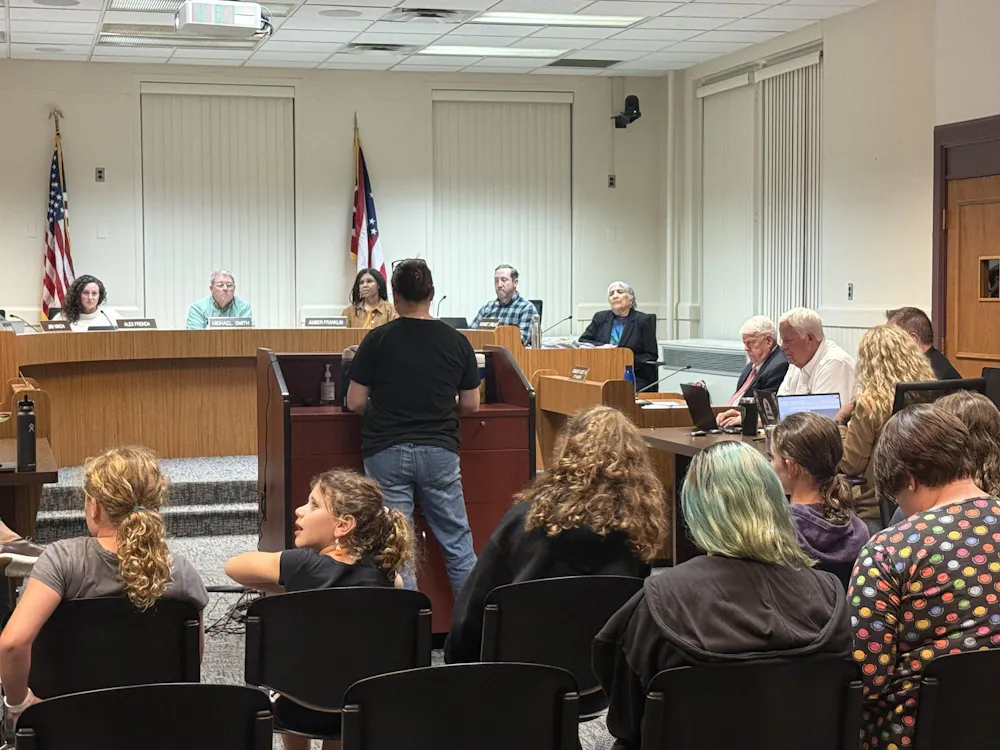
Oxford City Council discusses assistance funding for 2027 budget
By Kylie Bunn | 15 hours agoThe Oxford City Council approved safety resolutions and the disbursement of community assistance funding in its meeting on Oct.6.