
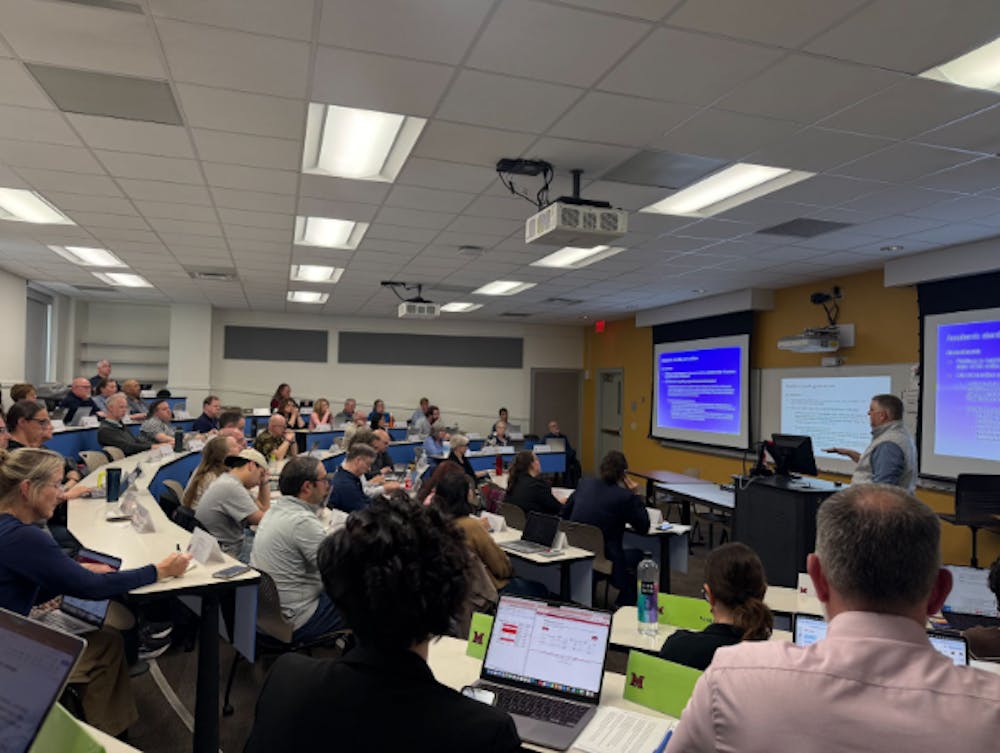
The University Senate reviewed end-of-year updates, advanced multiple policy proposals and introduced new academic initiatives as the end of the spring semester nears.
Nathan French, vice chair of senate and chair of the Senate Executive Committee, opened the meeting by thanking members for their service and noting how the university stands at the moment.
“While we do have our challenges as a senate and as an institution, Miami remains in a relatively fortunate position,” French said, noting colleagues close by are facing “incredible challenges.”
French reminded the body that the budget symposium will be held on April 27 in Benton Hall. He also announced the Senate Executive Committee will distribute a feedback survey due May 4.
The provost spoke on the university’s decision to incorporate artificial intelligence into all majors by the end of the next academic year. The policy is flexible, encouraging faculty control over how it affects student coursework.
The senate approved the recommendation to support revisions to the undergraduate certificate requirements. The proposal aims to reduce credit hour requirements to match other programs and allow flexibility.
Enjoy what you're reading?
Signup for our newsletter
In addition, the senate approved the updated attendance policy following extensive feedback and questions from the body at last week and this week’s meetings. The new policy allows room for absence for students participating in university sponsored activities as well as upholding expectations for makeup work.
The senate approved revisions to the Miami Plan, including the creation of the Miami Integrated Learning Office (MILO) and implementation of the Miami Integrated Learning Experience (MILE). They are expected to begin in fall 2027.
Jason Abbitt, associate dean of the graduate school, presented proposed changes to graduate policies. These include a 10-day deadline for dismissal appeals and clearer expectations for handling dismissals in order to create unity across departments.
Abbitt also introduced updates to the Graduate Summer Research Fellowship. The changes aim to align eligibility with graduate assistant requirements, in addition to allowing students to be employed during the fellowship.
“We really tried to decrease the overall length of the policy,” Abbitt said. “We just wanted to clean it up and focus on eligibility criteria and things like that. We still have the same funding and award level.”
Ellen Yezierski, director of the Center for Teaching Excellence and professor of chemistry, presented the University Senate Task Force that will focus on improving how faculty evaluations are executed. The task force will include a mix of faculty members, department chairs, associate deans and leadership from the Center for Teaching and Excellence.
“It will be really instrumental to have a mixed group of people on the implementation team in addition to consulting with the other bodies,” Yezierski said. “We will get enough inputs from enough different perspectives so that we do this in a way that supports excellent teaching.”
Following public business, the University Senate entered executive session.
The University Senate will meet again at 3:30 p.m. Monday, April 27, in 102 Benton Hall.
Read More


Private charity isn’t enough: The state is failing our children with cancer
By Jacob Van Riper | 8 hours ago"College students have to raise money for these causes because oftentimes, those in power do not help enough. These campaigns seek to spread awareness and raise money for people affected."
