
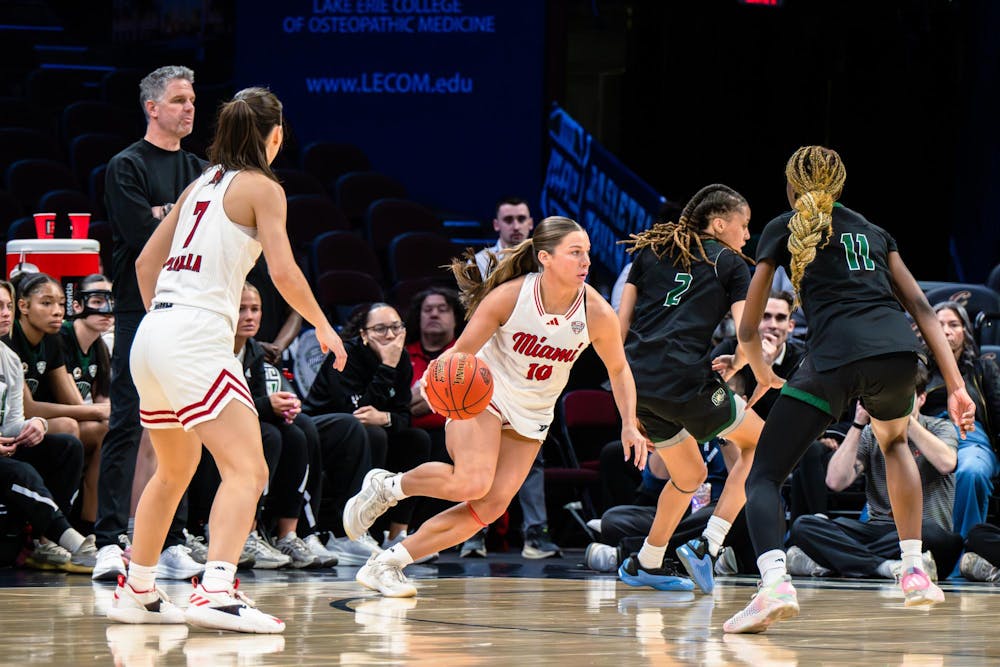
I’ve spent more time in Millett Hall than I’d like to admit. Though it’s part of my job, I never viewed sports here as entertainment. I loved when we won, but as the phrase goes, “You win some, you lose some.” This last year has given me two huge exceptions I couldn’t have predicted going in: men’s and women’s basketball.
The similarities are clear. Both were undefeated in their home games during the entirety of their regular season. Both had their coaches honored as Coach of the Year from the Mid-American Conference (MAC). Both broke long-held records.
But only one side has the attendance and marketing to match. At the beginning of the season, they had similarly small turnouts of dedicated fans, but why weren’t their viewerships comparable in the end?
Although the perception of women’s sports has radically improved over the years, it is still riddled with controversies. For example, on-screen representation has continued to be a struggle as ESPN has a history of limiting NCAA women’s basketball tournaments to afternoon and regional coverage.
It was only in 2022 and 2023 when they were slotted for primetime television, breaking records with an 75% increase in viewership and a peak of 12.6 million. In 2024, despite being taken off primetime, the tournament finale accumulated 18.87 million viewers, becoming the most-watched women’s basketball game in history. For ESPN platforms, it was the most-viewed college basketball game ever, including men’s.
However, this success is undercut by the fact that women are broadcast differently than men. According to a 2020 study on the sexualization of women at their sporting events, commentators tend to focus more on their physical appearances rather than their athleticism and in-game plays. As a result, viewers become alienated and adopt the mindset that women players are not as skilled or interesting as their male counterparts.
Even in video games, WNBA players were not included in the 2K franchise until NBA Live 18 in 2017 and 2019. The league had existed for more than 20 years at that point, and when these inclusions occurred, it wasn’t without a wave of sexist comments. Though it seems insignificant, it demonstrates how women are often an afterthought in sports fandoms. But luckily, from personal experience, I’ve seen the audience gender demographics split pretty evenly overall for Miami’s basketball games.
The problem with women’s basketball is not lack of audience, but visibility.
Miami University has had the opportunity to support all its women’s teams on a larger scale. In the past, our women's volleyball team only peaked in attendance during their Sept. 3, 2025 Ohio State game, despite being the sole volleyball team for Miami, with 2,550 people. For basketball, the late-season doubleheader events did the best, with a significant portion of the 5,034 attendees there because people wanted to secure a good seat for the men’s game.
But is it really record-breaking attendance if people are just sitting around on their phones during the women’s game, waiting for the “real stuff” to start? Personally, it was disheartening to see, and while players on the men’s team have shown up to multiple women’s games, the general student body does not hold the same amount of respect.
I hope the women’s basketball team’s recent MAC tournament win (their second after their first and only win in 2004), this season’s program record of 28 wins and second ever historical inclusion in a NCAA Tournament game (first in 2008) will help students and recent fans realize talent isn’t gendered. The historical and continuing disparities in coverage reveal the implicit biases we hold against female athletes’ capabilities, but we don’t need to maintain that gap.
Recognizing that men have been given more opportunities to develop interesting and unique narratives for their players and team dynamics — an aspect we don’t initially perceive as a reason for watching sports — is important in understanding why showing up for women’s sports matters. They’re hardworking athletes and students, too.
Enjoy what you're reading?
Signup for our newsletter
Maureen Wilson is a first-year student double majoring in media and communication and emerging technology in business and design, with a minor in creative writing. She is an Opinion writer for The Miami Student and is involved in Sigma Tau Delta, Asian American Association and MU Kababayan.
Read More

Alcoholic beverages lack transparency and oversight
By Elisa Rosenthal | 3 days ago"The back of the can doesn’t give much information either, only a government warning and a select few nutritional facts: calories, carbohydrates, protein and fat. Although I’m sure that’s enough for some — and too much for others — it lacks transparency."

Oxford listened to the community and terminated its Flock Safety contract
By Charley Babb | 4 days ago"The issue with Flock isn’t the arrogant name brand, nor is it just the critical security flaws in every aspect of their system. The real issue with Flock is the fact that it allows warrantless tracking of citizens, for no other reason than the whim of a police officer."

We’re applying 18th-century worldview to today’s society
By Ethan Foster | 5 days ago"This creates a real problem because originalists attempt to solve these debates through worldviews contemporary to the time they were written. These perceptions are oftentimes completely different than the ones we have today."