
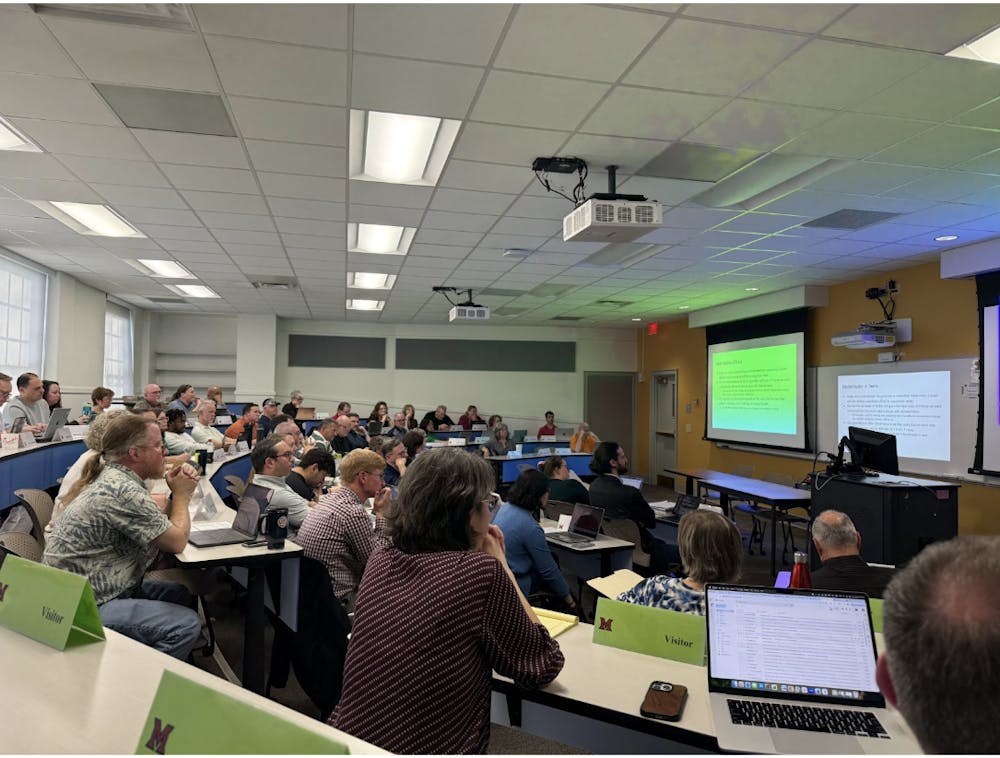
The University Senate reflected on its role in shared governance, provided updates on the Miami Access Program and discussed the merger of the Department of Microbiology and Department of Biology during its March 9 meeting.
Nathan French, vice chair of senate and chair of the senate executive committee, welcomed the meeting by discussing the remarkable success of the Miami University men’s basketball team and head coach Travis Steele. The undefeated team will go on to compete in the Mid-American Conference tournament in hopes of securing a spot in the NCAA Division I Men’s basketball tournament.
The Board of Trustees approved the resolution for a new arena located at Cook Field with an estimated cost of up to $281 million. French noted the passionate community members and students that attended the board’s meeting. He also mentioned the questions regarding shared governance that arose after the decision.
“This year I challenged our senate to understand itself as aspiring to be an indispensable part of our institution,” French said. “To become indispensable means that we will be able to clearly answer the question, why does the senate matter and why does shared governance matter?”
French also discussed the address he made to the Board of Trustees at its February meeting.
“I noted to the board that it is the aim of the senate to become a body at this university that is recognized for its ability to draw upon the expertise of students, staff and faculty to provide advice on matters of sound principal policy,” he said.
Enjoy what you're reading?
Signup for our newsletter
He encouraged the senate to remain motivated despite the skepticism after the arena project was approved.
Provost Chris Makaroff announced that syllabi must be posted on a public website prior to the first day of class beginning fall 2026. Faculty are encouraged to begin referring to the information given to students as a “course guide” instead of its traditional title as a syllabus to differentiate between what is public and what is given to students.
Pepper Stetler, professor of art history, and Ashley Johnson, assistant chair of educational psychology, clinical professor and inclusive special education program coordinator, gave an update on the Access Miami Program.
The program aims to provide education for students with intellectual and developmental disabilities. It currently stands as a week-long summer program, but the committee is working to turn it into a full-time certificate program.
“Students who go through these programs are much more likely to have jobs once they’re out of them,” Stetler said. “They are also earning a lot more money from these jobs, so they are definitely allowing students with disabilities to have a better professional life.”
Students will be able to enroll in the certificate program beginning fall 2027. The plan is to admit cohorts of five students each year and expand as the program grows. Students will receive support from Johnson as well as peer mentors on campus.
“We have a really dynamic curriculum that we’re going to offer to students, and it is grounded in disability studies,” Johnson said.
Elizabeth Hoover, interim director of liberal education and teaching professor of musicology, discussed the proposed changes to the Miami Plan. The Miami Integrated Learning Experience (MILE) aims to add integrated learning courses, civics literacy and applied professional skills courses into the curriculum.
She detailed the skills they hope students will develop through the program which include oral communication, teamwork, problem solving, digital fluency, quantitative reasoning and civic-mindedness.
“It provides a more streamlined curriculum,” Hoover said. “It’s more coherent, moving away from just checkboxing and it creates a meaningful narrative to students that they can take and continue on in their lives.”
Rachael Morgan-Kiss, chair of microbiology and O’Toole Family professor, Paul Harding, chair and professor of biology and Jessica Sparks, associate dean for personnel and curriculum, introduced a proposed merging of the microbiology and biology departments.
The proposed merger is a result of financial implications and strategic opportunities. There has been a decline in microbiology enrollment, as well as growth in the biology department.Putting the two departments together will create chances to streamline the curriculum and eliminate redundancy.
“My recommendation is that with transparency and thoughtful implementation, this is a really good opportunity,” Sparks said. “This is a chance to make a stronger, more integrated department.”
The University Senate will meet again at 3:30 p.m. Monday, March 23, in 111 Harrison Hall.
Read More
PHOTOS: The future of The Miami Student
By Sarah Frosch and Elise Hanna | 4 hours agoThe Miami Student Newspaper's senior staff produces their last newspaper before the new staff transitions in and takes over.

Miami men’s basketball’s takes first loss of season against UMass in MAC tournament quarter finals
By Kethan Babu and Cooper Meneghetti | 17 hours agoAfter 31-straight wins, the Miami University men’s basketball team’s perfect record has finally concluded.

ASG discusses residence hall laundry costs, approves National Volunteer Week programming
By Kathryn Hippe | YesterdayAssociated Student Government (ASG) discussed a proposal Tuesday to reduce or eliminate residence hall laundry costs and approved a resolution to expand volunteer opportunities during National Volunteer Week.