
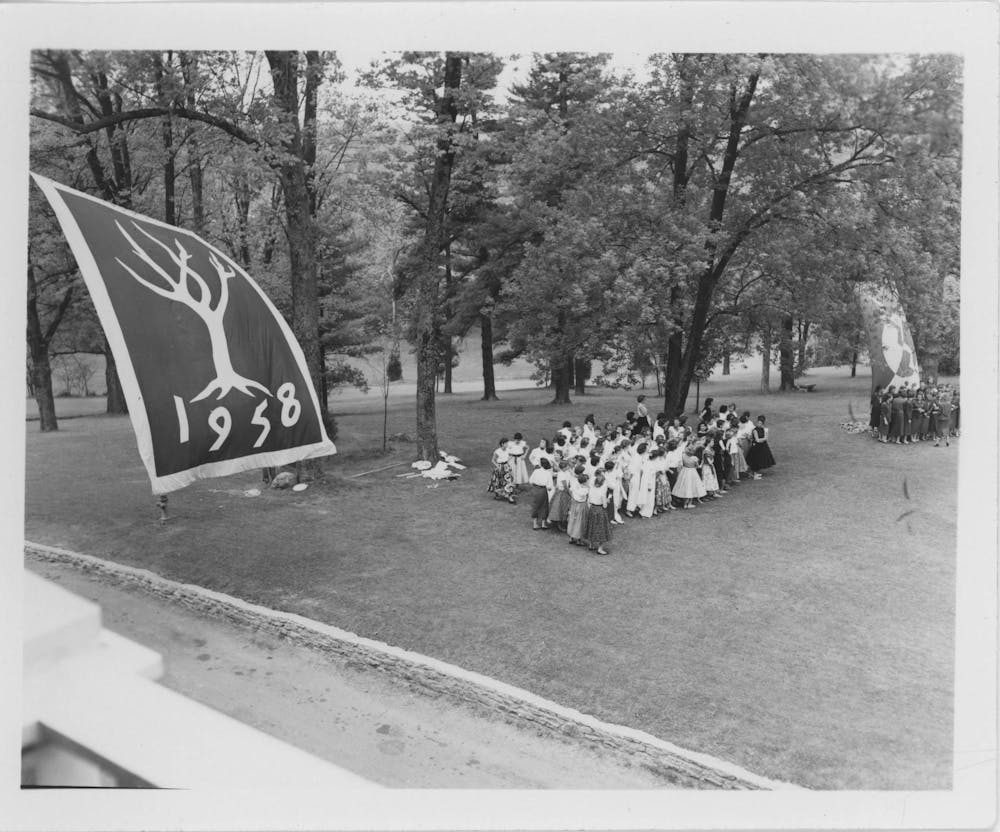
This year welcomes the 55th anniversary of Earth Day, a nationwide celebration for environmental protection and allyship. Miami University has decades of history with Earth Day, transforming from low support to ample community involvement and activities.
Earth Day was first recognized on April 22, 1970, after former Senator Garlord Nelson proposed a conservation tour focused on bringing attention to the environment. This tour originally failed to put environmental issues on the national agenda, so Nelson tried again years later.
This time, Nelson’s goal was to reach the minds of United States citizens through students. He urged millions of young people to participate by contacting college newspapers across the country.
Celebrations in Oxford began slowly in the 1970s. The Earth Action Group planned to march from Oxford to Hamilton to honor Earth Week. Ruth Gerbauer, former editor of the 1971 edition of The Miami Student, wrote that plans were forced to change because of little support from Hamilton donors.
“In substitution for the march from Oxford to Hamilton will be an inner Oxford walk along the major streets to pick up little and waste,” Gerbauer wrote.
Sandi Woy-Hazleton, former deputy director for Miami’s Institute for the Environmental and Sustainability department (IES), said student-led Earth Day celebrations began during her time with IES. She said the Peffer Western Environmental Education Program (PWEEP) played a large role in organizing these events.
PWEEP was active primarily in the 1980s, and it would host field trips for children around the community. These field trips included a tour of Peffer Park guided by those who wanted to pursue environmental education.
“That was the most important student group that was interested in the environment,” Woy-Hazleton said.
Woy-Hazleton said PWEEP was eventually dismantled after the environmental education program in schools was eliminated, but traces of PWEEP’s mission are still found at Miami.
Celebrations continued and grew into the 1990s, with the transition from celebrating Earth Day into creating Earth Fest. Lisa Rardin and Kris Oravec, writers in the April 24, 1990 edition of The Student, wrote Earth Fest activities began at 10 a.m. and lasted until dark, ending with stargazing.
The major change in celebrations came with sponsors. Hueston Woods Student Naturalists, Ohio EPA and New World Bookstore were some of the listed sponsors representing booths that presented storytelling, face painting and snack making.
“These booths, which consisted of both community and campus organizations, provided information on environmental issues, activism and lifestyles,” Rardin and Oravec wrote. “Many of these booths encouraged people to make environmental awareness a way of life.”
Enjoy what you're reading?
Signup for our newsletter
In recent years, Miami organizations have provided opportunities for students to be involved with Earth Week, both on campus and Uptown. Celebrations in 2025 included a LEGO building competition, therapy dogs, pop-up thrifting and numerous service opportunities for students to enjoy.
Miami Environmental Professionals Associations (MEPA) is the primary organizer for Earth Fest. Samantha Gaines, current president of MEPA, said the group hosts the Earth Fest planning committee — which is open to members of any organization — to plan the annual events.
“We often get members from other green [organizations] on that committee,” Gaines said, “or even just people who are really interested in planning this huge Miami event.”
The Miami University Botanical Society (MUBS) uses Earth Week for community outreach and education. Felix Karmilowicz, a senior at Miami and president of MUBS, said typical involvement in Earth Fest includes setting up a booth and playing games that result in a free plant giveaway.
“We’ll usually have people play a game to guess which plants are or aren’t invasive,” Karmilowicz said. “Last year, we had a lot of little kids who were really good at guessing.”
Karmilowicz said he hopes that Earth Fest celebrations will bring new members to MUBS. This group hosts student-led activities like hikes, painting, bouquet making and honeysuckle removal, as well as offers volunteer hours for students.
While the details of activities and involvement have changed over decades, the core message and goal of Earth Fest stays the same: to celebrate a commitment to environmental activism and protection. This year’s celebrations occur on the Saturday after Earth Day: April 25, 2026.
Read More

From printing press to pixels, journalism constantly evolves
By Parker Green | 2 hours agoLike everything in this digital age, journalism has rapidly evolved. While some assume this shift was out of the blue, journalism and media more broadly have long been subjected to rapid evolution.

New opportunities, but an even better family
By Taylor Powers | 6 hours ago"My first semester was extremely challenging. But it was my friends at The Student who made me feel less alone."

Two centuries later: Why 1820s fashion still matters
By Ren Chaffee | 6 hours agoCollege students’ fashion today consists of hoodies, leggings, thrifted pieces and Shein packages. If you look back 200 years, fashion for young people in the 1820s consisted of tailored, mended and long-lasting clothes. Understanding 1820s fashion can show us how clothing went from a few specially-made, meaningful pieces to the fast-changing wardrobes the world knows today.