
Women’s startups historically have acquired significantly less funding than men’s. According to data from PitchBook, only 2% of the total share of venture capital-funding for high-potential startups in exchange for owning equity of the company in 2023 went to companies with all-female founders. This number has barely changed over the past decade.
This remains consistent in the realm of FemTech. While there has been an increase in recent years, according to Venture Well, investment in FemTech companies accounts for only 4% of the total investments in healthcare companies in 2023. This creates a huge growing industry to remain unimpeded. According to Grand View Research, “The global FemTech market size was estimated at $39.29 billion in 2024 and is projected to reach USD 97.25 billion by 2030.”
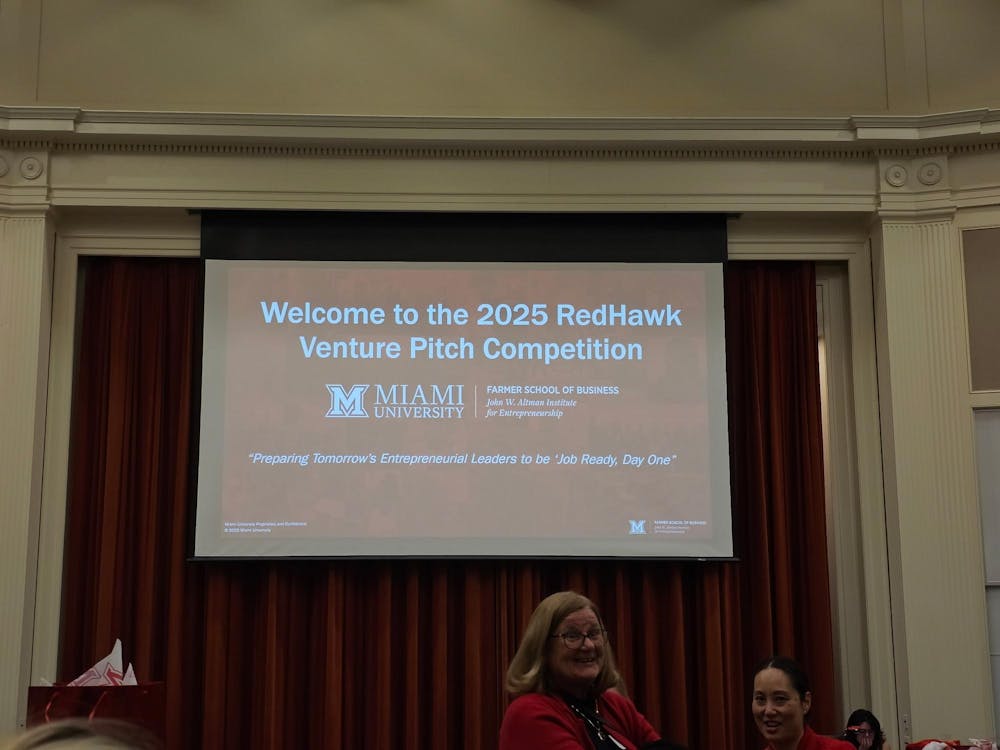
On Dec. 4, 2025, the Farmer School of Business hosted the RedHawk Venture Pitch Competition. Participants were a part of the Entrepreneurship New Venture capstone and, throughout the semester, developed a product or service that proved to solve a problem, was marketable and had viable financial predictions so we could inevitably present to real-world investors.
With the help of the supportive faculty, our all-female group and I proposed Ember, a one-on-one mentorship app for women seeking support during postpartum depression. We shared our findings and financials with the mentors provided to us, and we were told by all of them how we had created a service that had large growth potential.
In the preliminary round, teams were divided into five rooms and had eight minutes to pitch before being stopped. Our group was placed with Chalk, a solution to gambling addictions, and ModMobility, an attachable motor that turns manual wheelchairs into powered ones.
According to the Harvard School of Business, although women make 80% of household healthcare decisions, men account for 89% of partners at venture capital firms. This was evident throughout our pitch, as the eight investors present in our preliminary round — seven of whom were male — hardly took any notes during our presentation. One even explained to us how his wife solved her postpartum depression with “some neighborhood friends and a bottle of wine.”
Meanwhile, one all-male group compared their product to a porn addiction platform, and they were still taken more seriously by judges.
What was even more shocking was how our male peers surrounding us mocked our presentation as we were speaking and after we left.
“There was a group who sat directly behind us in Taylor Auditorium,” said Meredith Vontroba, a member of the Ember team. “... They had seen our presentation, and I don’t know if they knew that we could hear them … but they were talking about how they were totally going to make it to the final over us because our group was all women, and they said that our problem wasn’t a serious enough problem to make it to the final because it only affected women and only affected moms.”
In addition to this, there were two other groups centered around women’s health in this contest: Her Turn, which focused on menopause, and Little Moon, which focused on period products.
Jack Isphording, a member of the Little Moon team, said during his group’s pitch, the judges seemed attentive and respectful, but felt the mood shift when the presentation ended.
“When it was time for questions, there was a good pause, almost like the judges didn’t know what to do or ask or were uncomfortable to ask questions due to the topic at hand,” Isphording said.
Enjoy what you're reading?
Signup for our newsletter
ModMobility won the entire contest, including a $5,000 check, despite not finishing their presentation in their designated time and speaking with judges when the preliminary round was already concluded. No women’s health group advanced to the final round, with Her Turn receiving the comment that they were very close.
My intention in writing this article is not to undermine the Farmer School of Business, as they provided us with this opportunity, but rather call attention to the male investors and peers who hindered our experience. The purpose of this pitch night was to simulate the interactions between potential startups and real-world investors.
It’s disheartening that this is what we can expect when FemTech represents a multibillion-dollar global market that, in a majority of circumstances, continues to be ignored.
Sophia DeVillez is a senior at Miami University, double majoring in creative writing and professional writing with minors in arts management, entrepreneurship and literature. After graduation, she plans to publish her 90,000-word young adult fantasy novel and pursue a career in copy editing.
Read More

The many labels we hold
By Anthony Caprara | 13 hours ago"To be compressed into an assumption of who we are based on a few interests is flattening for us all, yet we find ourselves victims and perpetrators every day."

Why do women need to be perfect?
By Veronica Dallas | Yesterday"However you look at this trend, women are getting more and more negative feedback no matter what they do or who they cater toward."

Alcoholic beverages lack transparency and oversight
By Elisa Rosenthal | 6 days ago"The back of the can doesn’t give much information either, only a government warning and a select few nutritional facts: calories, carbohydrates, protein and fat. Although I’m sure that’s enough for some — and too much for others — it lacks transparency."