
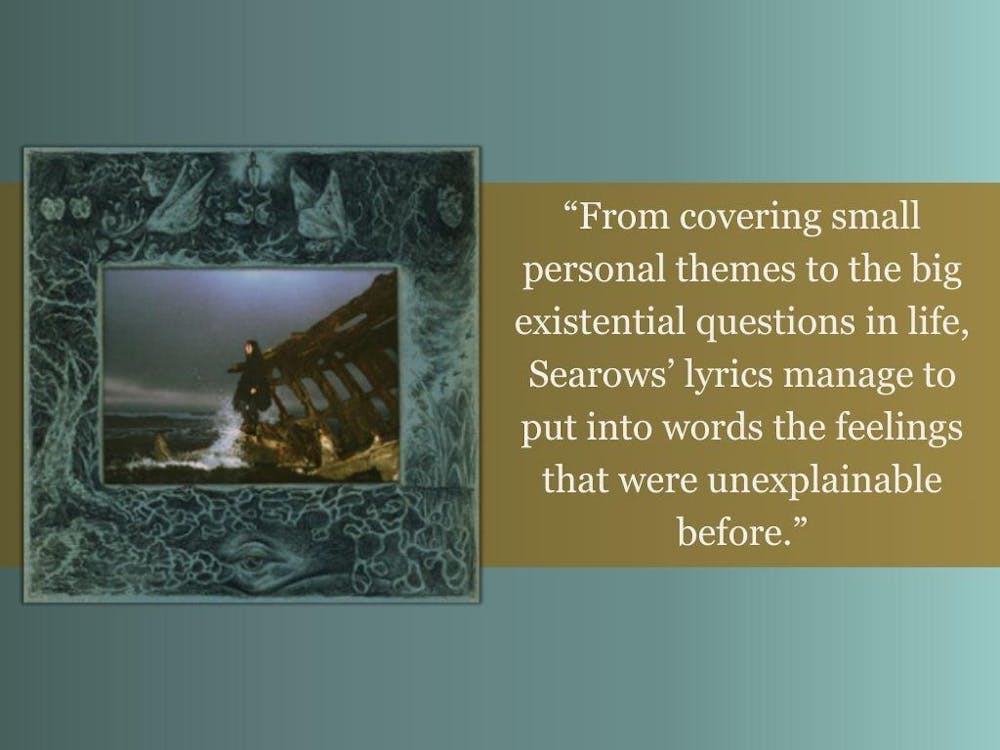
Searows, otherwise known as Alec Duckart, recently released the album “Death in the Business of Whaling” on Jan. 23.
Searows’ has an intimate and folk-style of music. His music is melancholic while still carrying a soothing ability. Searows is the type of musician you listen to during times of high-stress for relatability and comfort. His music is perfect for late nights.
The album is heavily connected to metaphors and imagery of the deep ocean. It tackles larger themes of death and what the ending of life truly means, rather than the album being a direct reflection of Duckart’s emotional experiences, unlike Searows’ previous projects.
“Belly of the Whale” starts the album with the feeling of being stuck in the world. The imagery of being in the belly of a whale creates a feeling of darkness, claustrophobia and the weight of life around you.
The album’s second track, “Kill What You Eat,” continues the nautical theme by using a fish as a metaphor for relationships. At the end of the track, he is “cutting out the heart of the fish I caught,” which can be interpreted as ending the relationship where it began: in the heart.
“Photograph of a Cyclone” touches on the human trait of repeating behaviors you learned from your environment. Searows compares the helplessness of being stuck in a cycle to watching a cyclone and not being able to do anything to stop its destruction.
The following track, “Hunter,” explores the idea of destructive behavior patterns. In this song, Searows sings about fulfilling self-destructive behavior all for the approval and affection of another.
“Dirt” marks the turning point of the album, moving from lyrics about relationships and life experiences to the finite existence of everything and finding peace in that.
Continuing the intersection of human connection and life, “Dearly Missed” has lyrics with ideas of how death and relationships are connected. The track explores grief and rage as a reaction to a traumatic loss. The song starts slow, and about halfway through the six-minute track, there’s a rise of aggressive instrumentals.
Duckart expresses the desire to escape life in “Junie”. Instead of the angry tones in the previous track, the song has soothing instrumentals that connect to Duckart’s desire for escapism from his own life to begin a new one. Duckart explains that he wrote this song after his guidance counselor unconvincingly tries to talk him out of dropping out of highschool.
“In Violet” moves from the pressure of external expectations to the insecurity of our own expectations for ourselves. This track explores the gap between how we want to be perceived and the reality of what others see. Searows incorporates banjos into this song, adding more depth to its instrumental elements.
The last track of the album, “Geese,” heavily alludes to Mary Oliver’s famous poem, “Wild Geese.” To escape the suffocating reality of having to be good, the person Searows is singing to remind them that they do not have to continuously improve themselves, but still, they cannot remain at a static state in their life.
Enjoy what you're reading?
Signup for our newsletter
The instrumental aspects of this album can be slow at times, as a lot of the songs carry a similar melancholic tone. However, the lyrics are immersive, so the instrumentals don't need to be extremely upbeat or quick.
Searows’ songs take a symbolic approach of telling a story addressed to someone else through memories. This technique is vague but leaves room for interpretation on what the gaps in the stories may be. From covering small personal themes to the big existential questions in life, Searows’ lyrics manage to put into words the feelings that were unexplainable before.
Rating: 9/10
chaffele@miamioh.edu
Read More

‘Practical Magic 2’: Shenanigans
By Eliza Garrett | 2 days agoThe Owens sisters are back after nearly three decades, and this time, they have even more magic, family drama and romance than ever before. “Practical Magic 2” brings Gillian and Sally Owens back to the big screen and allows the audience to experience their magic once again.

Lizzy McAlpine makes folk her own in ‘Angel’
By Ren Chaffee | 4 days ago“Angel,” Lizzy McAlpine’s new album, released Sept. 18. Although there are some mixed reviews, “Angel” hits the mark for me.

Finding comfort in food
By August Humphrey | 6 days agoFood: possibly one of my favorite four-letter words; not just because I love a good meal, but also because of how it can represent people’s identities. Just take a quick look at the TV schedule for the Food Network, where celebrities take us into their personal lives with food. People like Ree Drummond take us behind the scenes and show us what food means to them, and the impact it’s had on their lives. Not only do we need food to live, we need it to thrive.