
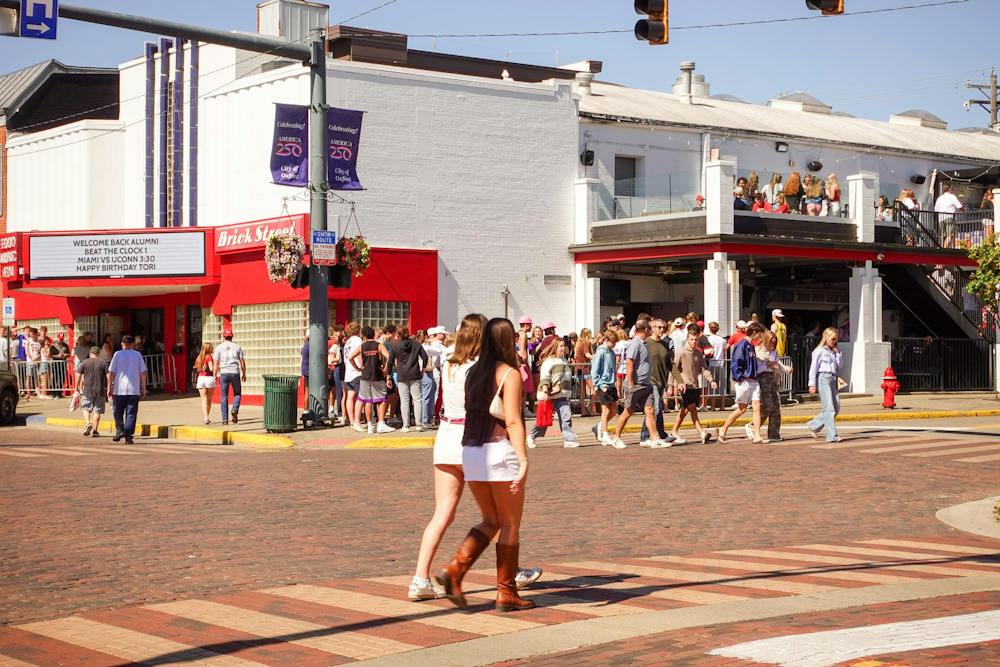
Like most students returning back to campus after a night of drinking, Rob anticipated his return home would be uneventful, maybe even a little boring. However, as he walked by the Maplestreet Station residence hall, this notion was shattered.
When he looked up, he saw a student climbing up the hall’s gutter to get to her dorm through the window, following friends that went before her. Concerned that she appeared to be slipping, he ran over to catch her, but not before she lost her footing and fell.
“I caught her shoulders, but I felt her ribs snap against the concrete,” said Rob, a senior political science major, who is identified here by his first name because he was underage at the time of the incident.
With the student injured and distraught on the sidewalk, he called 911 for an ambulance. After they arrived and put her on a stretcher, the paramedics thanked Rob for his help and told him he was free to go home.
While he didn’t know it at the time, Rob, who was intoxicated and underage, didn’t just get away with a stroke of luck. He received no punishment because there was a system in place meant to protect people like him who took a risk and did the right thing: Miami University’s Good Samaritan Policy.
The Good Samaritan Policy is a limited medical amnesty policy that is meant to prevent students who call for assistance for another student on campus from administrative consequences if they themselves are also under the influence of drugs or alcohol.
Enjoy what you're reading?
Signup for our newsletter
Developed during the 2013-14 school year and administered by the Office of Community Standards, the policy was designed to encourage students to care for one another during crisis. It is a comprehensive policy that covers both Code of Conduct violations and charges pressed by the Miami University Police Department (MUPD).
“[The Good Samaritan Policy] means that students will very likely not be held accountable for the alcohol piece or the drug piece of calling for help the first time that ever happens,” said Alex Fields, the director of the Office of Community Standards.
The process is relatively straightforward. When the MUPD or university staff respond to a distress call on campus, the report is later evaluated by the Office of Community Standards, who determine whether or not the student(s) actions fall under the Good Samaritan policy. If the students are cooperative and nonviolent, callers are not disciplined by the university and legal action is not taken against them.
“If somebody calls for you and you are engaging in what we would consider like disorderly conduct, for example … we would not hold to the policy,” Fields said. “If you are breaking other other policies [such as possessing a fake ID] we could maybe consider [proper consequences for that] but not the alcohol piece.”
Students are allowed to call for another student an unlimited number of times without any penalty. If a student is intoxicated and calls for assistance themself, they are only allowed one call before normal university and legal rules apply.
Importantly, however, this policy cannot trump state law, so it only applies to students who call the MUPD on campus property, and are either cited for by the MUPD or for Code of Conduct violations. If a student is confronted by the Oxford Police Department (OPD) off campus, they enjoy no such legal protections.
“We are going to follow the Ohio Revised Code and the appropriate charges,” OPD Lt. Adam Price said. “It’s not like … we arrest somebody and figure out they’re a Miami student, we’re going to un-arrest them.”
Had Rob’s incident taken place Uptown, he and the injured student may have faced harsher consequences, which usually manifest in citations like disorderly conduct, underage intoxication or possession of a fake ID. Students are typically cited and released or transported to the emergency room for medical treatment, depending on the responding officers’ judgement of their ability to take care of themself. Very few students are transported to jail on alcohol charges alone.
“We’re gonna give you a citation, it’s almost like a speeding ticket,” Price said. “... You’re not being arrested, put in handcuffs and taken to jail necessarily.”
Legally speaking, the Good Samaritan Policy only applies on campus. However, Price said that while there are no guarantees, the OPD often uses discretion when responding to distress calls and rarely interrogates those who flag officers down for help.
“If you’ve been drinking, and you’re calling for someone else, you’re probably not going to get yourself in trouble.” Price said.
However, despite the relative uncertainty around consequences on and off campus, Price and Fields both said students shouldn’t focus on weighing potential consequences when deciding to make a call for help.
“When it comes to alcohol, things can go from bad to tragic in a matter of moments,” Fields said. “I’d rather them get a ticket … then be at significant risk of loss of life [or] loss of brain function.”
Fields said her office receives relatively few Good Samaritan reports compared to other alcohol incident reports, a troubling sign that Miami students are often reluctant to call for help for each other.
“There’s still a ton of cases where we find people passed out outside Roudebush in the morning … and you have to think how many people have walked past a member of their community and didn’t do anything,” Fields said.
Many students don’t even know the policy exists at all, until they run into it.
“I didn’t really know about it in effect, but I knew about it in theory,” Rob said. “I wasn’t really worried about it at the time, I was more worried about her getting hurt.”
Fields reiterated that even if the policy doesn’t end up applying, the discipline policy is not something to be afraid of, and its consequences are nothing compared to the hazards of leaving an unconscious person alone.
“I am never going to ask a student to commit to never drinking again,” Fields said. “What I want students to promise me is that they’re going to be aware of their surroundings.”
Rob chose to only provide his first name to protect his identity, because he was underage and intoxicated at the time of the incident.
Read More
David McComb’s journey to the starting quarterback job for the RedHawks
By Alyssa Vazquez | 1 hours agoMcComb was impressive through his first four games with the RedHawks before suffering a season-ending injury in week four against the University of Connecticut.

‘Primetime’ is an absolute must-watch
By Elisa Rosenthal | 3 hours agoA24’s “Primetime,” starring Robert Pattinson as Chris Hansen, is one of the most unsettlingly fantastic movies I’ve seen in a long time. As someone who used to not like going to movie theaters, this had me squirming.

Miami football needs a change
By Vincent Jolliff | YesterdayMartin is a legend in Oxford. He should be appreciated and applauded for all he has done for the program, but as frustrations continue to grow, is he the best option for the future?