
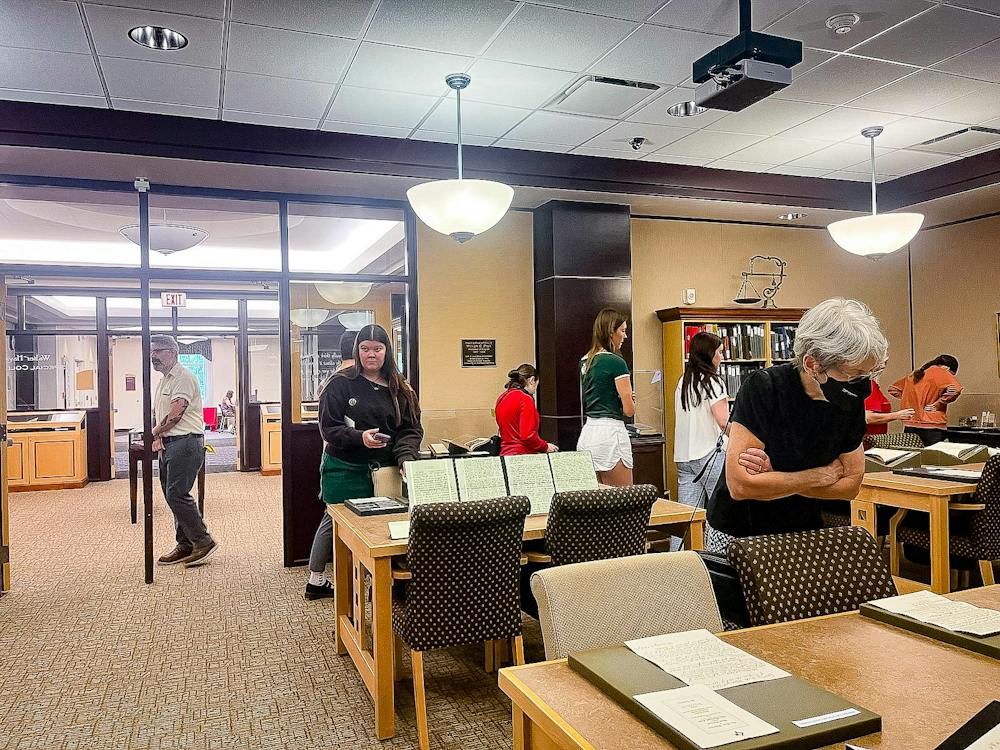
Within King Library, Special Collections, manuscripts, archives and preservation act as a cultural hub providing students, patrons and residents the coveted privilege of directly engaging with the past for academic pursuits and curiosities alike.
“Humanity is not just a specific group of people; it’s everybody, and part of my job as an archivist is to tell those stories the best I can, while acknowledging the fact that we don’t have everybody — and that is a gap and a foresight that we have to correct moving forward,” University Archivist Ani Karagianis said.
Karagianis said the principle remains just as relevant now.
“Archives, despite being kind of sometimes hidden in an ivory tower [are] actually for lay people because one: they’re in English mostly, but [also because] they tell stories about folks that most of the time don't even have names” she said.
Special Collections Librarian Rachel Makarowski said the collections reveal a plethora of information about a specific time and place in history.
“With archival and special collections research you get a story and these small glimmers, these hints, but there’s almost always something that is either crucial to telling a story or something that is going to remain a mystery because we just don’t have the documentation about it,” Makarowski said.
This information is revealed through both personal and official documentation, which interlock together to create a more complex picture. Makarowski holds another role as the vice president for librarians in the Faculty Alliance of Miami.
She said archival documents help illuminate the dynamics behind union and university decisions.
“The official documents are also interesting because it’s really easy when unionizing and when negotiating union contracts, to be like it’s us versus them … but the documents actually show that the university is genuinely doing what they can behind the scenes to close the contract,” Makarowski said.
Blending personal and official documents to create a coherent story proposes an opportunity to illustrate a historic profile. Most recently, Rare Books and Manuscripts Librarian Candace Pine curated the Cradle of Coaches Exhibition.
“[Miami University] hired a whole outside media company to put together a documentary about the Cradle of Coaches, and they came here to do the research. They took some of our old film and digitized it. We pulled all kinds of photos for them to scan and use” Pine said.
Although, even with documented resources, some views are limited and people are underrepresented.
Enjoy what you're reading?
Signup for our newsletter
“When you work, when you start to have all these things in orbit together, it does tell as close to a full story as you can, while fully noting that we didn’t get everything,” Karaginis said.
These missing puzzle pieces form the “myth of neutrality” which highlights past gaps in the literature and living record of humanity.
“Special collections, especially, has been a memorial to powerful white men. When you look at the history of whose books cost the most, whose first editions are most rare, who is it that people want to collect …” Makarowski said. “History is made up of everyday people making small choices that create national and international movements, which help both to answer the question of who is missing and who is here.”
The archives are more than just showcases. They also do the work of preserving a whole host of mediums. Preservation Librarian Eric Harrelson said the task is delicate, time sensitive and requires incredibly in-depth knowledge.
“[Perservation] is a lot of the same principles of understanding materiality, construction and how to disassemble, repair and reassemble,” Harrelson said.
Essential to archival research, preservation supports physicality — encouraging visitors to see, flip through and read first-hand letters, manuscripts, speeches and more.
“Our instruction program is largely based on faculty bringing their classes in for archival instruction and research,” Makarowski said. “There is also when we’re embedded into a class, essentially a co-partner or faculty member, and we help to shape the overall and make sure students have access to the materials throughout the course.”
Karagianis helped to bring archival information to a class discussion on Freedom Summer.
“I did a class about the Freedom Summer, which is really compelling, and we were able to pull some publications and posters from the Student Nonviolent Coordinating Committee,” Karagianis said. “It was really great to see the students start making these connections and seeing how visceral these posters and documents were.”
Right now, there is a real focus on how digital technologies are changing archives. For Makarowski, it’s a double-edged sword.
“On the one hand, it’s great in terms of accessibility, but I think more and more as technology changes and evolves, people expect there to be everything online, when really, what is online is just a very small portion — at most 3% — of what we have,” Makarowski said.
For now, Special Collections is focused on making their unique expertise available to the public, a task Department Head Jacky Johnson is particularly proud of.
“We’re really good with making sure that our doors are open, that we’re accessible, and we make our items available,” Johnson said. “The people — it’s always going to be [about] the people helping patrons, researchers, high school students, college students, the general public and faculty and staff find materials.”
Read More

ASG votes to encourage university to provide allergy shots
By Shannon Mahoney | 2538 minutes agoMiami University’s Associated Student Government (ASG) passed a resolution involving allergy shots, discussed lighting issues at the intramural courts and elected members to serve on the search committee for the next student trustee at its meeting on Oct. 6.

The many labels we hold
By Anthony Caprara | 6 hours ago"To be compressed into an assumption of who we are based on a few interests is flattening for us all, yet we find ourselves victims and perpetrators every day."

The death of the aux cord
By Ren Chaffee | 6 hours agoThe way that we listen to music as a society has shifted and changed over time. Yet, it remains a crucial part of many people’s lives. The sad thing is that music has become an isolated part of life, even though it was created as a way to connect and communicate with others.