
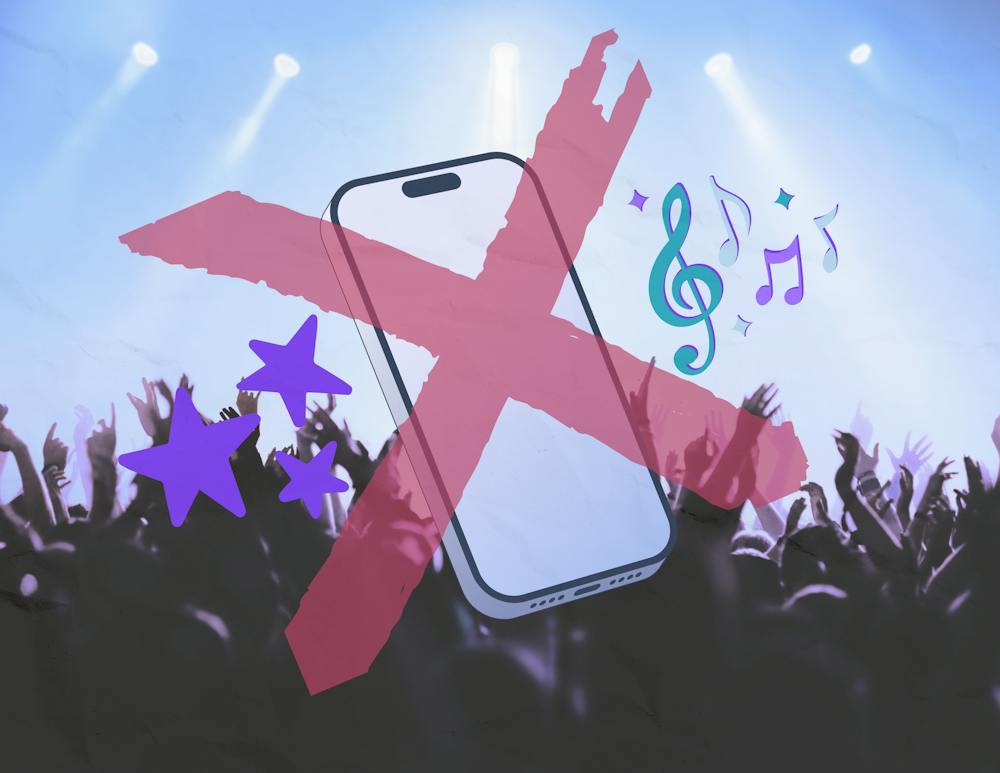
Phoebe Bridgers launched “The Lost Tour” this year, following her new album “Lost Weekend.” Every aspect of her tour is normal, except for one rule — there are no phones.
I attended her show in Columbus on Sept. 22, and I will never forget that amazing and unique experience.
My two friends and I had general admission pit tickets, so we got there around 10 a.m. and were approximately the sixth group in line. While countless people were camping out all day, some gave out glowsticks to everyone in line, in anticipation of the phone-free rule that would prohibit us from using flashlights during songs.
A little before 6 p.m., we got through the doors. We scanned our tickets and went through security. Then, arena employees waited at a table with Yondr Pouches. These are fabric bags that have a magnetic lock and can only be unlocked with the corresponding magnet. We were asked to turn our phones off, and the devices were locked into those bags. The pouches could be kept with us, and they had a sling so they could be worn on your shoulder.
It wasn’t just phones that were banned, either. Any recording devices or smart devices, including digital cameras, Apple Watches and Meta glasses, could not enter the venue.
At first, I was a little upset about the phone ban. We got a place right at the barricade, so we were front row for her B-stage where she played half of her set. I wanted proof to take pictures of this experience and document my time. But in the end, I am glad I did not have my phone, and I would not trade my experience for anything.
Bridgers gave a heartfelt speech before singing the song ‘Standing Still’ off her new album. She talked about grief and the vulnerability behind losing her dad. She explained to the crowd that her songs showcase this vulnerability, and having screens surrounding her while pouring out her heart creates a disconnection. It feels rude to record someone’s moments of hurt just to display on the internet.
The human connection was there, and everybody felt it. Before the concert, people had conversations; they made friends, played games and truly talked to each other. The whole crowd continued ‘the wave’ for almost 20 minutes, and everyone was entertained. During the concert, there were no screens blocking your view or flashlights blinding your vision. Some brought in lighters to hold up during slower songs, which was magical to see.
The last song she played was “Scott Street,” off her album “Stranger in the Alps,” which turned 9 years old the day of the concert. At the end of that song, she repeats, “anyway don’t be a stranger.” As she sang this, the warm lights came on around the arena, and all you could see was a sea of faces singing along, crying, swaying and holding their loved ones. Everyone was focused right on the music and the words.
The device-free concert may seem intimidating in a world where screens are everything. Instead, it felt inspiring. It reminded me that every person in that room was real and had the same vulnerable human emotions I was feeling. I felt more connected not only to the music, but also to every person in that building.
Layla Norris is a sophomore double majoring in political science and professional writing, with minors in history and human capital management and leadership. Alongside writing for The Miami Student, she is involved with Kappa Alpha Pi and RedHawk Radio.
Enjoy what you're reading?
Signup for our newsletter
Read More

Preview: Miami football travels to UMass looking for its first conference win
By Alyssa Vazquez | 23 hours agoThe matchup between UMass and Miami is an important mid-season test, with both teams looking to respond after disappointing conference losses.

Horse therapy builds new pen to expand services
By Ada Lillie Worthington | 23 hours agoThis semester, the horse therapy services at Miami are changing as the construction of a new round pen nears its completion. With this new addition, students will have more freedom moving the horses around during their sessions.
Growing concerns around a new synthetic opioid cychlorphine
By Tori Fee | YesterdayCychlorphine, a strong synthetic opioid, has become a growing concern in at least 24 states, including Ohio. Recent overdose cases at college campuses across the nation are putting a spotlight on cychlorphine and its risks.