
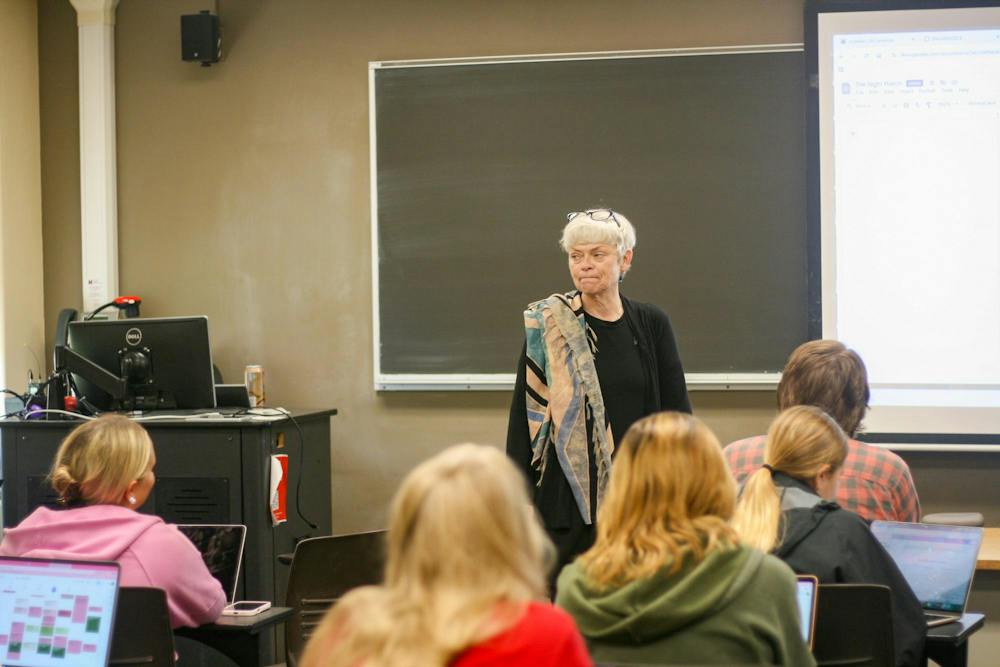
In the past five years, five Miami University journalism professors have left the department or taken leave: three retired, one visiting professor unexpectedly left mid-semester and one professor is currently on medical leave.
None of those open positions have been filled. In fact, the last journalism department hire was in 2014.
Miami’s hiring process for new professors begins with department chairs requesting a new hire line from the dean of their prospective college. The Office of Equal Employment and Opportunity (OEEO) must also review the request for a new professor.
After these approvals, the request is forwarded to Academic Personnel Services, which ensures that the department chairs and deans follow the guidelines and procedures for hiring. If Academic Personnel Services approves the request, the Office of the Provost has final authorization in granting the requesting department a new faculty hire.
In an email to The Miami Student, Trent Gould, provost and executive vice president for academic affairs, said new hire lines depend on current student demand and workforce needs, not where the faculty opening originated.
“When faculty retire or move on, their positions are evaluated at that time as part of normal workforce planning, which often means instructional capacity is redirected to where student and program need currently exists rather than remaining tied permanently to a single field,” Gould wrote.
Despite hiring trends following student demands, departments across campus are still struggling to fill open positions.
Rosemary Pennington, chair of the Department of Media, Journalism and Film (MJF), said when she requests new faculty lines, she knows her colleagues are asking for faculty lines as well.
“Anytime you’re asking for a faculty line, you’re also competing with people in English, history or even outside of the humanities,” Pennington said. “Because the final approval comes from the provost, maybe you’re also up against someone in Farmer or the Engineering School.”
Current professors are taking on extra responsibilities partially because department chairs are struggling to hire new professors, but also because Miami is working to create equity around teaching loads.
Current Miami policy states that teaching, clinical professors and lecturers must maintain 4/4 workloads, meaning they teach four classes in both the fall and spring semesters. For professors in departments that are down faculty members, such as journalism, these professors must also pick up extra service responsibilities. Service within their departments includes advising students and overseeing student organizations.
Fred Reeder Jr., associate clinical professor of journalism, said the added workloads have affected the quality of his teaching and his mental health.
Enjoy what you're reading?
Signup for our newsletter
“It’s certainly a problem for the faculty being able to find ways to teach students to the level that they want to teach them and to help students, while not sacrificing not only the quality of their teaching, but the mental health of the faculty as well.”
This semester, Reeder is teaching four written journalism courses, giving him about 20 more students. He said grading 20 extra assignments has amounted to seven more hours of grading.
“It’s pretty daunting to face this extra work, and so you end up trying to figure out how you can survive the semester,” he said.
Not only are professors facing difficulties this semester, but students are seeing the drawbacks of faculty deficits as well.
The English department had six professors leave at the end of the last school year and have not hired replacements. Emily Blanford, junior English literature major, said she’s noticed that these openings led to fewer English elective courses being offered.
“We haven’t had a lot of Shakespeare because currently we only have one person who teaches Shakespeare,” Blanford said. “My only experience of taking Shakespeare was when I studied abroad, so I haven’t actually had a course at Miami on Shakespeare, which is odd for an English major.”
Blanford said she’s also worried if required classes will be taught in time for her to graduate due to faculty openings.
“I can understand the student stress of, ‘Oh my god am I gonna graduate on time?’ because I have those thoughts also,” Blanford said. “But then we have to think this is also a university issue.”
The solution here is a joint effort between university administrators and teaching faculty.
The remodeling of Bachelor Hall brought new spaces for the humanities, including film screening rooms, a broadcast television studio, audio recording studios and events spaces for community engagement.
Reeder said he recognizes Miami’s efforts to revamp their humanities programs, but more needs to be done.
“So the messages from Miami I get [are] that we do indeed care about the humanities, but the next step needs to be heavy recruiting of the students who are going to study the humanities,” Reeder said.
Recruiting more students and increasing numbers within the humanities, would help these departments gain new hire lines from the Office of the Provost.
Along with recruiting more students, Miami needs to recognize where faculty deficits are placing the most strain on their respective departments.
“I do think the deans and the provost have to figure out where the most urgent need [is] and try to address it,” Pennington said.
Pennington recently received approval from the Office of the Provost to hire a new journalism professor. She said she intends to hire a professional that can teach students about artificial intelligence. in journalism and new media technologies in general. MJF hopes to have their new professor hired by the end of this semester and teaching by fall of 2027.
For the time being, Reeder said he recognizes that professors must continue managing increased workloads to the best of their ability.
“If the reality is going to be that we teach as much as we now have to teach, then at some point you have to do your best to also find ways to solve the problem,” Reeder said. “Certainly it would be nice if the university fully understood what a burden teaching four writing classes is, as opposed to four broomball classes.”
Read More

Hockey captain helps Miami hockey rebuild after loss-ridden past
By Adelaide Christensen | 296 minutes agoFor many people, the love for sports starts at a young age. For Miami University men’s hockey senior captain Doug Grimes, that’s exactly where his journey began.
A duty to vote
By Christian Poppell | 2 hours ago"Single votes rarely decide an election, but close races are often decided by a handful of people in each community who did or didn't show up."

Takeaways from all the fashion weeks
By Kiser Young | 2 hours agoIf you’ve been following the Council of Fashion Designers of America (CFDA) calendar, then you’ve likely noticed the busy past couple of weeks. From September through October, there are hundreds of designers debuting presentations and runway shows across the globe, or, more honestly, the traditional fashion capitals of the Western world.