
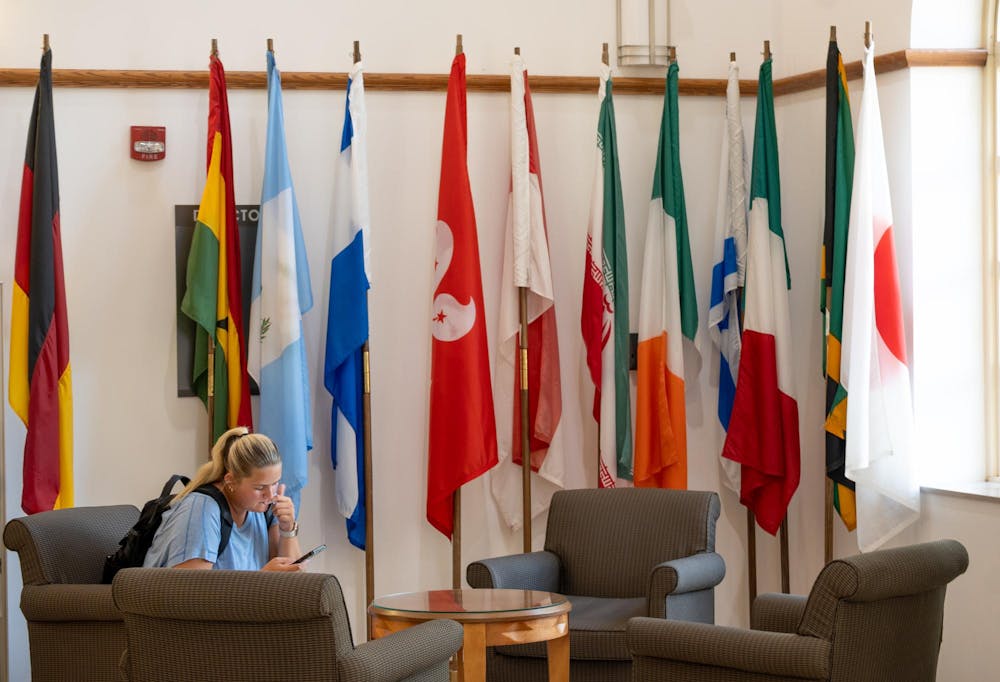
On Aug. 12, I left my hometown in India and moved halfway across the world to start college at Miami University. My parents couldn’t accompany me as they did not have a visa, and neither could the other Indian students who were supposed to be here with me this fall.
When I asked my friend, whose visa was rejected and who could not be here at Miami, what he would want to change about the visa process, he said he’d want more information about the application, because it will help applicants make the necessary changes and reapply.
“I would want more details as to why my application was rejected, apart from the slip code they normally give,” he said in a phone call.
His experience is not an isolated one. Inside Higher Ed reported that 35% of F-1 student visa applications worldwide were refused in 2025, the highest refusal rate in a decade. The refusals were particularly concentrated in Africa, the Middle East and South Asia.
People around me have had very different reactions to the situation. One of my relatives believes students should stop going to the U.S. altogether. Others think that while pursuing higher education in the U.S. is still worthwhile, students should not rely solely on that option and should maintain “backup plans” in their home countries. Others take a more balanced view.
Khushi Shah, a junior and international peer orientation leader (iPOL) at Miami who has worked closely with international students, said people applying for visas must go through an administrative process adopted by every country.
“While it could be better in terms of transparency, students applying also have to make sure that they are well-versed with the rules facing them,” Shah said.
Some international students consider the return on investment (ROI) of a degree before deciding to study abroad. I did too. There are financial costs, visa requirements, uncertainty and the question of whether the opportunities after graduation will justify all of it. Those things matter.
But I think we need to move past ROI for a moment.
To me, education is not just about the degree at the end. It is also about the journey: the people you meet, the perspectives you encounter and the ideas you are exposed to. That should matter regardless of where a student comes from. International education is an exchange, and that exchange does not have to happen in only one direction.
History gives us plenty of examples of people crossing borders to learn from one another. The Chinese Buddhist monk Xuanzang traveled from China to India in the seventh century to study Buddhist philosophy and texts, spending years learning from Indian scholars before returning home. He was not the only one.
People have been traveling across borders to learn languages, study different intellectual traditions and bring new ideas back with them for centuries. That exchange is not new, and I don’t think it’s something we should lose sight of now.
Enjoy what you're reading?
Signup for our newsletter
That is what I value about being at Miami. My liberal arts education matters to me not only because of what I will eventually do with my degree, but because of the people and perspectives I encounter along the way. I am learning alongside people who grew up differently from me, speak different languages and sometimes perceive the same question differently. That is education too.
Universities are communities before they are institutions that award degrees. The people in those communities shape what is questioned and learned. Domestic students benefit from international students too, not only academically, but socially and culturally. Meeting someone from another country can challenge an assumption you did not even realize you had. It can simply make your world a little bigger.
When visa restrictions become tighter, we tend to talk about the economic and material consequences first. How many students will stop applying? How much will universities lose? Will international enrollment decline? But I think we also need to pause and think about the social value of this exchange.
I am not arguing that international students are entitled to visas, or that they should come to the U.S. to immigrate. Students have rules to follow too. Visa processes will probably always involve bureaucracy, extra scrutiny and uncertainty.
What I am asking is: what do we lose when fewer people from different parts of the world are able to participate in higher education together?
Every international student brings another perspective, set of experiences and ways of seeing the world. Fewer students can mean fewer ideas flowing in.
That matters.
Vedika Kaushal is a first-year student studying political science and economics. She is an aspiring journalist and international relations researcher. She spends time reading research on the politics of India and the Middle East. Beyond academics, she enjoys reading poetry, playing chess and finds joy in the kitchen.
Read More

Shows to keep you entertained this fall
By Ren Chaffee | 3556 minutes agoSometimes the transition into fall can be scary. The weather inevitably gets colder, and class begins again. The perfect way to fight the impending sense of doom is to watch a good show.

Miami’s civics center faces potential changes in proposed bill
By Owen Martin | 20 hours agoLess than two weeks after it began offering courses, Miami University’s Center for Civics, Culture and Society is facing a potential restructuring from the same body that created it.

“The heart of Hepburn”: Building Grounds Associate dedicates 24 years to Miami
By Zoee Robinson | 20 hours agoOn the first day of the 2026-27 school year, Kimberly Durham celebrated nearly two and a half decades of service at Miami University – 24 years on Aug. 24, to be exact.