
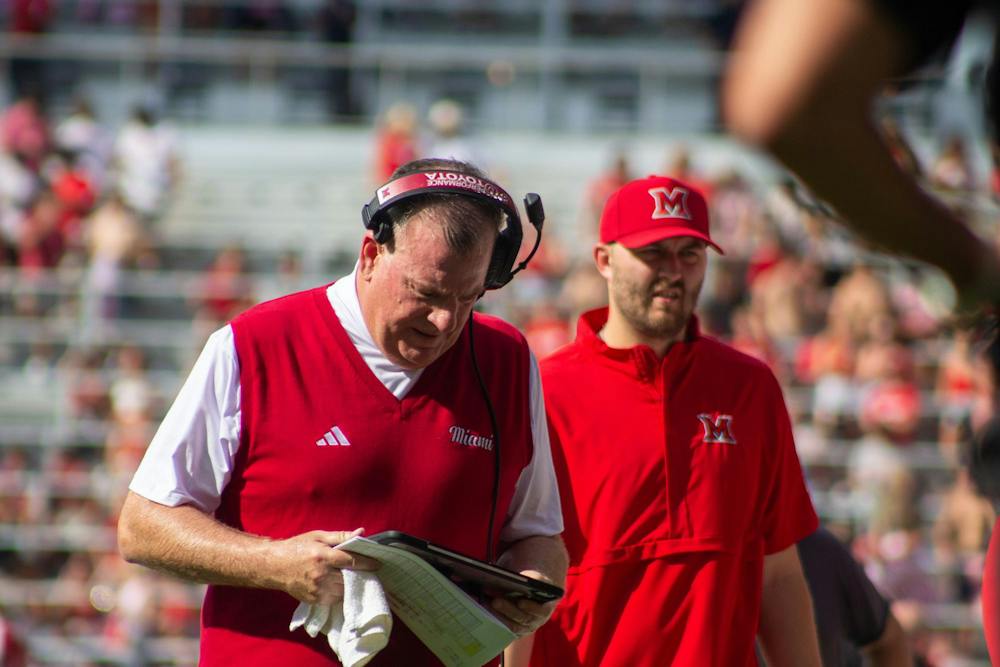
When Miami University head football coach Chuck Martin looked across the field before the Arizona Bowl against Colorado State University in 2024, he saw the RedHawks were being left behind in the new era of college football.
Martin asked a coach from Colorado State how much money the team had available for its roster. He expected an answer somewhere in between $500,000 and $1 million.
The answer was $2.5 million. Martin had only $80,000.
The difference became a wake-up call for Miami. Instead of taking the financial difference as a given, Martin started pushing the program to find new ways to raise money. Miami needed the ability to compete in an environment where name, image and likeness (NIL) and revenue sharing have become a bigger part of roster construction.
“I thought, holy cow, if we’re that far behind Colorado State, I can only imagine where Ohio State is at,” Martin said. “But I’m not trying to catch Ohio State. I’m trying to be a Group of Six competitor.”
According to CBS Sports, Miami’s 2026 roster cost sits in the mid-to-upper seven figures, with one source estimating the total between $8 million and $10 million. The spending helped Miami assemble a 15-player recruiting class, currently ranked first in the Mid-American Conference. It includes several players who had previously been in the transfer portal from Power Four schools.
For a program that only recently started seriously investing in NIL, the jump represents a change in philosophy.
“We’re still in the infancy, we’re still figuring it out, we’re still building this thing,” Martin said. “But we took a giant leap in one year.”
Martin said Miami has looked toward professional football as a general model for how different positions might be valued. Quarterbacks, wide receivers, offensive tackles and pass rushers can command more money because of their importance and value at the professional level.
But Miami doesn’t have the ability to compensate every player significantly.
“We’re not at the point where we have money to pay, everyone,” Martin said.
This separates Miami from the highest-spending programs in college football. Martin said some of the largest spenders are talking about issuing around $50 million annually, while he believes a Group of Five program such as Miami can operate more realistically in the $5 million to $10 million range.
Enjoy what you're reading?
Signup for our newsletter
“If you’re trying to talk about raising five million a year, I think that’s sustainable, if you’re talking about raising 50 million a year, yeah that won’t work,” Martin said.
The financial push has also changed Miami’s ability to recruit players through the transfer portal.
Brad Okel, Miami’s associate athletic director for revenue generation and assistant vice president for development, said the program had difficulty attracting higher-end players in the portal. The increased investment has changed that.
“We’ve been able to bring some folks in football,” Okel said. “They’re buried in these rosters, and they’re coming here now; they’re getting all sorts of playing time.”
That playing time opportunity, coupled with Miami’s increased financial commitment, gives the RedHawks another tool when competing for transfers against bigger programs.
The transition has also required changes beyond just raising more money. When Okel arrived at Miami in 2023, he said the university had little NIL infrastructure in place. The athletic department worked with alumni to build the Red Brick Legacy Collective and started educating donors about NIL as another way to invest in the athletic program.
“It’s taken some time to get people’s heads kind of wrapped around it as this is just the reality of how we need to invest in our program and in our student athletes going forward,” Okel said.
Robbie Trittschuh, Miami’s assistant athletic director for compliance, said it’s necessary to adapt because the college sports landscape is changing rapidly.
“It’s either you adapt or you fall behind,” Trittschuh said.
Miami’s approach has shifted from reacting to NIL to making it part of its long-term roster strategy. The question now is if the university can sustain funding that strategy as costs continue to rise across college football.
Okel said the growth rate is his biggest concern.
“If the growth rate were to flatten a little, maybe we can find the right levers to be able to compete at this level for a really long time, but if it keeps growing at that pace, I don’t know how anyone can,” Okel said.
For Miami, the goal isn’t to match the biggest programs in the country. Instead, the RedHawks are trying to figure out how much they need to invest to be able to compete in the Group of Six.
After moving from an $80,000 roster budget to an estimated $8 million to $10 million roster this offseason, Miami has already shown just how quickly its strategy can change.
As Miami continues to increase its investment in football, the RedHawks will have to prove that their new approach to NIL can keep them competitive without becoming financially unsustainable in the coming years.
Read More

More than a Midwest school: Miami attracts students from across the nation
By Sofie Terlesky | 1 hours agoMiami University brings together students from all different backgrounds. For some, it’s a 45-minute drive from home; for others, it’s a six-hour plane ride. Regardless of the distance, many students come to see Miami as their home away from home.

Finding comfort in food
By August Humphrey | 2 hours agoFood: possibly one of my favorite four-letter words; not just because I love a good meal, but also because of how it can represent people’s identities. Just take a quick look at the TV schedule for the Food Network, where celebrities take us into their personal lives with food. People like Ree Drummond take us behind the scenes and show us what food means to them, and the impact it’s had on their lives. Not only do we need food to live, we need it to thrive.

Wells Hall time capsule grand unveiling: Insights from the women of 1923
By Kate McDonough | 20 hours agoClustered in King Library on Friday afternoon, a crowd of students, administrators and chapter members awaited the grand unveiling of the Wells Hall time capsule. The cohort of students has the unique opportunity to read about what the women of 1923 hoped for Miami University over 100 years later.