
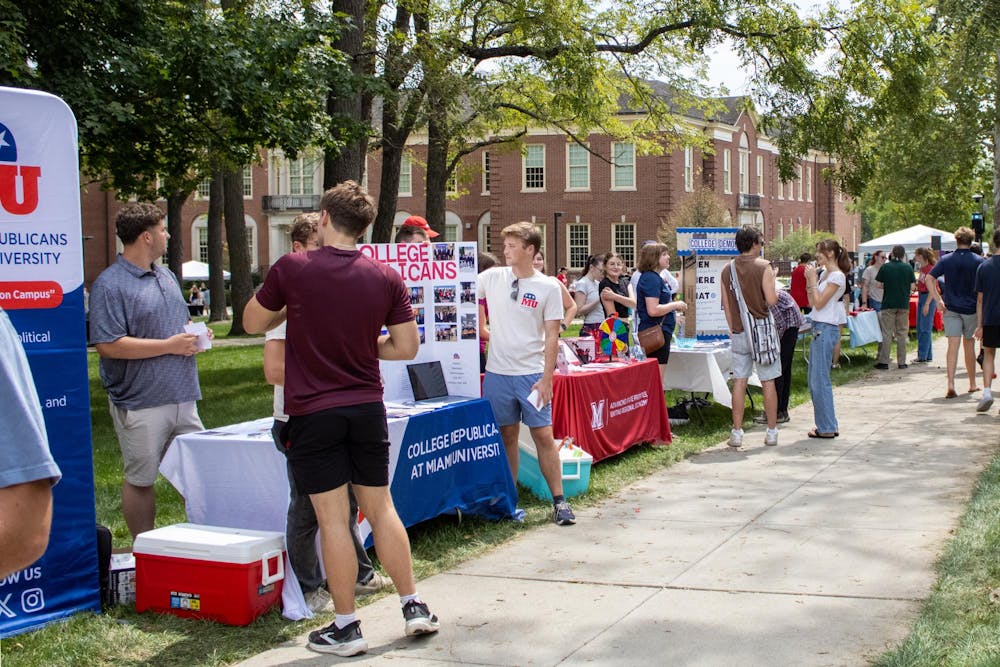
The Miami University (MU) Debate Club is preparing for its second annual College Democrats and College Republicans debate. This bipartisan event drew 800 people last November, a total far exceeding the 500-seat space.
But the MU Debate Club is more than their now-signature event. Their daily focus is organizing formal debates within their club every other week, over a variety of topics.
“From the debate club standpoint, we are just trying to get as many people interested in politics, really make Miami viewed as the marketplace of ideas,” said MU Debate Club Recruitment Head Tommy Stone.
Still, all eyes are on November.
This year, all three clubs, College Republicans, College Democrats and MU Debate, are looking forward to the debate being held in a larger venue, so more people can attend. The event is marketed towards all students, regardless of political affiliation.
MU Debate and College Republicans member Austin Andrews said the debate is mutually beneficial for all.
Enjoy what you're reading?
Signup for our newsletter
“It’s nice to have a forum that’s both organized and public-facing because there’s so many people on here that either aren’t interested in politics or don’t know how to get involved,” Andrews said. “I know definitely from the [College Republicans, College Democrats] side, it’s [an] advertisement for the club.”
Both College Republicans and College Democrats hold tryouts to select which students will participate in the debate. MU Debate moderates the event. The goal is to keep a respectful, positive debate where both sides are allowed to articulate their beliefs.
MU Debate also writes all the questions, trying to keep them concise and not skewed toward any political beliefs. The majority of their questions are neutral, but they reserve some questions to be aligned with one side.
“It was a decent amount of [unbiased] questions, and then there’d be essentially like kind of more like one Democrat-coded one, one Republican-coded one, and they go back and forth,” Andrews said.
The event is held to keep Miami students informed about politics, especially those who aren’t involved in any of the three organizations. Politics matter, even to those who don’t care or aren’t involved, so the debate is a way to engage people.
College Republicans Chairman Andrew Belcher feels this is the most important aspect of the debate.
“I think the biggest thing is that it serves as an example for how to actually have a constructive political conversation,” Belcher said, “I think kind of providing that platform and providing that example for students.”
That’s the central idea for not only the debate, but the aim of all three organizations across the political spectrum. College Democrats President Anna Sergio also said exposure is the main purpose of the event.
“I think it’s cool to hear what young people’s opinions are on it specifically because a lot of debates that happen between the two parties in our political climate are with just older adults,” Sergio said. “It’s very interesting to hear the takes of students specifically on a lot of these issues; I think it’s a very engaging opportunity.”
Because this year’s debate is being held in the same month as the midterm elections, the conversation should present a wide range of issues that relate to the current political climate across the U.S.
Neither the College Republicans nor the College Democrats can choose what issues they want to address during the debate; the most they can do is prepare and study the main political issues in play that may come up.
Belcher and Sergio both said current issues like immigration and foreign policy are topics that should be discussed. Although the organizations usually hold different viewpoints on political topics, MU Debate hopes to get them to see each other’s perspectives and find things to agree on amid all the disagreement.
“I think a lot of people get caught up in emotions with politics,” Stone said. “I would say trying to find where we agree more than where we disagree now is something that I think we should focus on in the debate.”
The College Republicans and College Democrats are also looking to continue to foster a relationship between organizations this semester to raise awareness for both clubs, but also to prove to students that bipartisan collaboration is possible.
A bipartisan blood drive is one planned collaboration that will occur this semester before the November debate.
The debate will be held in the Fritz Pavilion in Armstrong Student Center on Wednesday Nov. 18.
Read More

Recommendations from a reminiscing junior on having roommates
By Jada Rogers | 4 hours ago"I made myself miserable as a first-year student because I refused to make other long-term friends, swayed by my own misconception that my roommate was the only person I needed. Humans crave companionship, so please go find your people."

Dorm room digest: How to not starve this semester
By Elise Hanna | 4 hours agoAs the honeymoon phase of campus life begins to wrap up, it might be hitting you that you’re reliant on the dining hall for sustenance this entire year.

Office of Community Standards updates Code of Conduct to focus on students
By Anthony Caprara | YesterdayWhen Alex Fields joined Miami’s staff as Director of the Office of Community Standards in April 2024, she brought a philosophy of conduct that pulls back on fear and leans into collaboration with students through a holistic approach. Fields took the initiative to apply that philosophy by collaborating with Dean of Students BaShaun Smith and the Student Life Council to reform Miami’s Code of Conduct during the fall semester of the 2026-27 academic year.