
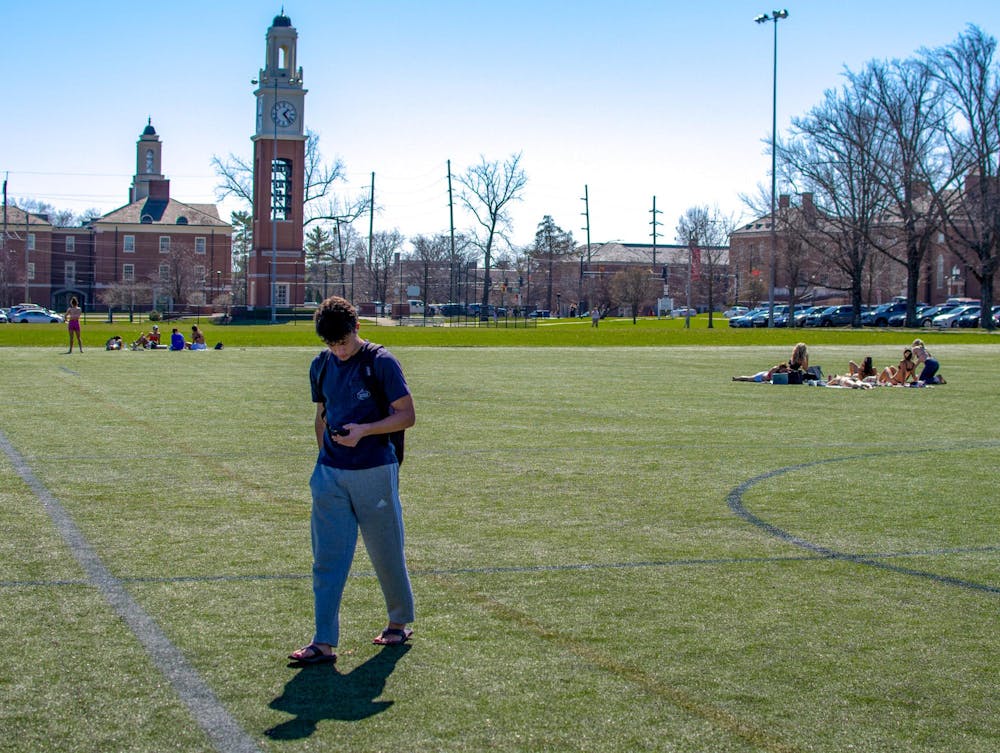
The Miami University Board of Trustees’ decision to approve a new $281 million dollar arena project on Cook Field shocked Miami students and triggered a wave of conversation and debate. Given the project’s direct proximity to Miami’s natural areas, one concern brought to the table was the preservation of these green spaces.
“There’s great potential to have enhanced use of the natural areas,” said Natural Areas Committee Chair David Gorchov. “... but also we’re concerned that if it’s not done well [there could be] negative impacts to the natural areas.”
One of Gorchov’s main concerns was how an increase in paved parking spots may impact the nearby ecosystem. Impermeable surfaces, such as parking lots, result in increased water runoff during heavy rainfall. Gorchov said this could erode the ecosystem’s soil and carry vehicle pollutants and excess sediment into Four Mile Creek.
As the project moves forward, the Physical Facilities Planning and Operations Department has begun partnering with the Natural Areas Committee to discuss these concerns and work towards a plan that will preserve these areas.
Cody Powell, vice president of Physical Facilities Planning and Operations, said that although the designs for parking structures and access roadways have not been finalized yet, any plans will need to adhere to Environmental Protection Agency (EPA) guidelines. He said he anticipates that the stormwater management design will involve retention strategies to slow flow and filter pollutants before water is discharged into Four Mile Creek.
“EPA provides a pretty detailed set of guidelines as to how you handle stormwater runoff,” Powell said, “so that obviously is the basis of design. From there, what we try to do is create a scenario like what we did [on Western Campus] with the ponds that help with clarifying properties.”
Powell said physical facilities and the Natural Areas Committee had recently partnered together during construction of the Sharon and Graham Mitchell Sustainability Park to create a space with new trail connections, signage and paths to invite new users in to appreciate the natural areas. The two parties envision something similar for the natural areas leading to the backside of the equestrian center, where there may be opportunity to incorporate improvements and a visible trailhead.
“I think it could be done really well on that eastern side of the arena site,” Gorchov said. “Good signage [and] a good trail inviting people to use the natural areas, but making it clear they’re now entering a different sort of space.”
Powell said the two groups will continue to collaborate and walk the site together, implementing feedback from natural areas stakeholders where possible.
“They’ve been, in my opinion, very reasonable in what they’ve asked for and we’ve partnered well,” Powell said.
When senior biology and environmental science double major Michelle Baker heard about the project, she shared similar concern for the nearby ecosystem. As president of Miami’s Audubon Society, she brought the group together to discuss their thoughts. This discussion grew into the student-led movement called Coalition to Represent Oxford Wildlife (CROW), which has since been in conversation with Miami President Gregory Crawford and Powell.
“CROW started with the arena project,” Baker said. “I think it’s no secret that the decision was unpopular with the student body, maybe a bit of a shock as well, but it’s our hope and our goal that by working with the university that this new arena could be a step towards sustainability rather than [a negative] to Miami’s sustainability goals, especially for wildlife.”
Enjoy what you're reading?
Signup for our newsletter
Baker’s concerns include disruptions to bird populations such as large glass windows and light pollution. Glass windows kill over one billion birds a year while artificial light sources can disrupt their migration patterns. However, Baker said there are many infrastructure possibilities to mitigate these problems, including special bird-friendly glass and participation in programs such as “Lights Out” to dim artificial lighting during peak migration times.
“We could have a sign out that says: Notice the lights are dim — that’s on purpose, because right now birds are migrating from Ecuador,” Baker said. “It could be an education opportunity alongside a way of reducing our carbon emissions, alongside a way of protecting our wildlife.”
Powell said that their architects are aware of concerns regarding bird populations and the infrastructure available to help mitigate impacts, but are weighing the possibilities with other factors such as safety, cost and emissions reduction.
“We’re still going to have to make some decisions around exactly what we ultimately procure,” Powell said. “We’ll involve them in that. We’ll share with them where we landed and why and partner with them. We are more than willing to take their feedback and suggestions and try to get some pricing and consider it operationally in what we do.”
Steve Sullivan, vice chair of the Natural Areas Committee, said there have been many ideas brought to the table — sometimes competing and sometimes mutually beneficial. Still, he has been encouraged by the collaboration taking place and by Miami’s attention to sustainability and ecosystem preservation in the past.
“As I look at what [Miami has] done on campus, they’ve either met the legal requirements or they have innovated,” Sullivan said. “They’ve never done worse. So that’s a huge benefit.”
Sullivan said that if these natural spaces are not preserved, he worries the student experience may be diminished in ways that new students would not be able to see without experiencing the natural areas before development.
“If you as a student come here, and you don’t see gnarly, awesome trees and understand what the world could look like, your educational experience is necessarily diminished, but you might not know, and if you don’t know, you can’t care.”
Powell said physical facilities will implement new green space for student use both on Chestnut Fields and the area where Millett sits. They will also aim to preserve notable natural features near the arena site, such as a centuries old osage orange tree, so long as its health and design plans allow.
Powell also said a huge sustainability goal of the arena has been reducing emissions by connecting the facilities to Miami’s geothermal plants.
“This particular location will allow for us to incorporate [the arena] into our geothermal plants,” he said. “Providing heating and cooling via our geothermal is going to have a big impact on carbon reduction.”
Cook Field has been closed off prior to student arrival on campus with construction anticipated to begin in mid to late September. Both CROW and the Natural Areas Committee will continue conversation with physical facilities throughout the process.
Read More

Leaving a green footprint: Sustainable clubs and organizations to join
By Venezia McHenry | 12 hours agoMiami University has many ways to experience nature, through hiking trails and local parks. In addition, there are also many clubs and organizations that can connect the outdoors to academic interests.

Water soluble confetti: A small change with big impacts
By Tori Fee | May 7, 2026In previous years, sidewalks around the seal, the Tri-Delt Sundial and the area under Upham Arch could be seen covered in plastic confetti following graduation photoshoots. This year, water soluble confetti has offered an alternative to plastic through a university-wide initiative.

North Chiller Geothermal project complete, next steps consider arena project
By Sarah Kennel | May 5, 2026Two years of construction on the North Geothermal Plant next to Millett Hall have come to a close. With big changes coming to North Campus in the form of a new arena and relocated intramural field, Miami's next steps in geothermal are taking this into account.