
The bench erupted and players crowded the field in celebration. Dillon Baker had just hit a walkoff solo home run for the RedHawks in a game against the Northern Illinois University Huskies in March 2025.
Amid the cheering from the team was a loud bang from a water jug hitting the head of Colin Canterbury, one of Miami’s bullpen catchers. It’s a moment and injury he will remember for the rest of his life.
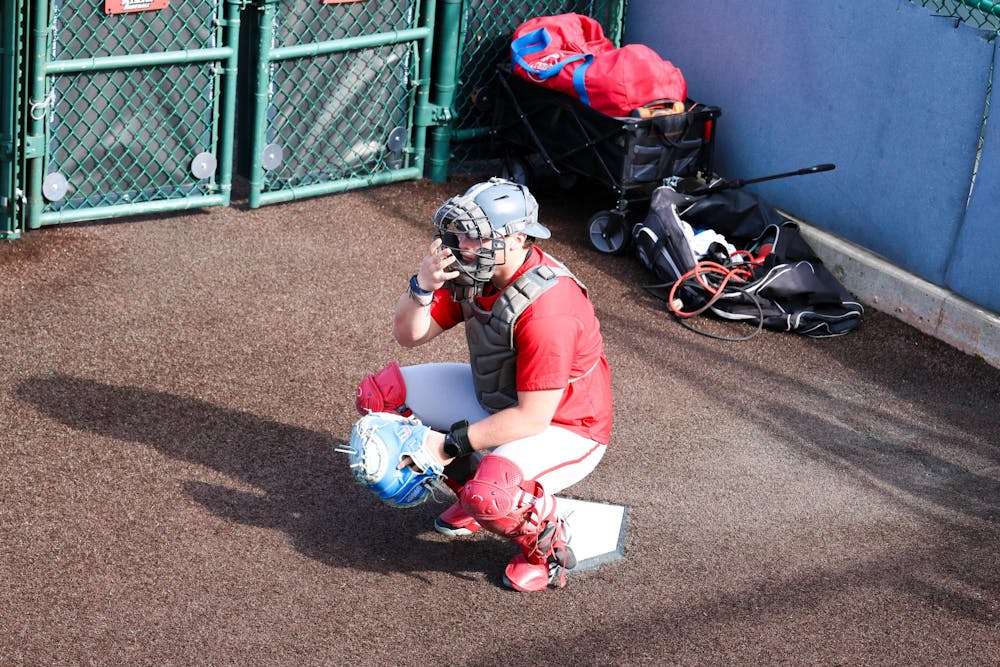
Though rarely recognized, bullpen catchers play a critical role in the development of the team’s pitching staff, serving as an extra set of eyes during practices and games. They also take pressure off the catchers, relieving them of knee soreness or injury, and giving them extra time in the batting cages.
In most cases, bullpen catchers deal with injuries to the hands, fingers or necks, the kind that come from hours of catching high-velocity pitches and fielding baseballs spiked in the dirt.
But Canterbury wouldn’t want it any other way, because of the bond he’s created with the team.
“You’re not a stranger to them,” Canterbury said. “You feel like you’re actually a teammate to these guys, and you’re not afraid to talk to any of them on and off the field.”
Alongside Canterbury is the team’s other bullpen catcher, Joey Heenan, who approaches the role from a different perspective. Heenan, a sophomore kinesiology major, sacrifices two hours per practice and three to four hours per game when he’s available.
Through the time commitment he’s given to the program in the last two years, Heenan has been able to gain firsthand experience with human movement, apply principles of biomechanics to improve performance and prevent injuries for pitchers and catchers.
Heenan is able to provide pitchers with tips on how to throw specific pitches and what scenarios to throw them in. Earlier this year, one pitcher was working with Heenan on two separate grips for his two-seam fastball.
Heenan observed the spin on the ball and the release point of the pitcher’s throwing motion to conclude that one had more depth, or vertical movement, and the other had more run, or horizontal movement.
“I told him, ‘I’m not saying you have to pick between one of the two, but I think one is more effective compared to right handed batters than compared to left handed batters,’” Heenan said. “That open dialogue with one another and trying to get them to be the best they can is very important and something I’ve learned over time.”
Heenan has not only developed his skills in kinesiology, but has also developed valuable friendships and connections that could impact his future.
Enjoy what you're reading?
Signup for our newsletter
“I still keep in touch with a fair amount of guys who have graduated or transferred out,” Heenan said. “There are even some that went into the same field as me that are speaking with their companies about internship opportunities in the future.”
Canterbury plans on pursuing a career in teaching and hopes to coach at whichever school he teaches at. Through serving as a bullpen catcher, Canterbury has learned more about the game and has observed what it’s like to coach a Division I baseball team.
“It’s like I’m shadowing a Division I coach every single day,” Canterbury said. “We’re not just there at practice to be a bullpen catcher. In scrimmages, batting cages and meetings, I’m learning how to become a coach.”
The impact is mutual. While bullpen catchers build relationships and gain experience, the pitching staff gains new perspectives on their craft, and the catchers gain hitting reps and time for their knees to recover.
Senior pitcher Zac Sohosky primarily works with Canterbury in his bullpen sessions. During a midweek practice, he was working on a changeup pitch down and away from the plate. Canterbury provided feedback on his grip and the specific placement of the baseball.
After throwing the pitch eight more times, Canterbury approved, letting him know that they were good pitches. Two weeks later, Sohosky struck out a batter with the same pitch. Instances like these contribute to Sohosky and his journey from a Division III school to a Division I team in the RedHawks.
“We didn’t have the luxury of having a bullpen catcher and someone who’s willing to take that beating for the pitching staff and help us get better,” Sohosky said. “It’s been really awesome to have them and not only that, but they’re great people, and I enjoy talking to them regardless of baseball stuff.”
While players like Sohosky see results on the mound, bullpen catchers like Heenan and Canterbury continue their work behind the scenes, gaining career tips, building friendships and embracing a role that often goes unnoticed.
@Grahamyounggm7
Read More

Alcoholic beverages lack transparency and oversight
By Elisa Rosenthal | 16 hours ago"The back of the can doesn’t give much information either, only a government warning and a select few nutritional facts: calories, carbohydrates, protein and fat. Although I’m sure that’s enough for some — and too much for others — it lacks transparency."

Books to read on a dark and stormy night
By Molly Fahy | 16 hours agoHere are my top picks for those looking for novels with a touch of darkness – who really want to live out their dark academia fantasies as they watch the rain fall.

Richard and Carole Cocks Art Museum temporarily closed for renovations
By Savannah Robertson | YesterdayThe Richard and Carole Cocks Art Museum has been temporarily closed while the building undergoes major renovations, like renewing the air conditioning system and replacing the windows. Several of these updates are intended to improve storage and help maintain the museum’s art pieces.