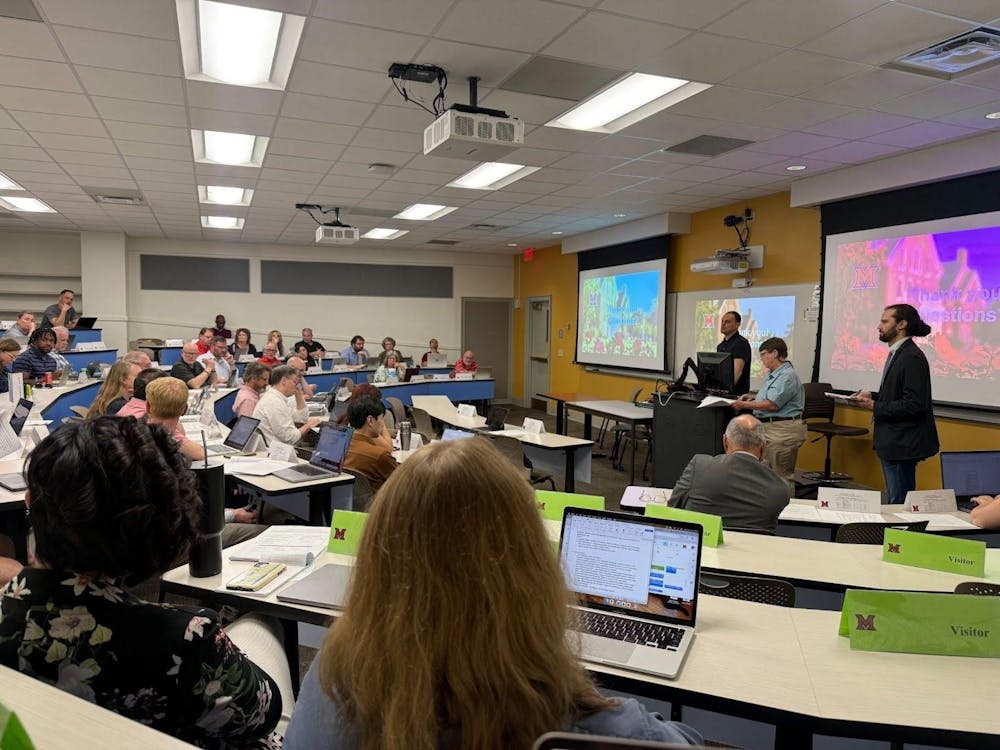
The University Senate introduced the new provost and Associated Student Government (ASG) representatives and delivered updates on sustainability efforts, as well as proposed changes to attendance policies and the Miami Plan during its April 13 meeting.
Nathan French, vice chair of senate and chair of the Senate Executive Committee, announced that Trent Gold, current dean of the College of Education and Human Sciences and professor at the University of Southern Mississippi, will join the Miami University community as provost on July 1.
Following discussions at previous meetings, the University Senate approved a motion to add contextual agility to the Miami Plan. Senators also approved a proposal from the Department of Sociology and Gerontology to create a criminology major. Both items will move forward in the university’s approval process.
Olivia Herron, director of sustainability, provided an update on Miami’s sustainability efforts and achievements.
Miami earned a gold rating in the Association for Advancement of Sustainability in Higher Education’s Sustainability Tracking, Assessment and Rating System assessment last academic year. In addition to that, Second Nature awarded the university with the decarbonization award at its Climate Luminary Honors.
Herron announced that the Sharon and Graham Mitchell Sustainability Park will open at 2 p.m. April 20.
Enjoy what you're reading?
Signup for our newsletter
French welcomed new ASG representatives, junior President-Elect Charlie Merill and sophomore Vice President-Elect Susanne Morrissey to the body.
Merrill and Morrissey shared their campaign process and goals, including their three pillars: Mental health, life development and love and honor.
“We’ve had a lot of fun during the campaign process and figuring out what our pillars are going to be and now that we’re in this position, we’re just excited to get started,” Merril said.
Theodore Peters, lead divisional advisor for student academic services in the College of Arts and Science, proposed the reduction of the minimum hours for undergraduate certificates from 12 to nine.
The change aims to align with other programs which have reduced credit hour requirements. The policy would also apply to graduate certificates, creating a single policy for both levels rather than the two that currently stand.
Carol Fabby, associate professor of the physics department, and Adam Beissel, associate professor of sports leadership and management, presented an update on the class attendance policy.
The Class Attendance Policy Committee, which began its work in fall 2024, met to address the inconsistencies in how student absences are handled. The committee has worked to revise the policy to create more clear and consistent expectations, specifically focusing on students representing the university in activities like athletics and other university-sponsored events.
“What we really tried to do when it came to forming this policy was try and keep the policy really broad, really fair and really applicable to everyone, but then couple that with a best practices of company and guide for faculty who have extenuating circumstance, issues and complexities in terms of the courses that they instruct,” Beissel said.
They provided a more clear definition of university-sponsored activities as well as an idea for a website to handle the updated policy and further guidance. This would also replace the current paper-based absence system that is used to notify professors when athletes will be missing class.
Elizabeth Hoover, interim director of liberal education and teaching professor of musicology, and Elizabeth Wardle, professor of English, presented the Miami Integrated Learning Experience (MILE), outlining its general education requirements and the role of the learning portfolio and co-curricular transcript.
Their plan is for students to start early on in their integrated learning core classes and take applied skills courses that will prepare them for research opportunities and internships later on during their time at Miami.
“They are going to be capturing this in a learning portfolio, then doing internships, co-ops [and] undergraduate research that is captured in their co-curricular transcript, and everything culminates in a capstone that they are going to be reflecting on their entire time at Miami,” Hoover said. “It’s a holistic and developmental approach that is not just a list of check boxes as part of a plan, but is able to provide a narrative and cohesion to students, which is currently missing.”
Hoover also announced that MILE would be handled by a new Miami Integrated Learning Office that would help provide support for faculty and students developing and using the portfolio.
The University Senate will meet again at 3:30 p.m. Monday, April 27, in 102 Benton Hall.
Read More

Underage alcohol sales, open container violations lead to multiple citations in Oxford
By Austin Smith | 5 hours agoBetween April 6 and April 13, police officers responded to 21 different incidents, according to the Oxford Police Department report.

Reviewing ASG leadership: A year of challenges and achievements
By Gabriel Slark | 3 days agoApproximately one year ago, Associated Student Government (ASG) Student Body President Daniel Martin and Student Body Vice President Kirsten Osteboe were elected. As candidates, they ran on a platform consisting of four pillars including civic engagement, community building, transparency and leading from behind. From building a stronger partnership between Miami University and the city of Oxford to aluminum can drives, this administration has emphasized leadership development.