
When I tell people I have a Russian major and a French minor, I usually get the same response: “Why would you do that to yourself?”
I chose these programs because I love the language learning process, but I recognize that’s not a common sentiment. If you’re like most Miami University students I’ve talked to, several years of struggling to learn new grammar and vocabulary sounds unappealing, to put it mildly.
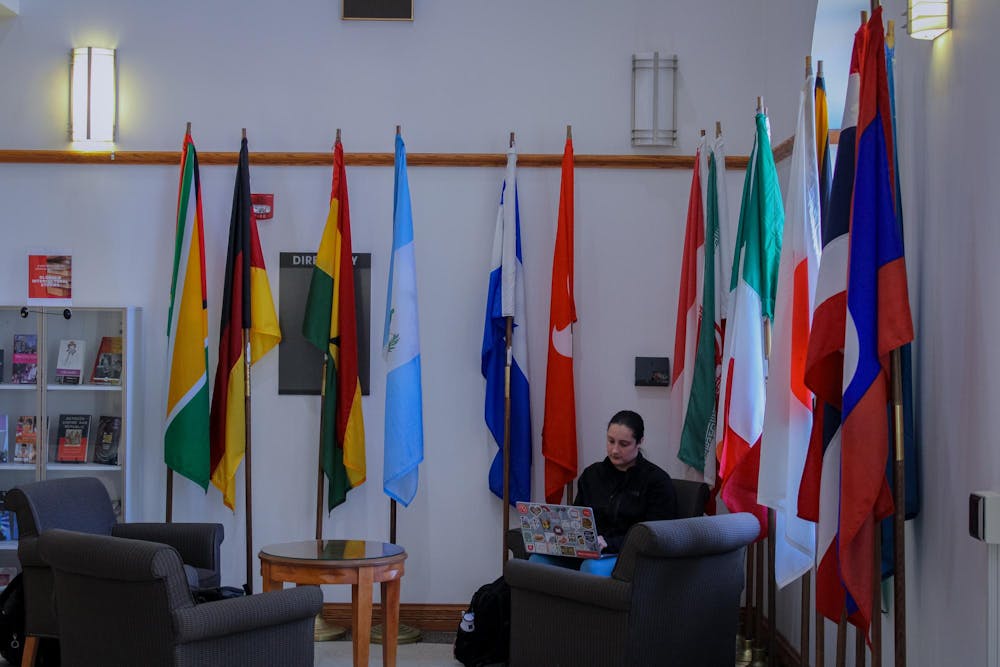
However, Miami has fantastic foreign language programs that few students take advantage of. Most would benefit from declaring a language minor — especially students in the College of Arts and Sciences (CAS) who already have to take these courses.
More students should also consider taking less common languages. As much as I love French, there’s nothing quite like the camaraderie of a Russian class. Because there are so few Russian students, we’ve all been in the same courses for several semesters. I’ve made great friends through the program; nothing bonds two people together quite like trying to figure out what a gerund is.
Miami currently offers minors in several languages, including Chinese, French, German, Italian, Japanese, Russian and Spanish, and teaches courses in others such as Latin, Korean, Portuguese and American Sign Language.
Statistically, students likely have the time to add a minor and still graduate on time. According to Miami’s 2022-23 Report Card, 62% of students on the Oxford campus graduated with at least one additional major, co-major or minor.
Students in CAS must pass a language class at the 202 level or higher to satisfy the college’s foreign language requirement. Depending on placement test scores, this can mean between one and four classes of a given language. After this requirement is met, students are often closer to finishing the minor than they may realize.
The foreign language minors are all around 18 credit hours — or 6 classes — though some can take more time to complete than others. For example, all Italian classes, beginning at ITL 101, count towards the minor, whereas all Spanish minor classes must be taken at or above the 300-level. However, many students learn Spanish in high school and can likely test out of the lower levels.
In most languages, if a student took classes from 101 through 202, they would be most of the way towards a language minor. After completing Russian 202, a student would only need to take one more class to get the minor. In Italian, the student would only need two more classes.
Beyond the low credit hour commitment, foreign language minors offer a plethora of personal and professional benefits.
For example, according to the National Institute of Health, being bilingual can lead to an increased capacity for learning, switching between tasks and dealing with conflicting cognitive information. Some studies even suggest that being bilingual can change the physical structure of your brain and protect against age-related decline.
Additionally, according to the American Council on the Teaching of Foreign Languages (ACTFL), employment demand for proficiency in foreign languages is great — as high as 90% of employers “rely on employees with language skills other than English” — and that demand is expected to grow as the economy continues to globalize. While Miami only offers minors in seven languages, all are among the top 10 most demanded languages by employers, according to the ACTFL.
Enjoy what you're reading?
Signup for our newsletter
Another study found that foreign language skills are positively correlated with an increase in salary, meaning that adding that minor could boost your earning potential right out of college.
Through my Russian and French classes, I have met some of my best friends, read some of my favorite books and completely changed my perspective on communication. Studying Russian grammar — where syntax and parts of speech really matter — helps me construct better sentences in English. Reading French literature requires me to slow down and really appreciate the book, which provides a nice break in my day in between all of my assignments.
While studying these languages does require me to endure the occasional suffering, it is far outweighed by the benefits of this type of learning. Given the low time investment and high reward, it seems counterintuitive to not minor in a foreign language.
Eliza Sullivan is a second year double majoring in diplomacy and global politics and Russian, Eastern European and Eurasian studies. She writes for the Opinion section of The Miami Student. She is also involved with Model Arab League and Miami University College Democrats.
Read More

Berggren to the Bronx; Yankees draft fiery RedHawk right-hander
By Cooper Meneghetti | July 15, 2026The New York Yankees draft former Miami standout reliever Austin Berggren with pick 368 in the MLB Draft

College students should be taught by human professors, not AI
By Elena Jackson Albarrán , Cathy Wagner and Theresa Kulbaga | June 12, 2026"The Faculty Alliance of Miami (FAM), the union representing nearly 800 full-time continuing faculty and librarians, is fighting for reasonable protections, including a stipulation that faculty cannot be replaced by AI. The administration is refusing to agree even to these minimal protections."