
I used to think of life as a blank sheet of paper — patiently, it waited for me to fill it, but the first word hung hesitantly on the tip of my pen. I tore out the page, crumpled it into my palm and began again.
I have sat down more times than I’d like to admit in pursuit of this inspirational article on feeling “ready” for graduation — repackaging a commonplace word into something deconstructed and redefined. But when every word carries weight, nothing gets written, and I have found there is a myth to feeling ready, just as much as there is to being ready.
From college applications to diplomas, “readiness” is a metric we’ve been racing towards since day one, competing with our peers to gain the fastest traction, to stand out and to signal to peers and faculty a meticulously crafted, neatly presented branding of the self.
We are not just graduates, but polished products shaped for selection.
In our clamor to elevate ourselves, the spectrum of distinction has, over time, collapsed into a kind of sameness, where we compete for the same titles, positions and internships as markers of difference. The more we try to set ourselves apart, the faster the baseline rises, until standing out becomes a race just to keep up.
What emerges is a paradoxical position: We seek to learn while simultaneously being compelled to project certainty where little exists. In that process, something quieter erodes: The willingness to sit with uncertainty, to engage deeply in the exchange of ideas and dialogue and to learn without immediate self-advancement.
Educators and scholars have grappled with this for decades — that consistent tension between a university’s role in intellectual inquiry and its push toward functional utility. Though perhaps they can exist not on opposing planes, but converging ones.
Nineteenth-century education reformer Wilhelm von Humboldt envisioned education as a space for “freedom to learn.” He argued that we, “cannot be good craftworkers, merchants, soldiers or businessmen unless … [we] are good, upstanding and — according to [our] condition — well-informed human beings and citizens.”
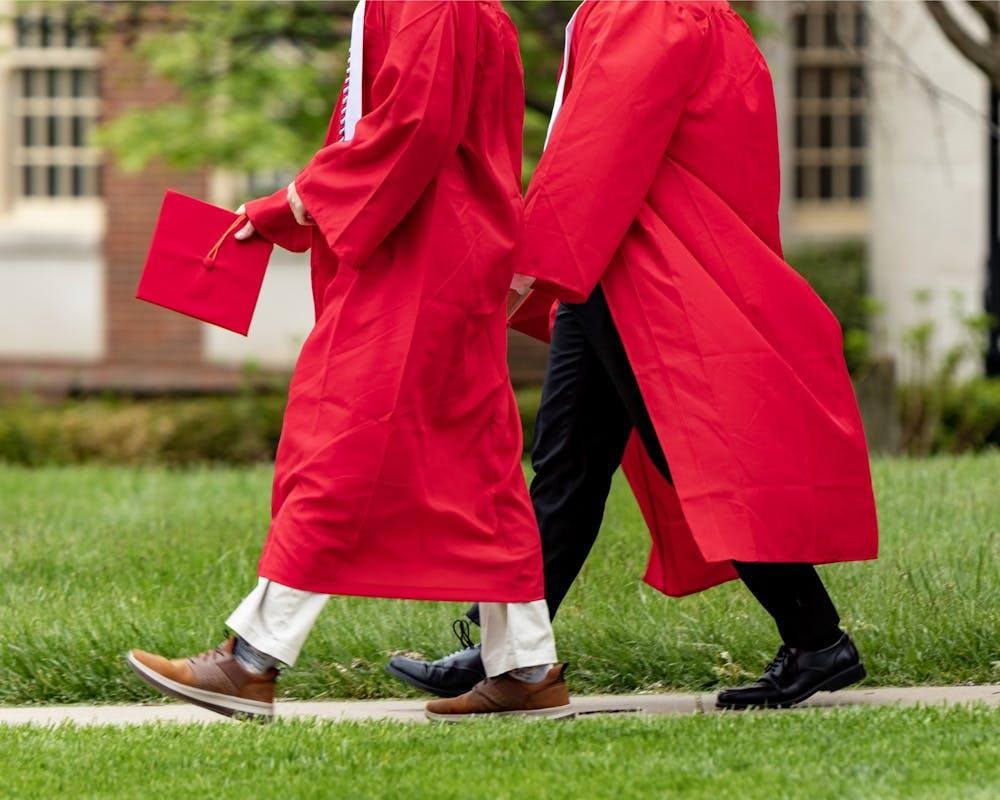
That tension doesn’t just exist in theory. If you keep your head up on your walk to class, you’ve likely noticed the paths worn into the grass, direct lines students take between the concrete sidewalks.
This is no novelty. Chelsie Trapani, a recent graduate of Miami University’s kinesiology, nutrition and health master’s program, wrote in a Facebook comment, “I can proudly say my footsteps have helped to create this path behind Phillips Hall,” under a Miami post showing one of these paths.
Campus is paved not just in concrete, but in the accumulation of small, ordinary ideas and decisions that, over time, become formidable.
As first-years, it is easy to think each step bears immense weight, that there is a right path to follow. But that sense of linear progression — that “fake it till you make it” mantra — begins to dissolve. If anything, college broke down every false narrative I tried to step into, and I will not leave built up; I will leave broken down.
Enjoy what you're reading?
Signup for our newsletter
Visiting Assistant Professor of Media and Communication Nicholas Karpinski emphasized that fulfillment comes not from settling into what we know, but from the kinds of engagement that draw original thought.
“In order to live a fulfilling life, you do need to live a curious life,” Karpinski said. “The worst possible outcome is that you figure out what you love to do.”
But curiosity comes with risk — one that often requires a kind of failure — and a loss of certainty we are conditioned to avoid. Morgan Wehby, a senior elementary education major, said she knows less now than she did as a first-year.
“People need to be more welcoming to the concept of failure,” Wehby said. “Failure is proof that they’ve actually tried. If you fail a lot, that’s great too, because you’re trying a lot, so just keep going.”
Ironic, isn’t it, that a resume highlights our qualifications as if they are not a compilation of the many failures it took to get there.
According to the National Association of Colleges and Employers, students consistently rate their own career readiness far higher than employers do. When we perceive our competency as high, very often it is the condition of the unchallenged — leaving behind a hollow space where character would have otherwise grown.
So, my fellow graduates, the question isn’t whether you feel ready; it’s whether you’re willing to keep learning in ways college didn’t require you to. The diplomas we receive on that concluding day will not mark a path paved. They will mark a path traced ubiquitously by those who have gone before us and carried forward in what we will leave behind.
Look back at your alma mater on that celebratory day, wave one last goodbye and never cease to trace the path of love and honor.
Kathryn Hippe is a junior journalism student with a minor in politics, philosophy and economics. She writes for the Opinion section of The Miami Student and reports on the Associated Student Government.
Read More

Meet the Columnist: Jacob Van Riper
By Jacob Van Riper | Yesterday"I enjoyed the writing process much more than I expected, and I decided to officially join The Student at the start of my junior year."

The bond behind Blake Mesenburg’s Teammate of the Year finalist selection
By Graham Young | 2 days agoBlake Mesenburg and Liam Jergenson have formed an incredible bond through Team IMPACT and the Miami University RedHawks hockey team.