
Music and conversation filled the Oxford Community Arts Center during the “Changing Climate, Changing Communities” art exhibition’s opening ceremony March 13. Organized by Engaging for Climate in Oxford (ECO), the exhibition features pieces from paintings to sculptures, all aimed at creating a local dialogue around climate change.
Katie Feilen, director of Project Dragonfly, said ECO first came up with the idea to begin hosting art exhibitions around 2018, when climate change was beginning to emerge as a major conversation within the broader public sphere. She said faculty members across campus wanted to figure out a way to communicate the implications of the data they were seeing to the local public.
“Most change happens not through a rational, data driven [reaction] but a more heart-focused, emotional reaction,” Feilen said. “We wanted to open space for the broader Oxford community to connect with climate change and share their own personal perspectives and stories through art.”
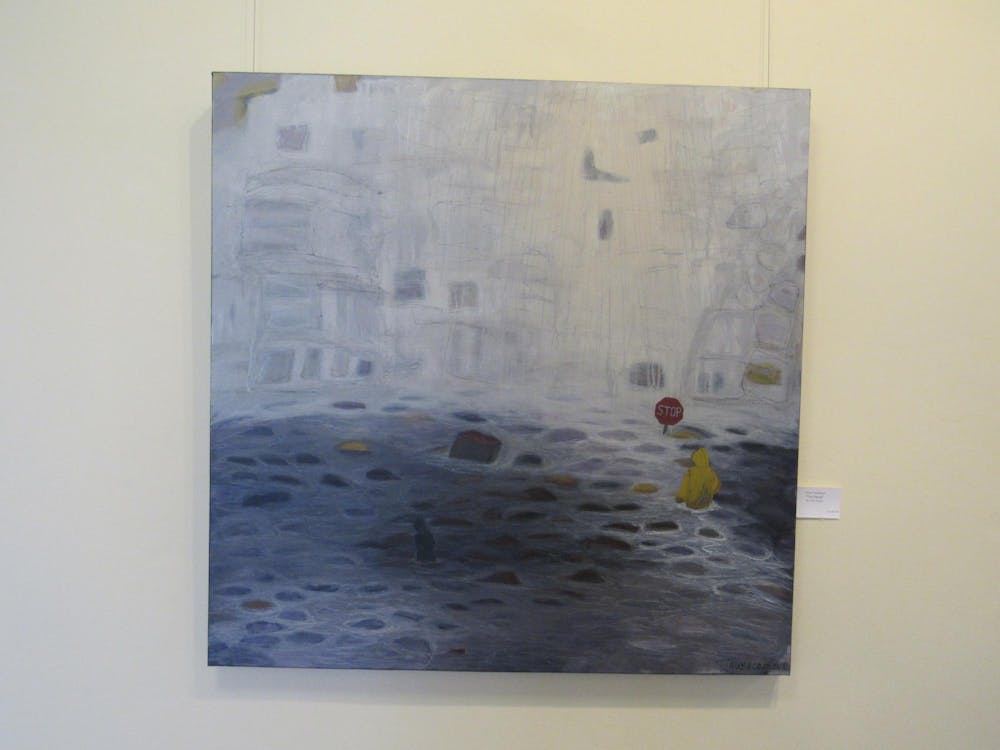
This year’s exhibition was the fourth show since ECO crafted the idea, and the art call uniquely aimed to encourage pieces that inspired positivity and a call to action. Feilen said that many of the pieces still had a heaviness to them, in content, tone and size. She said one of her favorite pieces, “The Flood” by Tara Trueblood, contained this sense of heaviness and crisis while still hinting at hope.
“It's a single individual walking in a rainstorm,” Feilen said. “It's a little bit abstract, but they're wearing a bright color, and it represents, to me, the brightness and light in the darkness and that contrast of those feelings.”
Jo Scofield, ECO board member and Project Dragonfly graduate student, helped put out the art call and communicate with featured artists. She said she found the collection of art to be diverse and stimulating, including mediums of paint, sculpture and even written word with graphic elements. Scofield also said she enjoyed the vast array of artists, ranging from professional artists living in cities to local elementary school students.
“With the elementary [students] you have that level that speaks to their perspective on how they see the world, which is always interesting and always fun and playful,” Scofield said.
Ridgeway Elementary School art teacher Liz Krehbiel featured art from three of her students at the exhibition. Inspired by a Miami University lecture series featuring artist Laurie Hogan’s show “Total Body Burden,” Krehbiel had her 6th grade students imagine and draw animals that never got the chance to be discovered because of climate change.
“I think they had fun with the media and looking at this professional artist, and then the idea of making up your own animal was fun for them,” Krehbiel said.
The imagined animals are now hanging side by side at the exhibition, beside plaques with student names and information about their animal. Krehbiel said that she hopes students feel empowered to continue creating art across the course of their lives because of their experience in the exhibition.
“Anytime you have a chance to showcase your student work, it just shows them there are other applications and there’s a bigger world out there if you want to do art, even if it’s something like the Oxford Community Art Center,” she said. “These are local community artists. They’re not necessarily world famous. Some of them are professional, there’s Miami professors that had work in the show and stuff, but also there are just regular people, and you can continue to do art throughout your life.”
The exhibition will be open to the public for viewing during the Oxford Community Arts Center’s regular open hours until Monday, May 4.
Kennelse@miamioh.edu
Enjoy what you're reading?
Signup for our newsletter
Read More

Water soluble confetti: A small change with big impacts
By Tori Fee | May 7, 2026In previous years, sidewalks around the seal, the Tri-Delt Sundial and the area under Upham Arch could be seen covered in plastic confetti following graduation photoshoots. This year, water soluble confetti has offered an alternative to plastic through a university-wide initiative.

North Chiller Geothermal project complete, next steps consider arena project
By Sarah Kennel | May 5, 2026Two years of construction on the North Geothermal Plant next to Millett Hall have come to a close. With big changes coming to North Campus in the form of a new arena and relocated intramural field, Miami's next steps in geothermal are taking this into account.

Earth Fest brings together local organizations under sunny skies
By Sarah Kennel | May 1, 2026Earth Fest brought out local organizations, small businesses and local advocacy groups to put on a day of celebration for the community. Activities fostered a local love and appreciation for the environment.