
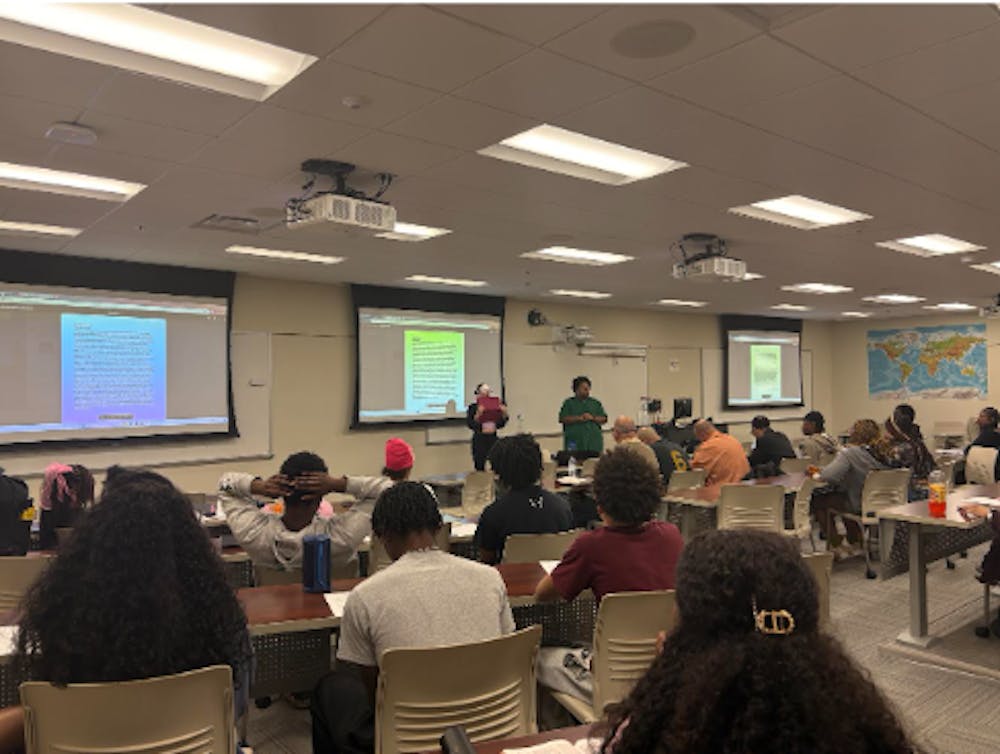
On a quiet campus Tuesday evening, Shideler Hall room 237 is anything but quiet. It’s busy with the bustle of people bouncing from table to table, excitedly catching up with friends. The room smells of cookies and Koolaide while the sound of lively gospel music fills the room.
The person behind this gathering: Kenzie Carter.
While Carter preaches togetherness to her peers, she said Miami University has not always made her feel welcome.
Carter is a sophomore organizational leadership and Spanish double major.
Her struggle to find community at Miami first began two summers ago, before her first year even began. She was on a campus tour with other minority students. As they were walking, a white male student passed the group and said, “Go back to where you came from.”
Go back to where I came from, thought Carter, but I came from the same place he did. Probably even the same state, as she’s from Ohio, along with over 60% of Miami students.
Enjoy what you're reading?
Signup for our newsletter
From that moment forward, Carter said she knew she would have to learn to adjust to being Black at Miami.
She’s learned she can’t control others’ racism. She’s learned not to let comments like those get to her. She’s learned to not feel insecure or bothered by oftentimes being the only Black student in her classes.
She’s learned to “code switch,” meaning she speaks and acts differently depending on who she’s around.
“It’s not like I have to change up my whole vibe or anything,” Carter said. “I just can’t say certain things around certain people.”
Carter said she will adjust her vocabulary, speaking more formal English around other ethnicities. She will also soften her tone. But Carter feared too much code switching might change who she was.
“Coming into Miami, socially I thought I was gonna turn into a white, preppy, social-y girl,” Carter said.
Despite changing her mannerisms in specific situations, she did not let her fear of losing herself become a reality.
When out with girl friends, Carter said her vivacious laugh and bold outfit choices, such as a black leather jacket over a red lace bra and cheetah print shorts, stick out among the crowd.
Even though Carter kept her sense of self, a sense of community still lacked.
She attended Miami’s “Black 2 School,” an event where Black organizations on campus get together for tabling and socializing at the Shriver Center.
“Black 2 School” led her to My Sister’s Keeper, a club for women of all colors to come together to build safe friendships and participate in activities that encourage individualism, along with a sense of pride within their communities.
Carter found confidence in My Sister’s Keeper. She met with a small group of four to five minority female students monthly to simply talk about life, celebrate holidays and participate in fun events like creating cranberry mocktails and eating pizza.
But yet again, Carter said Miami was not kind to her and her fellow minority women.
In compliance with Ohio Senate Bill 1, Miami discontinued the Center for Diversity Equity and Inclusion (CDSI). The CDSI hosted and funded My Sister’s Keeper; the club was disbanded June of 2025.
To fill the void My Sister’s Keeper left, Carter reached out to the leaders of Cru, the largest Christian organization on campus.
Originally, Carter just wanted a Cru member to “disciple” her, or help mentor her throughout her relationship with Christ. But as she recalls, the Cru leaders randomly assigned her to co-lead a bible study for the residents of Morris Hall with a fellow member, a white girl.
Carter said the Bible study was unsuccessful. Carter and her co-leader consistently knocked on doors in Morris, inviting people to attend that week’s meeting. Most of the time, only a handful of people showed up.
Carter began to text her own friends, inviting them to the gatherings. Attendance grew as the weeks went on, and her friends loved hearing her preach.
Except Carter’s friends were Black.
The few other attendees of the Bible study began to complain to Carter’s white co-leader. There was obvious tension hovering over the group, Carter said.
Carter took matters into her own hands and left Cru.
She started her own Bible study, finally creating a lasting place of safety and welcomeness for Miami’s Black community.
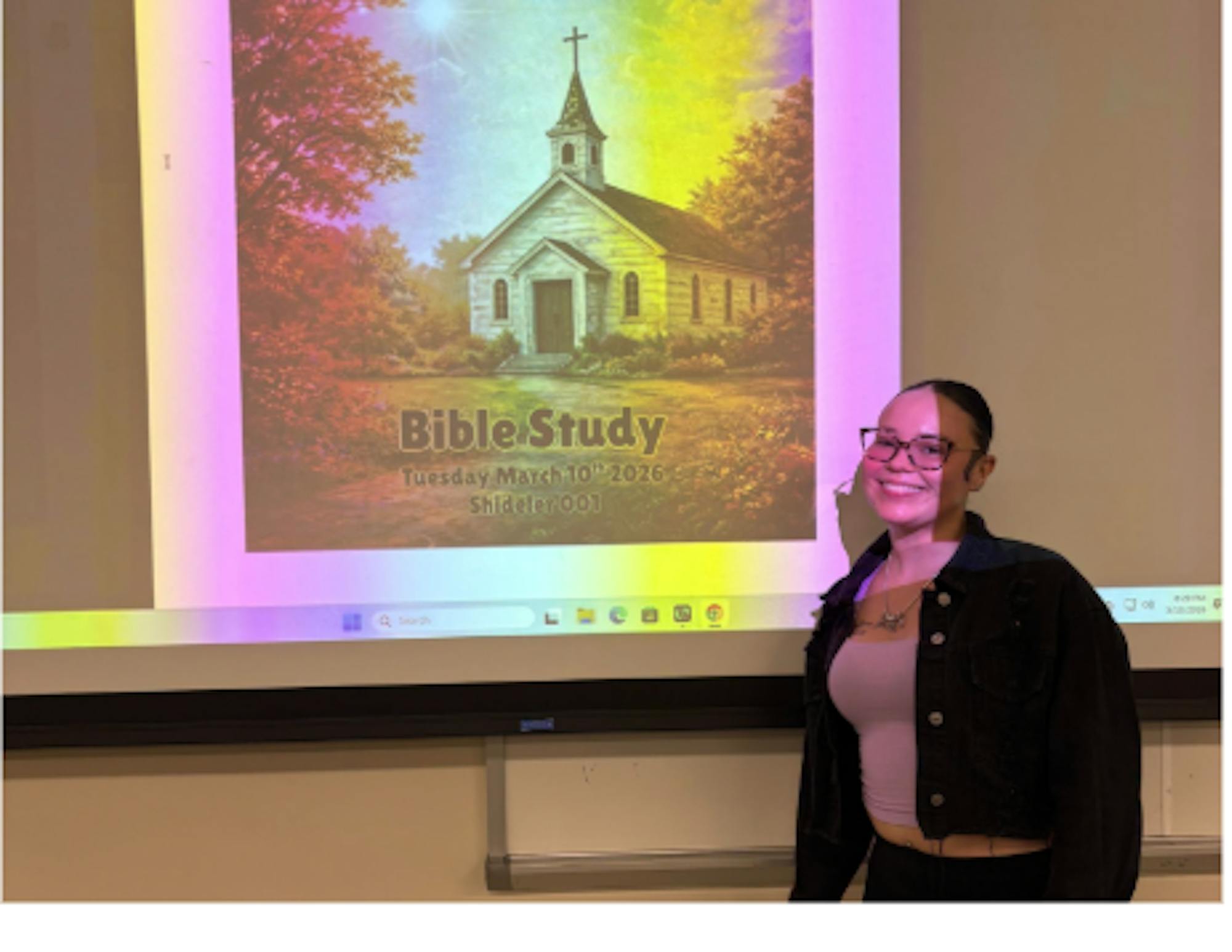
To prepare for her Bible study, she spends an hour every Sunday creating lesson plans based on what she says God brought to her that week, either via daily life or social media.
She shows up to her meetings 40 minutes early to pray over the room. As she plays gospel music, Carter moves around the entire space, touching every chair and table. Carter said she hopes her messages bless at least one person.
At this week’s study, Carter led about 50 African American students through scripture from the book of Matthew.
She read 16 verses out loud, interpreted and explained the passage, then guided her students through a worksheet, encouraging them to apply the scripture to their own lives.
Despite initial grumbles, she also had students form small groups of unfamiliar faces to review their answers, reinforcing a sense of togetherness. Once in groups, they quickly warmed up to one another — girls nodded their heads in agreement while boys laughed and joked together.
Reeling the groups back in, Carter spoke loudly and confidently as a true leader, but there’s also a compassionate undertone. In her final remarks, she said she hopes to leave her students knowing they are important, their differences are unique and the world needs diverse minds like theirs.
“If I can get one person to understand what I’m saying, that’s all I really care about,” Carter said.
Konyinsola Sofowora, first-year biology major, said Carter’s Bible study has helped Miami’s campus feel smaller.
“I’ve seen new faces [here] and made new friends once I’ve seen them out more around campus,” Sofowora said.
Brie-Ann Tackie, another first-year biology major, also said the Bible study has helped her connect with people and find her place at college.
“I think it’s been really nice having this Bible study,” Tackie said. “I’ve met a lot of people and it’s felt like family.”
Read More

Meet the Columnist: Karma Abboud
By Karma Abboud | Yesterday"While I still love creative writing, creating opinion articles for The Miami Student is not just a hobby or coping mechanism: It allows me to share my thoughts confidently with the Miami community."
Agree to disagree: Debate club fosters inter-club dialogue
By Elisa Rosenthal | 2 days agoThe Miami University (MU) Debate Club is preparing for its second annual College Democrats and College Republicans debate. This bipartisan event drew 800 people last November, a total far exceeding the 500-seat space.

Recommendations from a reminiscing junior on having roommates
By Jada Rogers | 2 days ago"I made myself miserable as a first-year student because I refused to make other long-term friends, swayed by my own misconception that my roommate was the only person I needed. Humans crave companionship, so please go find your people."