
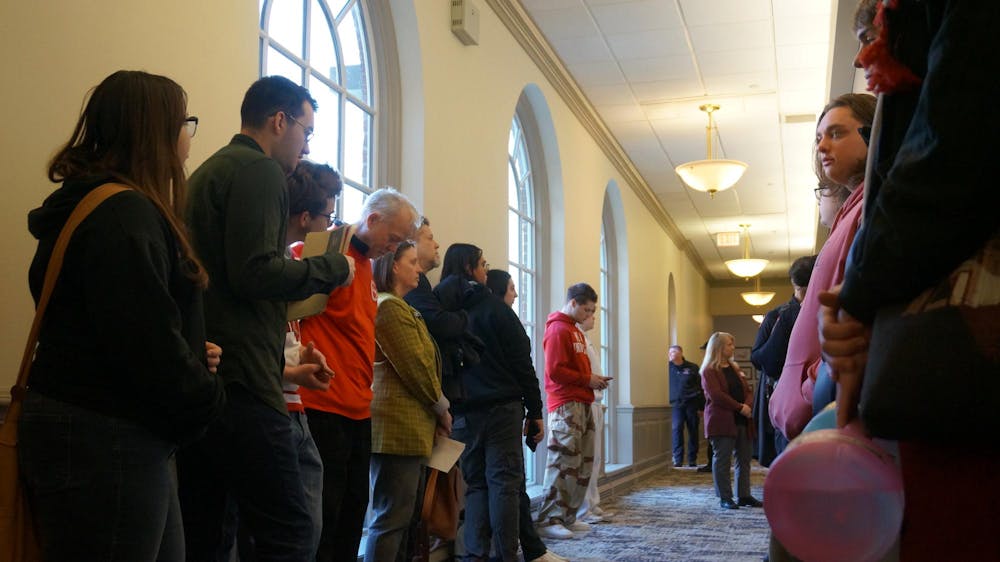
During their Feb. 27 meeting, Miami University’s Board of Trustees approved construction of the new Arena District on Cook Field.
News reports of the meeting showed protestors packing the halls of the Marcum Hotel and Conference Center, where the board meets, and noted a lengthy public comment section, where many spoke in opposition to the arena.
But when it came time to vote, the board unanimously approved the resolution, without any discussion. They failed to respond to — or even acknowledge — the concerns of the protestors and those who spoke against the resolution during public comment.
In official statements, such as one from February about the approval released by University Communications and Marketing, these concerns have remained unaddressed. However, opposition to the arena has not lessened.
This can be seen in the comments on every social media platform where the university announced these changes. On Miami’s official Instagram account, the university published a post celebrating the approval of the arena, calling it a “major moment for Miami University’s future.”
The comments are overwhelmingly negative, calling the decision “disappointing,” saying “no one wants this” and claiming the university has failed to listen to its students.
Similar posts were published by the university across LinkedIn, Facebook and X, again with negative reactions, though more commenters seemed supportive on the X post.
There is a prevalent theme in the backlash to this decision: Students feel like they aren’t being heard. Many comments mocked the idea that the university pushed this as a “student-centered” project, saying the university has ignored their opposition.
Commenters frequently cited a survey that found that 89% of respondents opposed putting the arena on Cook Field. Major concerns cited included traffic, lack of green space and the cost of the decision. These issues were frequently brought up by social media commenters as well.
The issue with this decision is not just its outcome, but the way community input was treated throughout the process.
In an Instagram post about the Board of Trustees meeting, Miami’s chapter of the Ohio Student Association said, “Management tried but failed to silence students, relegating them to a different room and refusing to let them hold signs.” The Miami University Policy Library has no regulations about holding signs at demonstrations. Regardless, the students were literally removed from the room where decisions about their future are made.
Miami has not acknowledged the results of the survey that suggest their decision is deeply unpopular, or any of the concerns related to the project. This has led to many feeling as if they have no say in the future of the university they fund, attend and will claim as their alma mater for the rest of their life.
Enjoy what you're reading?
Signup for our newsletter
No organization can function well when its constituents feel their voices are being ignored. The board should have done a better job of addressing the concerns of students and community stakeholders ahead of voting.
Moving forward, the university should do more than repeat the same “student-centered” talking points. They should explain how this project will improve the Miami experience, and address the very real concerns over traffic, funding priorities and campus branding.
The upper levels of Miami’s administration should create a working relationship with their students and stakeholders, where the community feels that their perspectives are valued, rather than unilaterally pushing through deeply unpopular decisions.
Eliza Sullivan is a sophomore double majoring in diplomacy and global politics and Russian, Eastern European and Eurasian studies. She writes for the Opinion section of The Miami Student. She is also involved with Model Arab League and Miami University College Democrats.
Read More

Oxford listened to the community and terminated its Flock Safety contract
By Charley Babb | 1 hours ago"The issue with Flock isn’t the arrogant name brand, nor is it just the critical security flaws in every aspect of their system. The real issue with Flock is the fact that it allows warrantless tracking of citizens, for no other reason than the whim of a police officer."

We’re applying 18th-century worldview to today’s society
By Ethan Foster | Yesterday"This creates a real problem because originalists attempt to solve these debates through worldviews contemporary to the time they were written. These perceptions are oftentimes completely different than the ones we have today."

The most radical thing college can do is change your mind
By Vedika Kaushal | 3 days ago"I am not leaving every discussion with a completely different set of beliefs. Instead, I am becoming more aware of why I hold the views I do, especially when someone gives me a reason to question them."