
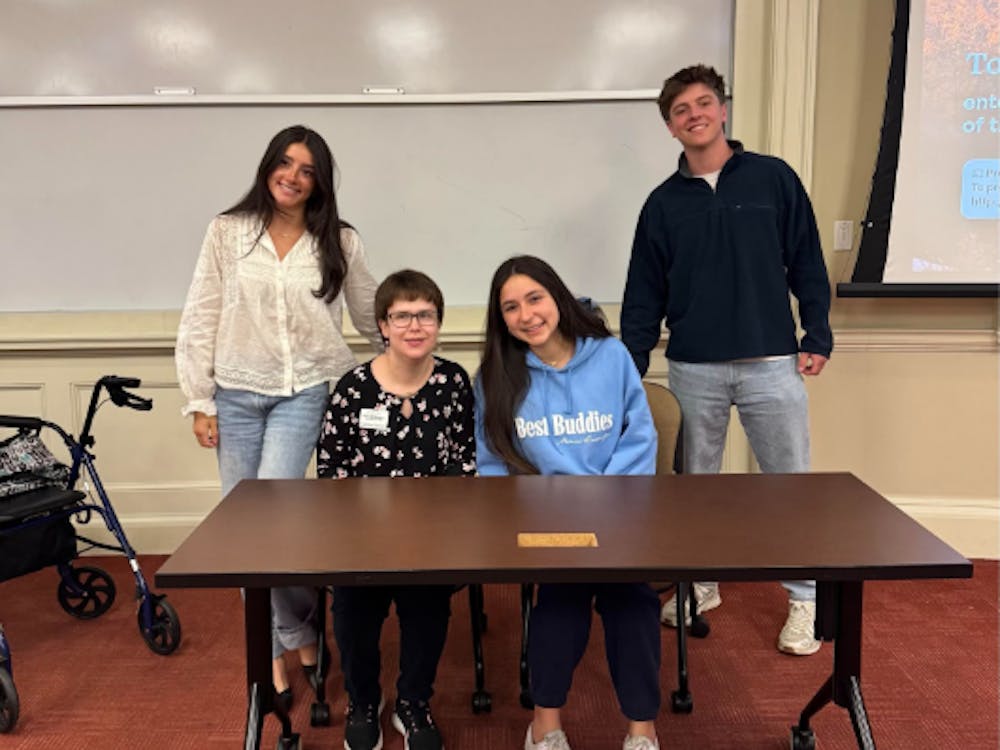
Courtney Hineman and Melanie Schael attended Best Buddies’ annual ball this February, each wearing black dresses and dancing to “Low” by Flo Rida and T-Pain. The pair sees nothing unusual about their friendship, but others might question it.
Best Buddies is an international organization committed to helping individuals with intellectual and developmental disabilities (IDD) form lifelong friendships, combat stigmas and promote inclusion.
Beth Sopp, chapter president and senior inclusive special education major said the average individual with an IDD has six people in their close circle, compared to 120 for college students. Miami University’s chapter works to close that gap.
The Miami University Friendship Chapter has 80 one-on-one buddy relationships between students and adults with IDDs residing in Butler County.
Hineman and Schael are one of these relationships.
Hineman joined Best Buddies in 2015 after graduating high school to meet new people. She’s had five friendship matches, some lasting the full four years.
Enjoy what you're reading?
Signup for our newsletter
Best Buddies also brought Hineman many opportunities. In 2018, she attended the Best Buddies Leadership Conference at Indiana University. In 2021, she gave the keynote speech at Best Buddies Ohio’s annual gala.
Hineman has worked for seven years now at the Butler County Board of Development Disabilities (BCBDD) as their community outreach advocate for the Speak Up self-advocacy group.
“I feel like that leadership experience helped me later on when I ended up getting my job at the Board of DD,” she said.
Hineman’s job includes helping those with IDDs access BCBDD’s services, implementing inclusion efforts in the community and hosting a Speak Up picnic every July.
Governor DeWine also appointed Hineman to the Ohio Developmental and Disability Council in 2021, where she advocated for inclusivity efforts to federal legislators.
Hineman and Schael have been buddies for two years now.
Schael is a junior and joined Best Buddies her first semester of college. Her younger brother, Ryan, has down syndrome. Growing up, Shael’s family always pushed Ryan to participate in general education classes.
Schael joined Best Buddies to continue fighting for inclusive environments.
“I thought that [Best Buddies] was a great thing because that’s exactly what I’ve always believed in,” Schael said. “I want people to see it that way. You’re just making another friend.”
Schael is now vice president of Best Buddies.
Schael and Hineman first met at Best Buddies’ October 2025 match party.
“I was really excited when I saw it was going to be Melanie because she had a big sign that had my name on it with purple and pink smiley faces,” Hineman said.
The pair bonded quickly, with Hineman coloring a mermaid that’s still hanging up in Schael’s bedroom.
“[We] have the same personality and sense of humor, so it was a perfect match,” Schael said.
Over the past two years, Hineman and Schael frequented local restaurants. Schael introduced Hineman to Fiesta Charra, and the pair tried the new Early Berds Cafe in Hamilton, Ohio.
Once, Schael and Hineman also baked a vanilla cake in Schael’s college house. The pair then ate lunch and watched Disney’s “The Incredibles” together.
Along with Best Buddies’ annual ball, Hineman and Schael enjoyed attending the Best Buddies’ fall carnival. Schael said they played every game twice.
When apart, they’re always sending each other picture updates to stay in contact.
Being friends has always come naturally for the pair.
“I cherish our friendship so much,” Schael said. “Hineman is just always giggly and having a good time, which spreads for sure.”
Hineman agreed, saying she’s always excited to spend time together.
“I feel like over time our friendship has really grown and [we’ve] really gotten to know each other,” she said. “I’m very thankful for our friendship.”
Hineman said stigmas lead society to underestimate individuals with disabilities.
“Sometimes people will treat me like I’m a little kid, even though I’m an adult,” Hineman said.
Schael said although individuals with IDDs may need more time to process information or complete physical tasks, they’re just as capable.
“I think a lot of people unintentionally place limitations because they think it’s what’s best or easiest,” Schael said. “This takes away from them thinking they can do any sort of challenge.”
Peyton Griffith, a sophomore political science and special education double major, said the panel encouraged people to step out of their own bubble.
“It’s very important for students to expose themselves to new perspectives and to find deep human connections with others,” Griffith said.
Sydney Oren, a sophomore primary special education major, said the panel explained that disabilities don’t define or limit people.
“It’s really important to hear how having a disability hasn’t really affected them,” Oren said. “They’re just normal people, and they should be treated the same.”
Read More
College students should be taught by human professors, not AI
By Elena Jackson Albarrán , Cathy Wagner and Theresa Kulbaga | June 12, 2026"The Faculty Alliance of Miami (FAM), the union representing nearly 800 full-time continuing faculty and librarians, is fighting for reasonable protections, including a stipulation that faculty cannot be replaced by AI. The administration is refusing to agree even to these minimal protections."
Board of Trustees approves Miami Plan changes, AI in majors and departmental mergers
By Shannon Mahoney | May 21, 2026Miami University’s Board of Trustees voted to approve the Miami Integrated Learning Experience (MILE), the addition of AI across all majors, departmental mergers and increasing tuition and fees for the incoming cohort.

Miami baseball earns regular season MAC champions and looks to take home a second straight title
By Graham Young | May 19, 2026The Miami University RedHawks baseball team will head to the MAC tournament as the one seed for the second straight year.